 A VETERAN OWNED SMALL BUSINESS |
The Impact of Redistricting and Partisan Gerrymandering on American Democracy
 Understanding Redistricting
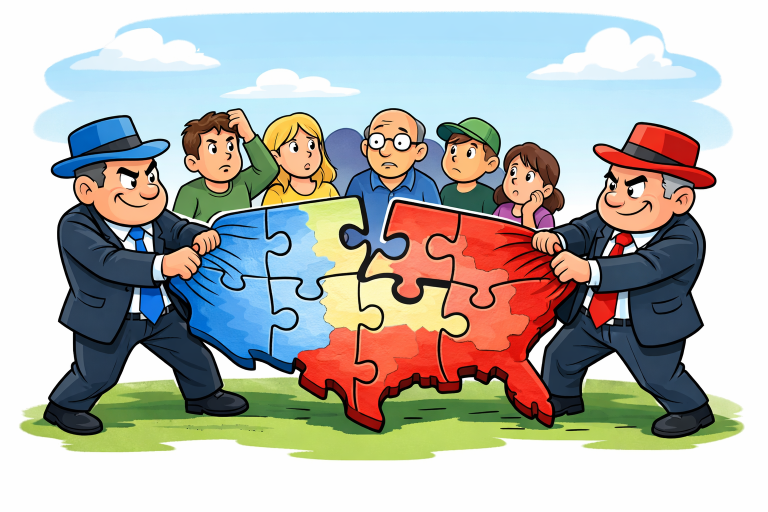
Redistricting is the process of redrawing electoral district boundaries, typically in response to population changes captured by the decennial census. This process is foundational to ensuring that each district encompasses roughly equal numbers of constituents and upholds the foundational democratic principle of “one person, one vote.” While redistricting is intended to promote fair representation, the methods used to draw lines can drastically influence political outcomes, sometimes undermining public trust in the electoral system. For more background on recent legal and political complexities, see Louisiana v. Callais.
The intricacies of redistricting come into sharp focus when we examine how states and political parties use the process to enhance their electoral prospects. District maps can be configured in ways that fragment or consolidate voting blocs, allowing those in power to minimize the impact of opposition supporters and maximize their own political influence. As a result, the stakes in redistricting battles are high, leading to intense scrutiny and litigation nationwide.
Historical Context
Throughout American history, redistricting has been riddled with controversy over fairness and representation. The Voting Rights Act of 1965 was a critical milestone, explicitly targeting racial discrimination within all aspects of the voting system, including how districts were drawn. However, efforts to manipulate district maps, known as gerrymandering, predate the VRA by more than a century. Early cases were motivated by both racial and partisan interests, embedding the potential for abuse deep within the structure of American electoral politics. Over time, state and federal courts have played a pivotal role in setting standards and boundaries for what constitutes legal redistricting, but evolving legal interpretations have left many protections in flux.
Major court decisions, such as Baker v. Carr and Shaw v. Reno, have influenced how districts are drawn and the considerations that must be taken into account. These cases sought to balance the tension between state autonomy over elections and the federal mandate to protect citizens’ voting rights. Yet judicial intervention has fluctuated with shifts in the Supreme Court’s composition and philosophy.
Recent Developments
Redistricting has become even more politicized in the past decade. The advent of advanced data analytics has enabled mapmakers to craft districts with precision, identifying and isolating particular demographic groups. Tennessee provides a contemporary example, where a new U.S. House map was designed to ensure a 9-0 Republican advantage by dividing previously Democratic-leaning areas. Such moves are not unique to Tennessee but reflect a broader trend in which political parties use every available tool to secure maximum control before key elections.
The passage of these new maps often follows contentious legislative votes and public outcry. In Tennessee’s case, the Republican majority passed the plan along party lines despite significant protests that highlighted fears of disenfranchisement and legal complications. The overt political motivation was apparent, with lawmakers signaling their allegiance through visible partisan symbols during debates. These developments, illuminated by recent Supreme Court decisions, signal a deepening of polarization as states rush to secure favorable electoral environments.
Partisan Gerrymandering
Partisan gerrymandering is the practice of drawing electoral districts to give one political party an advantage over another. Thanks to sophisticated voter data and mapping technologies, parties can now fine-tune district lines to gain disproportionate power. Both the Democratic and Republican parties have utilized these strategies when in control of the redistricting process, perpetuating a cycle of escalating one-upmanship as political fortunes change hands between states and cycles. Gerrymandered maps can have profound effects not only on individual races but also on the national political landscape for entire decades.
Legal Challenges
The legal framework for redistricting has shifted considerably in recent years, particularly following landmark Supreme Court rulings. The decision in Louisiana v. Callais imposed significant barriers to legal challenges based on vote dilution. To succeed under the current standards, plaintiffs must now demonstrate intentional discrimination, a burden of proof that is rarely achievable. This ruling has effectively weakened the Voting Rights Act’s core enforcement provisions, especially the protections for minority voters that were pivotal in earlier decades. The re-interpretation of the Fifteenth Amendment to limit Congressional authority over voting rights legislation marks a pivotal change in judicial philosophy, removing many tools for fighting discrimination from Congress’s hands. This is a departure from decisions such as Shelby County v. Holder, which, while restrictive, still left open the possibility of legislative remedies.
Impact on Democracy
Partisan gerrymandering has far-reaching consequences for democracy. By engineering “safe” districts for incumbents or parties, gerrymandering reduces competition and dampens electoral accountability. Lawmakers in these districts may feel less compelled to respond to constituents’ needs, knowing that their reelection is almost guaranteed regardless of performance. In addition, when district lines are drawn to split up or isolate minority communities, these voters can be systematically deprived of meaningful representation. The resulting loss of trust in elections can lead to broader disengagement and skepticism toward the democratic process.
These undemocratic effects are not theoretical. Research consistently shows that gerrymandered legislatures are less responsive to shifts in public opinion and more likely to pass extreme policies. This undermines the basic premise of representative democracy and raises alarm about the future health of American institutions.
Proposed Reforms
Recognizing the threat that partisan gerrymandering poses to democracy, numerous reforms have been proposed. The most prominent among these is the creation of independent redistricting commissions, which aim to transfer map-drawing powers from partisan legislators to neutral bodies. States like California and Arizona have already implemented such commissions, with early results suggesting less partisan manipulation and fairer representation.
Proportional representation is another reform gaining traction. This approach reallocates seats based on parties’ overall vote share, ensuring that minority voices are more likely to be heard. Additionally, strengthening legal safeguards at both the federal and state levels could help restore protections against discriminatory redistricting practices. However, these reforms face significant political resistance from those who benefit under the current system.
Conclusion
Redistricting remains a critical foundation of American democracy. While it is intended to promote fairness and equal representation, partisan manipulation and judicial retrenchment have threatened its legitimacy. Comprehensive reform is needed to preserve the integrity of elections and ensure that every citizen’s vote carries equal weight in shaping the nation’s future.








 Business Programs

Leave a Reply
Want to join the discussion?Feel free to contribute!