 A VETERAN OWNED SMALL BUSINESS |
7 Best Modern Prefab Timber Frame Homes for Faster Build Timelines
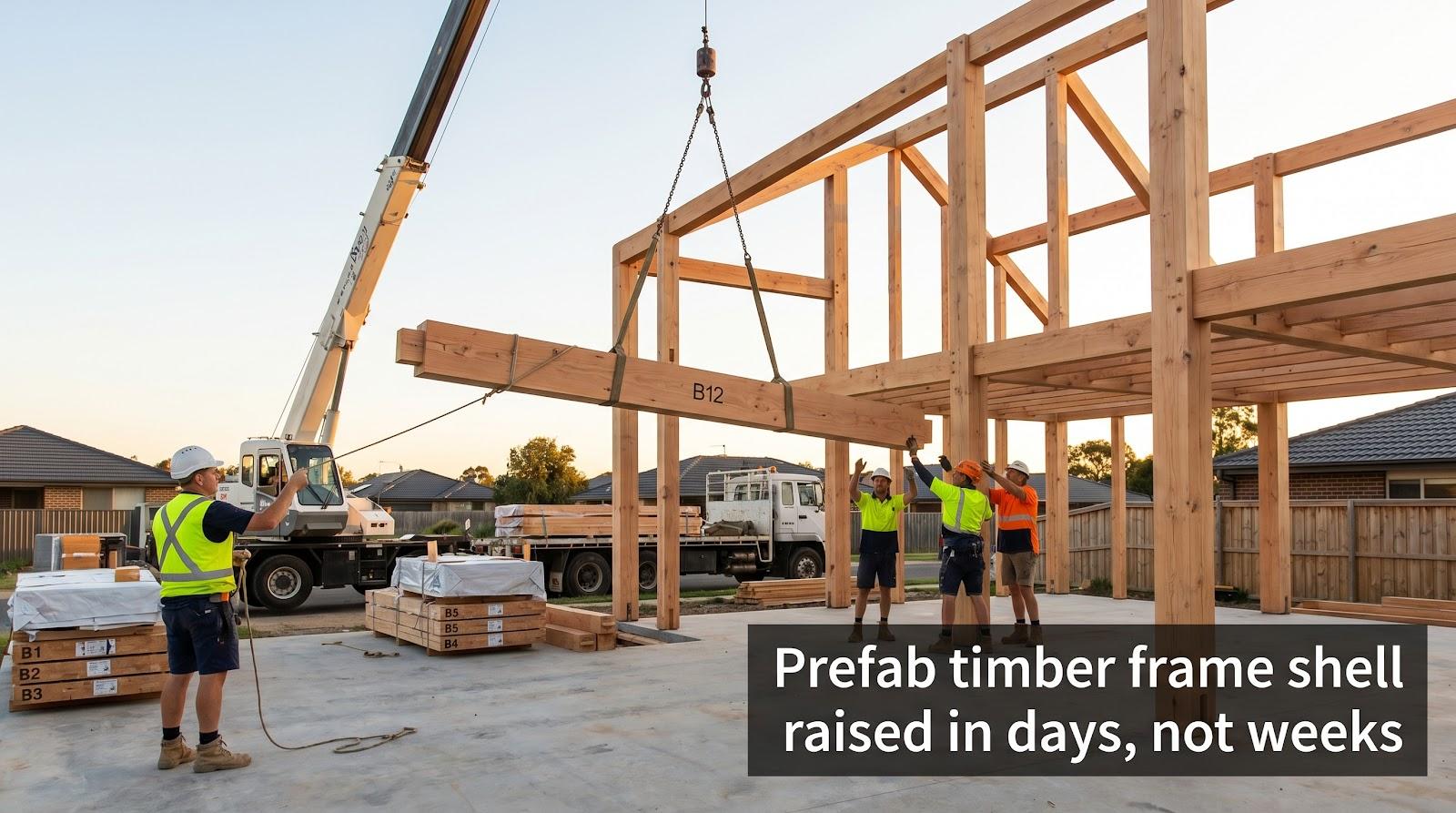
Material tariffs still tack on $7 500–$10 000 to a typical new-build—even after lumber prices cooled. Prefab timber-frame systems claw back those dollars by shipping every beam pre-cut, labeled, and insulated so a crew raises a weather-tight shell in days, not weeks. Below, we rank seven manufacturers that turn factory precision into real-world savings without compromising vaulted ceilings, exposed wood, or net-zero ambition.
We didn’t pull names from a hat. We built a scoring model that mirrors the headaches and hopes you face on site.
First, we scraped 2025–2026 sources: manufacturer spec sheets, customer case studies, and independent round-ups such as Sky Rye Design’s pricing survey of barndominium timber-frame kits. That survey set our cost baseline and showed which companies publish numbers worth trusting.
Next, we turned the data into six weighted criteria:
- Cost per square foot (30 percent): budget overruns end projects faster than bad weather.
- Factory-to-lock-up speed (20 percent): time costs interest and insurance.
- Energy efficiency (15 percent): thicker panels and airtight details trim utility bills for decades; according to Green Building Advisor, the Bensonwood OBPlus Wall reaches about R-35.
- Material quality and warranty (15 percent): a 10-year structural guarantee or FSC-certified timbers separate pros from copycats.
- Design flexibility (10 percent): can you tweak a floor plan without blowing the budget?
- Support and delivery reach (10 percent): nationwide shipping and on-site help keep builds on schedule.
Each provider earned a 1–10 score in every box. We applied the weights, added the totals, and let the math decide the podium. Ties broke on customer-service speed, measured by average email reply time during our secret-shopper tests.
The result is a ranking you can reverse-engineer. Prefer off-grid performance over sticker price? Increase the energy column in the table and rerun the math; our framework flexes like a timber truss.
Now meet the winners.
1. Hamill Creek Timber Homes: Speed Meets Showcase Craft
Picture a CNC-cut timber skeleton rolling off a flatbed at dawn. By week’s end the frame is standing, pegs tapped home, rafters reaching for the sky. That pace is Hamill Creek’s calling card.
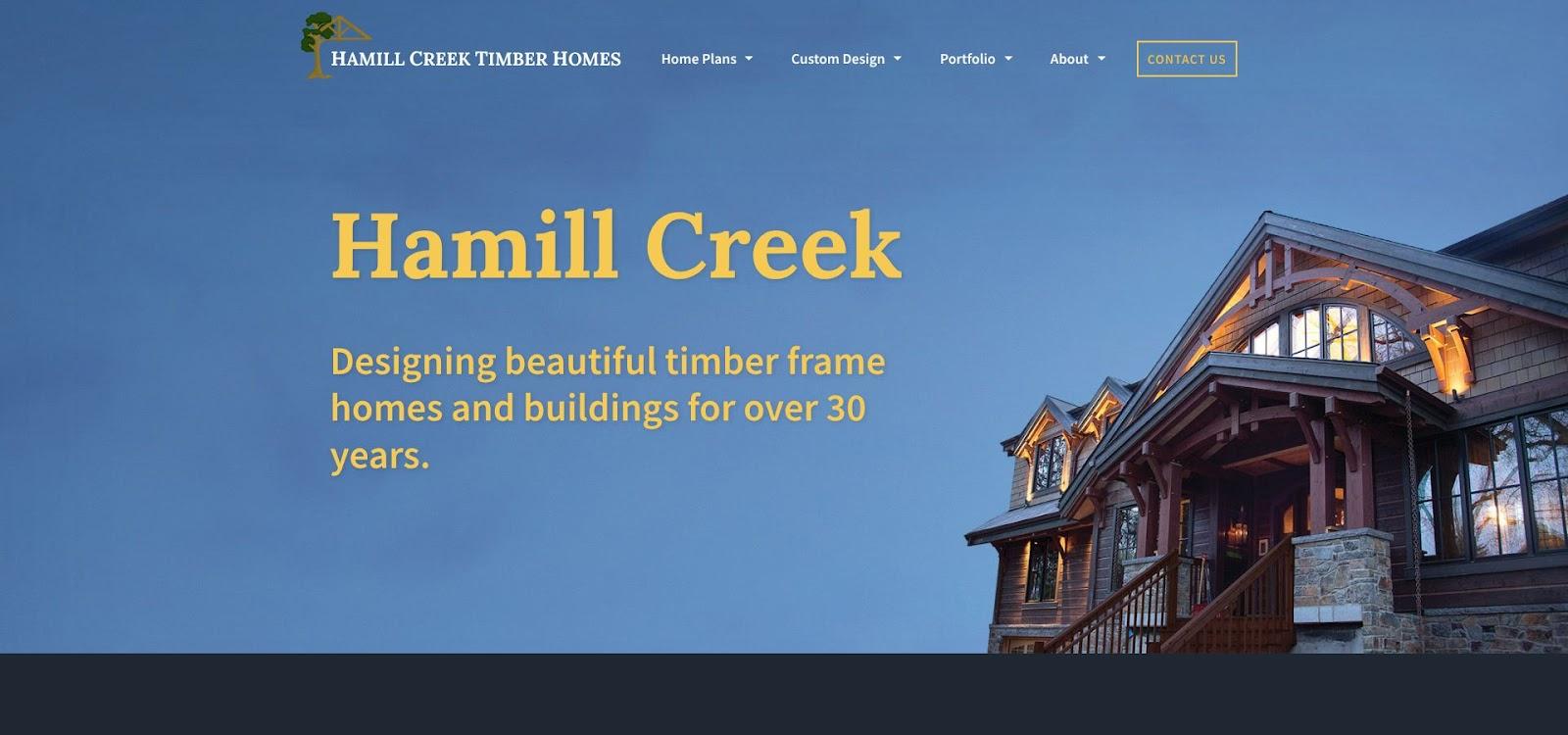
Hamill Creek timber frame prefab home kit and crew in action
The British Columbia veteran has spent three decades refining its kit-plus-crew model. Every beam arrives numbered, pre-drilled, and factory-sealed; the same truck also delivers the raising team. You supply the slab and crane, they supply the muscle. Result: a weather-tight frame in three to five days instead of the usual four- to six-week slog.
Costs stay transparent. Expect $60–$90 per square foot for the structural package, including on-site erection and engineer-stamped drawings. A 2 000-square-foot home lands between $120 000 and $180 000. Because the price is locked before fabrication, budget creep never starts, and the factory math outlined in Hamill Creek’s guide to timber frame prefab homes shows how reduced labor hours and near-zero off-cut waste keep those numbers intact.
Performance is no afterthought. Most clients wrap the frame in six- or eight-inch structural insulated panels, creating R-24+ (≈ RSI 4.2) walls and R-40+ (≈ RSI 7.0) roofs. The airtight shell pairs with kiln-dried Douglas Fir timbers, so seasonal shrinkage and the drafts it causes in weaker builds never appear. Owners chasing net-zero have pushed Hamill envelopes close to Passive House levels by adding thicker panels and triple-pane glass.
Flexibility matters too. Choose a catalog plan, tweak the loft, or hand over a quick sketch, and the in-house design crew will translate it into shop drawings. Once the saws fire up, though, changes pause. That discipline keeps schedules sacred and mistakes rare.
Who wins with Hamill Creek? Anyone who wants show-home charisma without full-custom chaos. Think boutique resort owners, families building forever cabins, or investors flipping high-end vacation rentals. You get artisan joinery, a predictable timeline, and a structure built to outlast fads.
If you crave cathedral ceilings but refuse to babysit framers for a month, Hamill Creek deserves the top spot.
2. Bensonwood & Unity Homes: High-performance, Data-driven Panels
If Hamill Creek leads on craft and speed, Bensonwood and its sister brand Unity excel on science. Their signature OBPlus™ wall is a 12-inch panel packed with dense-pack cellulose that delivers about R-35 (≈ RSI 6.2) and arrives on site with windows already installed.
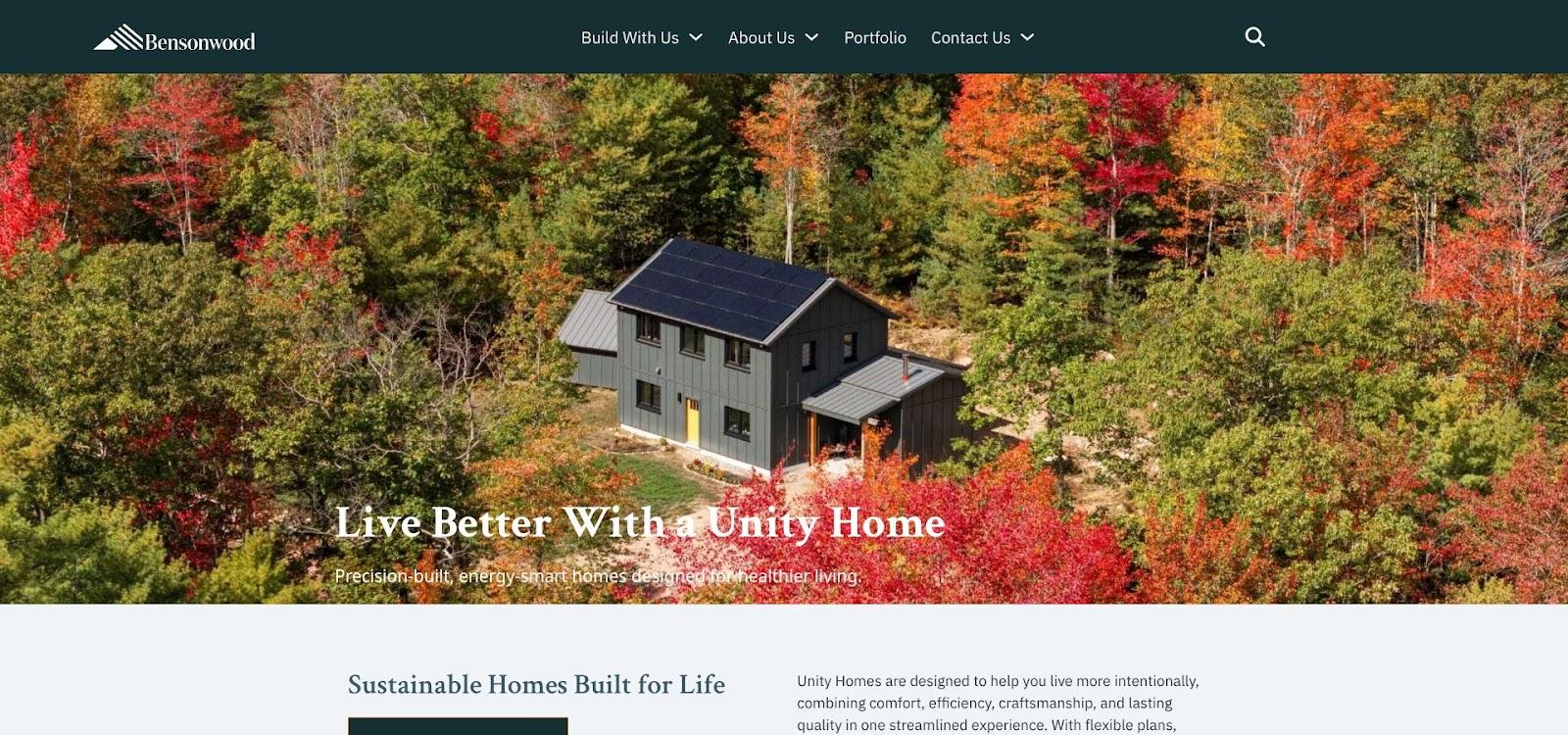
Unity Homes high-performance prefab timber panel home exterior
That factory precision trims both risk and schedule. Unity lists shell assembly times as short as two weeks; crews crane finished wall sections, roof cassettes, and the timber core into place with set-piece accuracy. While local trades handle plumbing and paint, blower-door tests often measure airtightness below 1.0 ACH50.
Performance at this level affects price. Unity catalog homes begin near $250 per square foot finished and can exceed $650 for full customization, according to recent quotes gathered by Prefab Review. The figure covers exterior finishes, triple-pane glass, and an HVAC-ready envelope in one purchase. Over decades, lower energy bills help close the gap.
Design freedom scales. Unity offers four base platforms—Zum, Xyla, Tradd, and Värm—each open to moderate tweaks. Seeking a bolder concept? Work with the parent firm, Bensonwood, and let its architects explore glulam and glass; budget accordingly.
Who benefits? Owners pursuing clear sustainability milestones, developers who need airtight pro formas, and anyone weary of site-built quality swings. For Passive House-level comfort without shepherding subcontractors, Bensonwood and Unity let the data guide the deadline.
3. PrecisionCraft Log & Timber Homes: Grandeur on Mountain Time
Step into a PrecisionCraft great room and conversation stops. Twelve-by-twelve Douglas Fir posts rise two stories before merging with curved glulam trusses. Stone, steel, and glass blend like old friends. Nothing here whispers “kit.”
Each project begins with a blank sheet and the M-T-N Design team. Expect a few extra months in design for a floor plan that hugs the ridgeline view to the degree. After drawings lock, PrecisionCraft pre-cuts every joint, test-fits the frame, and ships it with a site supervisor to locations from Tahoe to Teton Village.
Budgets match the artistry. Full build costs often exceed $400 per square foot, and the timber shell alone can top $200 000 on midsize homes. Buyers accept the premium because resale on a showpiece lodge stays strong and luxury ski rentals keep climbing.
Energy performance surprises newcomers. Wrap those massive bents in SIP walls and R-40+ (≈ RSI 7.0) roof panels and you get an alpine retreat that sips propane while neighbors guzzle. PrecisionCraft crews have delivered blower-door numbers on par with many contemporary builds, proof that cathedral ceilings do not require cathedral heating bills.
If your dream home involves panoramic slopes, hand-finished timbers, and a build story fit for a design magazine, PrecisionCraft turns a sketch into a legacy. Bring patience and a checkbook equal to true custom work.
4. Timberlyne: DIY-friendly Barn Homes That Respect the Budget
Scroll Instagram for five minutes and Timberlyne A-frames or barndominiums appear in every third swipe. The Nebraska and Texas firm balances cost control with curb appeal.
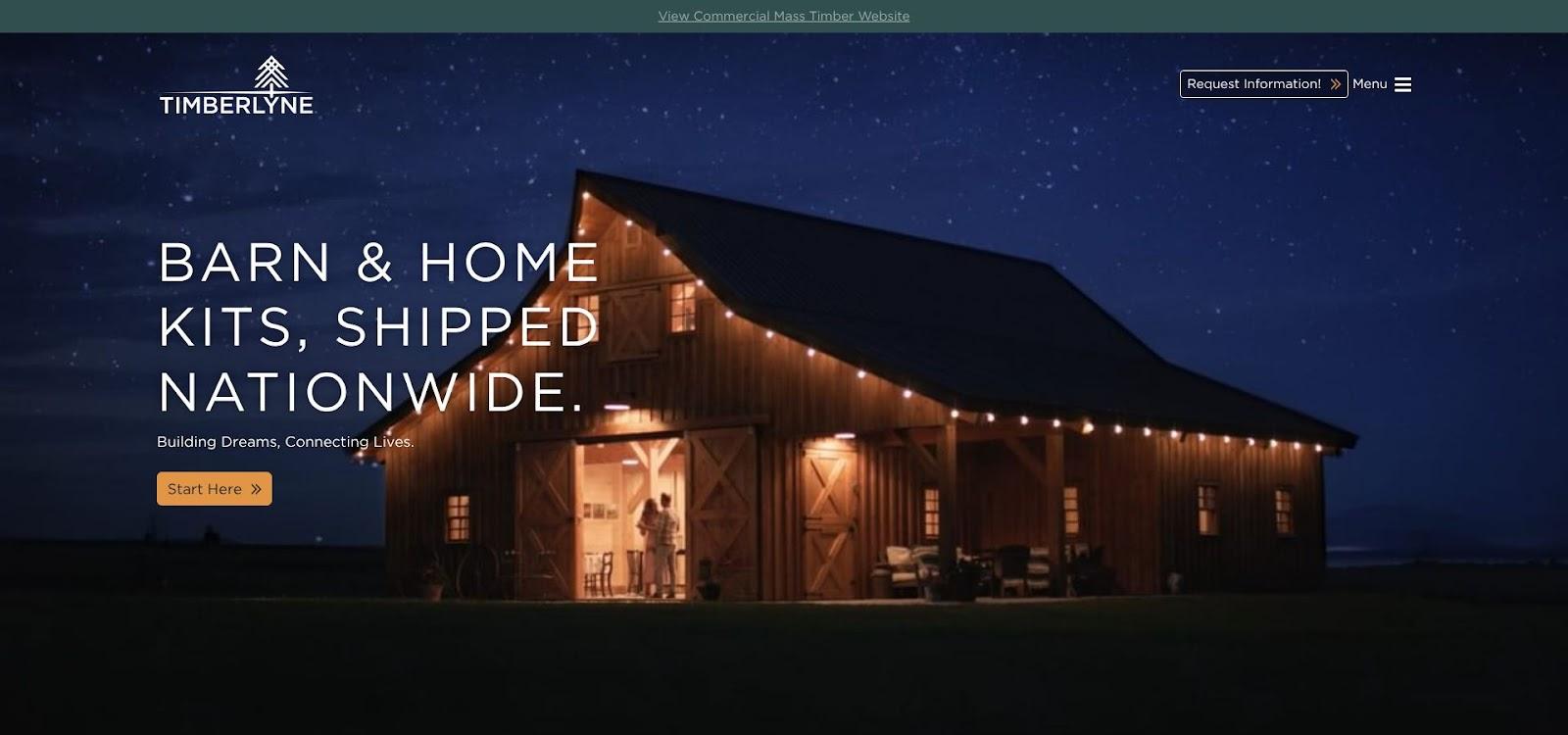
Timberlyne barn-style barndominium prefab kit exterior
Here is the hook. For about $60 per square foot you receive a pallet of pre-cut timbers, board-and-batten siding, roof decking, and fasteners. Add sweat equity or a local Amish crew, and your shell dries in within a week. Owners say the labels are so clear you could assemble it like IKEA, only with a crane.
Flexibility stays high without surprise charges. Stretch the porch, mirror the floor plan, or add dormers, and the drafting team integrates changes quickly. You also pick the insulation path: slide SIPs between posts for R-24 (≈ RSI 4.2) walls, or stick-frame infill and spray foam on your own schedule.
The look leans rustic-modern: tall gables, black powder-coated steel plates, and working hay-loft doors. Swap cedar for metal siding and the same frame shifts to an industrial vibe. That chameleon quality widens resale appeal.
Know the limits. Timberlyne ships materials, not labor, so budget for a framer if you want turnkey help. Warranties apply to individual products rather than one umbrella guarantee.
When you want true timber character at a starter-home price and you are ready to swing a hammer, Timberlyne stands out as the budget choice.
5. DC Structures: Barn-chic Shells That Arrive Nearly Finished
Think of DC Structures as Timberlyne’s big-city cousin. The same barn DNA, but the kit shows up with windows, doors, and a roof already chosen.
The shell package bundles heavy timber posts, pre-framed wall panels, cedar or fiber-cement siding, Andersen windows, and a standing-seam metal roof. On delivery day you are halfway to dried-in before the first nail fires. Most crews lock the exterior in two to three weeks, even on 3 000-square-foot barndominiums with RV-height garage bays.
Pricing stays competitive because DC buys materials at scale. Recent client invoices show $45–$50 per square foot for the shell, placing a 2 000-square-foot Columbia model near $100 000. Add another $100–$150 per square foot for interiors and you can still finish under $300 000, which is notably low for a home that could grace an Architectural Digest “modern farmhouse” spread.
Energy details deserve applause. Roof assemblies include rigid foam above tongue-and-groove decking, walls accept spray foam or SIP inserts, and the standard low-E glass posts U-0.30 (≈ 1.7 W/m²·K) or better. Add a heat pump and you edge close to IECC 2024 targets without heroic measures.
Custom tweaks stay painless. Need a bigger shop bay, a catwalk loft, or fire-resistant siding for a wildfire zone? The design studio edits the BIM file and updates the material list before you sign. Because every member is pre-cut by CNC, last-minute changes after fabrication are the only real no-go.
The catch: labor is on you. DC can suggest vetted builders, but if you want a company crew from slab to paint, plan for extra help. Also budget for a telehandler; those 40-foot glulams do not hand-carry.
For owners who want a polished exterior fast, such as wedding-venue operators, car collectors, or families racing winter, DC Structures delivers a camera-ready barn home while letting you shape the interior style.
6. Purcell Timber Frame Homes: Eco-luxury for Harsh Climates
Some sites scoff at ordinary construction. Steep coastal bluffs, 12-foot snow loads, or rainforest humidity can chew through bargain builds in a decade. That is where Purcell shines.
Based in Nelson, British Columbia, Purcell pairs architect-level design with factory precision. Walls arrive as insulated panels up to a foot thick, often pre-fitted with triple-pane glazing. Crews crane them into place beside curved or tapered timbers, bringing a 3 500-square-foot custom home to shell complete in about four weeks—even when the jobsite sits halfway up a mountain road.
Budgets start high and rise with ambition: finished costs land between $400 and $600 per square foot. Clients accept the premium for comfort, low energy bills, and resale cachet. Purcell’s catalog lists more than 50 designs that use high-insulation wall panels and vented roof systems meeting strict energy codes. Add solar and a heat pump and you flirt with net-zero while wearing a ski jacket.
Design sets Purcell apart. The team can model a butterfly roof to channel rainwater into a cistern, carve barrel-vaulted ceilings over a glass curtain wall, or add steel moment frames for 30-foot (≈ 9.1 m) window corners. Everything appears in VR before a single beam is cut, giving you confidence, plus time to tweak, while concrete trucks warm up.
Service matches the creativity. In Western Canada, Purcell offers turnkey build-out through occupancy. Farther afield, they ship the prefab shell and send a supervisory crew to guide local trades and keep quality on script.
Choose Purcell when your project needs architectural bravado backed by engineering that shrugs at 100 mph (≈ 161 km/h) winds. It is the very definition of “invest once, enjoy forever.”
7. Riverbend Timber Framing: Heritage Craft With Modern Efficiency
Riverbend has choreographed timber raisings since 1979, and the experience shows in every peg driven.
Select a PerfectFit™ plan and the design phase wraps in weeks, not months. CNC machines carve mortise-and-tenon joints with museum-grade precision while your foundation cures. When the trucks arrive, Riverbend’s crew lifts the frame and installs SIP panels in a tidy one- to two-week sprint. Neighbors may say the house “grew overnight.”
Budget lands in a comfortable middle ground. Plan on $80–$120 per square foot for the frame, panels, and installation, plus another $150–$200 for finishes. That positions Riverbend as a value play for buyers seeking authentic craft without luxury-home pricing.
Energy performance comes built in. Standard packages wrap the timbers with R-24 (≈ RSI 4.2) wall and R-40 (≈ RSI 7.0) roof panels, easily clearing IECC 2024 targets. Blower-door tests around 1.5–2.0 ACH50 are common, a far cry from drafty barns of the past.
Style versatility is Riverbend’s sleeper advantage. From storybook cottages to flat-roof modern hybrids, the library runs wide. Tweak an existing plan or mix and match elements; the design team keeps structural math tidy so costs stay predictable.
Customers praise service the loudest. Project managers handle permits, coordinate shipping, and stay on site for the raising. Your general contractor finishes the interior instead of deciphering a pile of mystery timbers.
Pick Riverbend when you want old-world joinery paired with present-day performance, and you would rather spend weekends planning décor than chasing subcontractors.
Side-by-side Snapshot: How the Seven Stack Up
| Provider | Kit / shell cost* | Lead time (factory) | On-site shell time | What’s included at base price | Energy spec (walls) |
|---|---|---|---|---|---|
| Hamill Creek | $60–$90 / ft² | 10–14 weeks | 3–5 days (crew supplied) | Timber frame, hardware, raising team | Pair with SIPs ≈ R-24 |
| Bensonwood / Unity | $250–$650+ / ft² finished | 12–16 weeks | 2 weeks | Panelized walls with windows, roof cassettes, timber core | OBPlus wall ≈ R-35 |
| PrecisionCraft | Custom; shell ≈ $200 000+ | 12–16 weeks | 1–2 weeks | Bespoke frame, SIP option, site supervisor | SIP wrap up to R-40 |
| Timberlyne | $60 / ft² | 10–14 weeks | ≤ 1 week | Frame, siding, roof deck, fasteners | SIP add-on R-24 |
| DC Structures | $45–$50 / ft² (shell) | 12–16 weeks | 2–3 weeks | Frame, siding, windows, doors, metal roof | Roof foam plus wall panels U-0.30 |
| Purcell | $400–$600+ / ft² finished | 12 weeks+ | 3–4 weeks | Full prefab shell, triple-pane glass, regional crew | High-R panels |
| Riverbend | $80–$120 / ft² (frame + SIPs) | 8–12 weeks | 1–2 weeks | Frame, SIPs, raising crew | Walls R-24; roof R-40 |
*Kit or shell pricing excludes foundation and interior finishes unless noted. Source costs are aggregated from manufacturer quotes and Sky Rye Design’s 2026 pricing roundup.
A few themes stand out:
- Speed versus finish level. Faster shell times usually pair with higher factory integration. Unity’s two-week pace is possible because walls arrive insulated, taped, and glazed.
- Cost bands. Timberlyne and Hamill Creek sit below the $100 per square foot structural mark, ideal for owner-builders. Purcell and Unity cross the $300 per square foot finish line but ship near-move-in envelopes that trim future utility bills.
- Energy upside across the board. Even the budget kits expect R-24 walls—well above many code minimums—so every option here positions you for upcoming IECC 2024 requirements without heroic retrofits.
Use the table as a quick filter. Circle the column that matters most to your project—cost, speed, or efficiency—and your shortlist practically chooses itself.
Buyer’s guide: Five Questions That Keep Builds on Track
1. What do you value most—speed, savings, or showpiece design?
Before signing any kit contract, name the target.
Is your top goal trimming months of carrying costs?
Stretching every dollar of equity?
Or impressing guests with a timber cathedral that doubles as a brand statement?
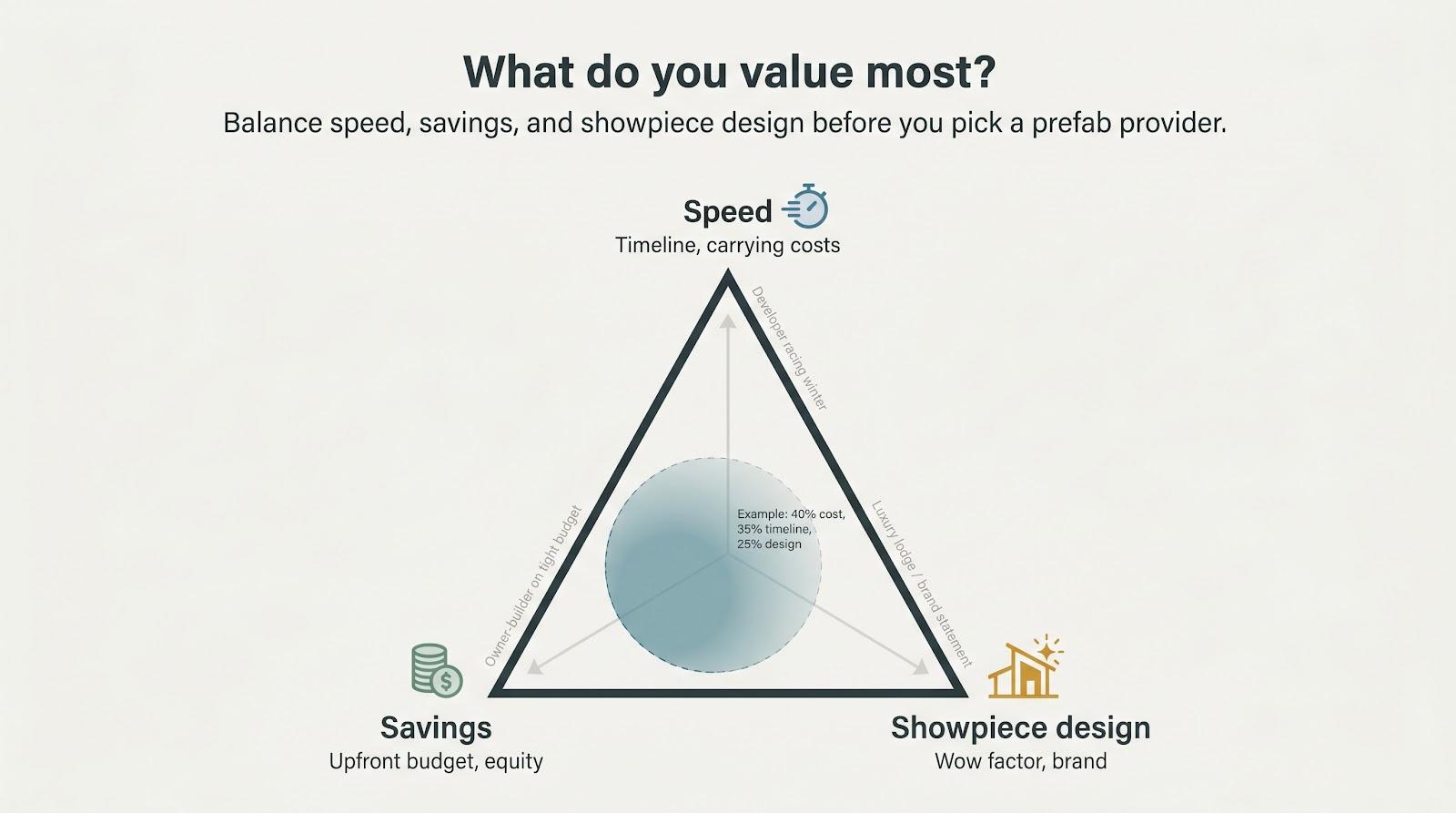
Write those priorities down and rank them. When clients skip this step, they chase glossy catalog photos and forget the spreadsheet reality. A clear hierarchy steers every later choice: shell level, insulation upgrades, even which lender will accept a large deposit for off-site fabrication.
Practical tip: assign rough weights—40 percent cost, 35 percent timeline, and 25 percent design—then compare providers through your personal lens. A Unity home may score highest overall, but if upfront spending is the pain point, Timberlyne’s lower kit price will win in your custom matrix.
Locking your values now prevents change-order headaches later, because once timbers reach the CNC bed, indecision gets expensive.
(Next up: Question 2 – “What exactly comes in the box and what still hits your wallet later?”)
2. What’s in the kit and what isn’t?
Every prefab brochure promises a “package,” but that word hides a thousand variables. Miss one and the budget balloons after the truck leaves the factory.
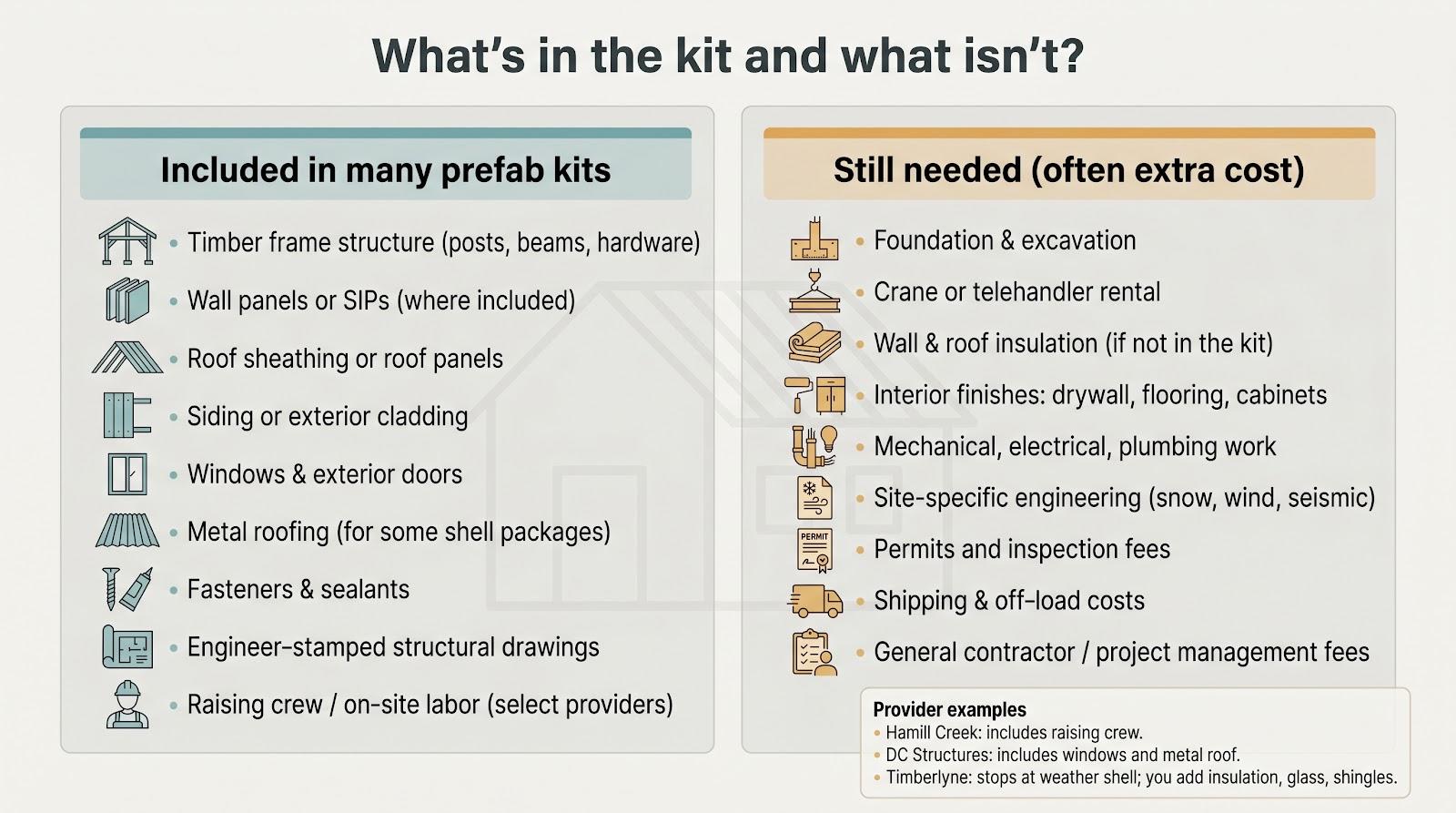
Open the spec sheet and circle each line item. Timber frame? Good. Now check for wall panels, roof sheathing, siding, windows, doors, fasteners, sealants, engineer-stamped drawings, and, crucially, on-site labor. Watch how the list shrinks as prices drop.
Hamill Creek, for instance, includes its raising crew, saving about ten thousand dollars in crane labor. DC Structures goes further, shipping Andersen windows and metal roofing so exterior trades can work from day one. Timberlyne stops at the weather shell; you will buy insulation, glass, and shingles à la carte.
Set up a two-column worksheet: “Included” and “Still needed.” Price the gaps with local suppliers before celebrating a low kit quote. Many owners learn that once windows, SIPs, and crane rental join the bill, the bargain frame moves into mid-market territory.
Apply the same test to soft costs. Ask whether structural calculations for your state’s snow and wind loads come baked in. If not, add an engineer’s fee and extra weeks in permitting.
The least expensive package is rarely the lowest total cost. Clear line items beat teaser pricing every time.
(Next up: Question 3 – “Who’s steering the build once the truck pulls away?”)
3. Who captains the build after the truck leaves?
Prefab does not remove project management; it raises the stakes. Those neatly labeled wall panels still need a choreography of cranes, electricians, inspectors, and weather windows. Someone must call the cues.
If you hold a contractor’s license or have managed renovations, you can act as owner-builder. Plan on mornings booking subcontractors and afternoons checking that every gasket and SIP spline is sealed. Time is money, and in prefab it is your money if inspections slip.
Most buyers hire a general contractor. The issue: not every GC understands timber frames. During vetting, ask pointed questions: Have you installed SIPs? Do you own or rent a telehandler? Can you share a schedule from a prior prefab job? A blank stare means keep shopping.
Leading kit companies keep preferred-builder lists. Riverbend and DC can name framers who have raised dozens of their packages, and Unity trains regional partners in its panel system. Hiring from that bench costs a bit more but saves far more in change orders and call-backs.
Whatever path you choose, lock roles in writing. Spell out who unloads the truck, who insures materials on the ground, and who pays standby fees if weather stalls the crane. Clarity now beats finger-pointing later.
(Next up: Question 4 – “Will your site and permit office play nice with timber?”)
4. Will your site and permit office cooperate with timber?
A prefab kit moves fast; permitting rarely does.
Before writing a deposit check, walk into the local building office with two questions:
1. What snow, wind, and seismic loads must this house meet?
2. Will a timber frame wrapped in SIPs satisfy the inspector, or will they want extra calculations?
Most jurisdictions say “yes” once they see engineer-stamped drawings, but assumptions wreck schedules. Mountain counties may require 100 lb/ft² (≈ 4.8 kN/m²) snow loads, while coastal towns chase 160 mph (≈ 257 km/h) wind ratings. Kit providers can resize beams and hardware smoothly—if they know the targets early.
Next, evaluate the ground itself. Can semi-trucks and a 40-ton crane reach the pad without stripping trees or collapsing a culvert? If access is tight, plan for smaller deliveries or stage materials roadside and shuttle them with a telehandler. Skip this step and the crane meter ticks $250 per hour while crews wait.
Zoning adds more curveballs. One agricultural parcel might cap dwelling size; another could limit metal-roof glare or dictate siding colors. Flag those quirks now so the designer picks compliant finishes instead of red-lining drawings later.
Call utility companies too. A prefab wall with factory-installed windows is unforgiving if the power drop lands two feet off. Staking exact meter and septic spots before fabrication keeps panels intact and neighbors content.
Bottom line: spending a week on code loads, access routes, and service hookups can save two months and thousands of dollars once the timbers arrive.
(Next up: Question 5 – “How will you finance, insure, and protect the project?”)
―――――――――――――――――――――――
Prefab timber-frame technology now offers paths for every budget and climate. Match the company’s strengths to your top priority—speed, savings, or showpiece design—and you will raise a home that stands tall for generations.






 Business Programs
Leave a Reply
Want to join the discussion?Feel free to contribute!