 A VETERAN OWNED SMALL BUSINESS |
Driving Growth with Brand Strategy and Marketing Funnels

Deconstructing Funnel Architecture: Brand, Marketing, and Sales Funnels
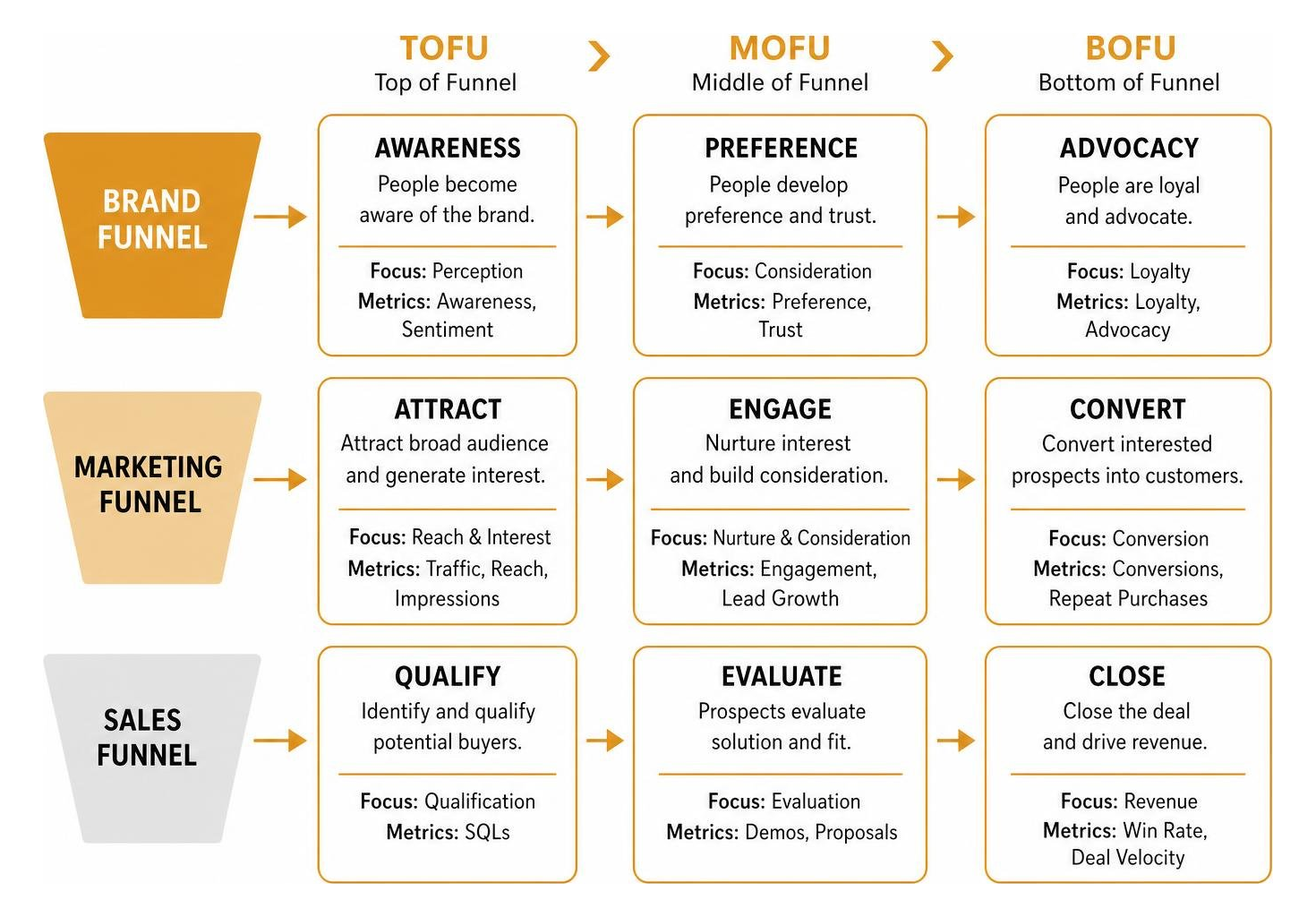
Understanding the distinct yet interconnected roles of brand, marketing, and sales funnels is foundational to driving sustainable growth. While all three describe a customer’s journey, their focus, metrics, and strategic implications differ significantly. Each funnel offers a unique lens through which to view customer dynamics, from initial awareness to lasting loyalty.
A marketing funnel provides a holistic view of the customer’s journey, mapping their progression from initial exposure to a brand through to repeat purchases and advocacy. It encompasses a broad range of activities designed to attract, engage, and convert prospects. The focus here is on guiding potential customers through a series of stages, nurturing their interest, and ultimately leading them towards a transaction.
In contrast, a sales funnel is typically more focused on the latter stages of the customer journey, specifically on converting qualified leads into paying customers. It’s a narrower, more tactical pipeline that tracks prospects as they move through specific sales processes, such as demos, proposals, and closing deals. Its primary objective is revenue generation, and its metrics are often centered around sales-qualified leads, conversion rates, and deal velocity.
A brand funnel, however, shifts the perspective to customer perception and emotional connection. It measures how effectively a brand moves individuals from mere awareness to deep preference and advocacy. This funnel delves into the psychological aspects of the customer journey, assessing sentiment, trust, and loyalty. It’s less about immediate transactions and more about building enduring relationships and cultivating brand equity. Analyzing brand funnel dynamics can reveal where a brand might be losing potential customers due to issues with positioning, messaging, or overall brand experience, offering crucial insights for strategic adjustments.
The Core Stages: TOFU, MOFU, and BOFU Alignment
Regardless of whether we’re discussing a marketing, sales, or brand funnel, the journey typically progresses through distinct stages, often categorized using the Top-of-Funnel (TOFU), Middle-of-Funnel (MOFU), and Bottom-of-Funnel (BOFU) framework. This structure helps us align our strategies and content with the prospect’s mindset at each point.
Top-of-Funnel (TOFU) activities are designed to cast a wide net, generating broad awareness and attracting a large audience of potential customers. At this stage, individuals may not even be aware they have a problem that your brand can solve. Our goal is to introduce the brand, educate them on relevant topics, and capture their attention. Metrics here often include website traffic, social media reach, impressions, and keyword rankings. Content is typically educational, informative, and easily digestible, such as blog posts, infographics, and general social media content.
The Middle-of-Funnel (MOFU) is where interest deepens, and prospects begin to actively seek solutions to their identified problems. Here, our focus shifts to nurturing leads, building trust, and demonstrating our expertise. We aim to move prospects from casual interest to active consideration. Key metrics for MOFU include lead generation rates, email open and click-through rates, content engagement (e.g., webinar attendance, whitepaper downloads), and demo sign-ups. Content becomes more specific and problem-solution oriented, such as guides, webinars, case studies, and email sequences.
Finally, the Bottom-of-Funnel (BOFU) is dedicated to converting engaged prospects into customers. At this stage, individuals are ready to make a purchase decision and are comparing specific solutions. Our objective is to provide the final push, addressing any remaining objections and highlighting the unique value proposition. Conversion rates, average order value (AOV), customer acquisition cost (CAC), and time to purchase are critical metrics. Content includes product demos, free trials, consultations, personalized offers, and compelling calls-to-action.
The Brand Love Curve and Emotional Trajectory
Beyond the transactional progression of a typical marketing funnel, the Brand Love Curve offers a powerful framework for understanding the emotional trajectory of a customer’s relationship with a brand. This curve illustrates how consumer sentiment evolves through stages: Unknown, Indifferent, Like It, Love It, and ultimately, Beloved. Integrating this emotional dimension into our funnel analysis provides a richer understanding of brand health and customer loyalty.
Initially, a brand might be Unknown to a prospect. Through TOFU marketing efforts, we aim to move them to the “Noticed” or “Aware” stage. If these initial interactions are positive, the prospect might transition from Indifferent to “Like It,” indicating a growing preference or positive association. This is often cultivated through consistent, valuable MOFU content and positive brand experiences.
As customers interact more deeply and experience the brand’s value, they can move to the “Love It” stage. This signifies a strong emotional connection, where the brand resonates with their values and consistently meets their needs. For many brands, achieving this level of emotional affinity is a significant milestone, leading to repeat purchases and strong loyalty.
The pinnacle of the Brand Love Curve is the Beloved stage. At this point, customers are not just loyal; they are advocates. They actively recommend the brand, defend it, and feel a sense of ownership or connection. These “beloved” customers are invaluable, driving organic growth through word-of-mouth and contributing significantly to long-term customer lifetime value (CLV).
Analyzing the Brand Love Curve in conjunction with the marketing funnel allows us to identify not just where customers drop off, but why—is it a lack of awareness, an indifferent perception, or a failure to convert positive sentiment into action? This analysis can reveal critical insights into where to invest in brand-building efforts versus performance marketing, ensuring that our strategies cultivate both transactions and lasting emotional bonds.
Integrating Brand Strategy and Marketing Funnels for Sustainable Growth
In today’s competitive landscape, simply running campaigns isn’t enough. For truly sustainable growth, brand strategy and marketing funnels must operate in lockstep. Brand strategy acts as the guiding compass, defining who we are, what we stand for, and why we matter to our audience. The marketing funnel is the operational roadmap, detailing how we engage, nurture, and convert that audience. Without a robust brand strategy, marketing funnels can become tactical exercises lacking direction, leading to inconsistent messaging, wasted spend, and ultimately, a leaky customer journey.
A strong brand strategy, built on a clear purpose, defined positioning, distinctive personality, and a compelling promise, significantly impacts the efficiency and effectiveness of every funnel stage. It lowers customer acquisition costs (CAC) by making marketing messages more resonant and memorable. It can increase pricing power, shorten sales cycles, and improve win rates by instilling trust and preference before a prospect even enters the sales conversation. Brand strategy is the foundation upon which effective marketing funnel execution is built, providing the clarity and differentiation needed to stand out in a crowded market.
This integration is not merely theoretical; it delivers tangible results. Research indicates that a well-defined brand strategy can reduce CAC by 20–40%, accelerate sales cycles by 24%, and boost win rates by 31% compared to brands without clear positioning. These numbers underscore why investing in thoughtfully crafted brand strategies is not an overhead, but a critical driver of revenue and market leadership.
Aligning Brand Strategy and Marketing Funnels Across the Customer Journey
Effective alignment between brand strategy and marketing funnels requires a meticulous approach to messaging, content, and touchpoint governance at every stage of the customer journey.
At the Awareness (TOFU) stage, our brand strategy dictates the overarching narrative and tone. Content should reflect our core purpose and personality, introducing our brand in a way that is authentic and memorable. We leverage our brand’s unique voice to cut through the noise, ensuring that initial impressions are consistent with our long-term vision. This involves crafting educational content that subtly introduces our brand’s perspective on relevant topics, rather than overtly selling.
Moving into the Consideration (MOFU) stage, the brand’s positioning and value proposition become paramount. Here, content demonstrates how our brand uniquely solves customer problems, differentiating us from competitors. Messaging architecture ensures a consistent hierarchy of benefits and proof points across all nurturing materials, from webinars to case studies. Our brand promise is reinforced through compelling narratives and testimonials, building trust and preference. Audience segmentation plays a crucial role, allowing us to tailor messages to specific persona needs while maintaining a consistent brand identity.
Finally, at the Conversion (BOFU) and Loyalty stages, the brand’s promise must be delivered and reinforced. The sales process, product experience, and post-purchase support all become critical touchpoints that either validate or undermine the brand’s claims. Clear communication about what customers can expect, combined with exceptional service that embodies our brand’s personality, solidifies the relationship. Touchpoint governance ensures that every interaction, from a website visit to a customer service call, reflects the brand’s values and commitment. This continuous alignment builds not just transactions, but lasting brand equity and advocacy.
B2B vs. B2C Funnel Architectures
While the core principles of brand strategy and marketing funnels apply universally, their architectural nuances differ significantly between B2B (business-to-business) and B2C (business-to-consumer) contexts. These differences stem from distinct buying behaviors, decision cycles, and emotional drivers.
B2B funnels are typically characterized by longer sales cycles, often spanning weeks or months, due to higher stakes, larger investments, and the involvement of multiple decision-makers. The purchasing process is generally more rational, driven by ROI, efficiency, and problem-solving. Consequently, B2B funnels require content that is highly informative, data-rich, and tailored to various stakeholders within a buying committee.
- TOFU focuses on thought leadership, industry insights, and educational content that addresses complex business challenges.
- MOFU emphasizes detailed whitepapers, webinars, case studies, and product comparisons to build credibility and demonstrate expertise.
- BOFU involves personalized demos, proposals, and consultations, often requiring direct sales engagement to navigate complex organizational structures and procurement processes. Brand strategy in B2B emphasizes reliability, expertise, and a clear value proposition for the enterprise.
B2C funnels, by contrast, are often much shorter and can be highly impulse-driven. Emotional triggers, brand affinity, and cultural relevance play a more significant role. The decision-making unit is typically an individual or household, and the purchase value is often lower.
- TOFU leverages broad reach through social media, influencer marketing, and engaging visual content to capture attention and spark desire.
- MOFU might involve personalized product recommendations, user-generated content, and lifestyle imagery to build aspiration and connection.
- BOFU focuses on seamless checkout experiences, limited-time offers, and social proof to drive immediate conversions. Brand strategy in B2C thrives on personality, emotional appeal, and creating a strong sense of identity or belonging.
Despite these differences, both B2B and B2C funnels increasingly rely on omnichannel touchpoints, ensuring a consistent brand experience across various platforms, whether it’s a social media ad, an email, or an in-store interaction. The underlying brand strategy must be flexible enough to adapt to these channel-specific tactics while maintaining a unified brand message.
Engineering the Full-Funnel Engine: Brand Building Meets Performance
The traditional divide between “brand building” and “performance marketing” is rapidly dissolving. In a full-funnel approach, these two disciplines are not separate but symbiotic, working in concert to drive both long-term equity and immediate conversions. Brand building creates the demand and cultivates intent, while performance marketing captures and converts that intent efficiently. Ignoring either aspect leads to inefficiencies: performance marketing without brand building becomes an expensive race to the bottom, while brand building without performance marketing struggles to demonstrate tangible ROI.
A truly integrated full-funnel engine requires a unified media mix, where investments in upper-funnel brand activities directly feed lower-funnel conversion efforts. This means moving beyond siloed budgets and metrics, fostering collaboration between brand teams, content creators, and performance marketers. Modern media mix modeling (MMM), enhanced with incrementality testing and multi-touch attribution, allows us to understand how different channels and activities contribute across the entire customer journey. This holistic view enables smarter media allocation, ensuring that every marketing dollar contributes optimally to both brand awareness and sales.
The benefits are clear: businesses adopting a full-funnel strategy can achieve up to three times more brand awareness, twice the amount of consideration, and double the purchases compared to those with fragmented approaches. This integrated methodology is crucial for effective marketing funnel execution, ensuring that all efforts contribute to a cohesive and measurable growth strategy.

Top-of-Funnel Demand Creation and Brand Salience
At the top of the funnel, the primary goal is demand creation and building brand salience – making our brand easy to find and easy to mind. This stage is crucial for planting the seeds of future conversions by reaching a broad, relevant audience and introducing them to our brand’s value proposition.
Addressable media plays a significant role here, allowing for precise targeting even at the awareness stage. Channels like digital streaming audio and video, programmatic display, and addressable TV offer granular control over who sees our brand messages, moving beyond broad demographics to specific interests and behaviors. This ensures that our brand-building efforts are not just widespread, but also relevant.
Organic discovery is another powerful TOFU driver. High-quality content marketing, search engine optimization (SEO), and active social media engagement help prospects find our brand naturally when they are seeking information. This includes creating valuable blog posts, engaging social content, and utilizing platforms where our target audience spends their time.
Thought leadership positions our brand as an authority and trusted resource in our industry. This can involve publishing original research, contributing to industry discussions, and participating in expert panels. For many professionals, sharing insights through various channels, including platforms like LinkedIn, can significantly boost brand visibility and credibility. Even activities such as securing podcast guest appearances can be highly effective in reaching niche audiences and establishing expertise, driving high-quality awareness.
Measuring the impact of these TOFU activities often involves brand lift studies, tracking increases in brand recall, recognition, and perception. While traditionally harder to quantify than direct conversions, modern tools allow for near real-time measurement of these upper-funnel metrics, validating the impact of brand-building investments.
Middle- and Bottom-of-Funnel Conversion Systems
As prospects move past initial awareness, our focus shifts to nurturing their interest and guiding them towards a purchase. This requires robust middle- and bottom-of-funnel conversion systems designed for efficiency and personalization.
In the Middle-of-Funnel (MOFU), the objective is lead nurturing. Lead scoring mechanisms help us prioritize prospects based on their engagement and fit, ensuring that resources are allocated effectively. Marketing automation platforms become indispensable, enabling personalized email sequences, content recommendations, and retargeting campaigns that keep the brand top-of-mind. Content here is designed to educate and persuade, such as detailed guides, webinars, and case studies that address specific pain points and demonstrate our solutions in action. The goal is to build trust and move prospects from general interest to active consideration.
For the Bottom-of-Funnel (BOFU), the emphasis is on conversion. This involves optimizing the path to purchase with clear calls-to-action, streamlined checkout processes, and persuasive landing pages. Checkout optimization is critical, reducing friction points that can lead to cart abandonment. Personalized offers, free trials, and product demos provide the final incentive. Remarketing strategies are crucial here, re-engaging prospects who have shown high intent but haven’t yet converted, often through dynamic ads that showcase products they’ve viewed.
Finally, the journey doesn’t end at conversion. Retention systems are vital for fostering loyalty and turning one-time buyers into repeat customers and advocates. This includes post-purchase email sequences, loyalty programs, and exceptional customer service that reinforces the brand’s promise. By integrating CRM with these systems, we can create an “intent engine” that not only captures demand but also cultivates lasting customer relationships, ensuring that our marketing efforts contribute to long-term customer lifetime value.
Brand Funnel Analytics, Diagnostics, and Spend Optimization
Measuring performance across the entire funnel is paramount for continuous improvement and maximizing return on investment. This goes beyond simply tracking conversion rates; it involves a deep dive into brand funnel analytics to diagnose where customers are dropping off and why.
We utilize a combination of absolute scores and conversion ratios at each funnel stage. Absolute scores tell us the raw number of individuals at each stage (e.g., 100,000 aware, 10,000 considering, 1,000 purchasing). While informative, these numbers alone don’t reveal inefficiencies. It’s the conversion ratios—the percentage of people who move from one stage to the next—that truly highlight the health of our funnel. For instance, a high awareness score with a low awareness-to-consideration ratio indicates a problem with our initial messaging or targeting, suggesting that we’re attracting the wrong audience or failing to articulate our value proposition effectively.
Analyzing these ratio gaps is a powerful diagnostic tool. A significant drop-off between consideration and purchase, for example, might point to issues with our product page optimization, pricing clarity, or the strength of our offers. We also implement leak diagnostics to identify common points of failure, such as high bounce rates on landing pages, low engagement with nurturing content, or cart abandonment rates. By comparing our ratios against industry benchmarks or competitors (where data allows), we can pinpoint specific strategic weaknesses and prioritize areas for optimization.

Measuring Brand Strategy and Marketing Funnels Performance
To effectively measure the impact of both brand strategy and marketing funnels, we track a comprehensive set of KPIs across the entire customer journey. These metrics provide a holistic view of performance, from brand health to commercial outcomes.
For brand lift and upper-funnel performance (Awareness, Interest), we monitor:
- Reach and Impressions: How many unique individuals saw our content and how often.
- Brand Recall and Recognition: Measured through surveys and brand lift studies.
- Branded Search Volume: An increase indicates growing interest in our brand.
- Direct Traffic: Users navigating directly to our website, showing brand affinity.
- Social Engagement: Likes, shares, comments, and mentions. These are often considered leading indicators, providing early signals of brand health and future demand.
As customers move into Consideration and Conversion stages, we focus on:
- Lead Generation Rates: The volume and quality of leads acquired.
- Engagement Metrics: Email open rates, click-through rates, content downloads, webinar attendance.
- Conversion Rate: The percentage of prospects completing a desired action (e.g., purchase, demo sign-up).
- Customer Acquisition Cost (CAC): The cost to acquire a new customer.
- Return on Ad Spend (ROAS): The revenue generated for every dollar spent on advertising.
- Sales Cycle Length: The time it takes for a lead to convert. These are lagging metrics that directly reflect the commercial impact of our funnel.
Finally, for Loyalty and Advocacy, we track:
- Repeat Purchase Rate: The percentage of customers making subsequent purchases.
- Customer Lifetime Value (CLV): The total revenue expected from a customer over their relationship with the brand.
- Net Promoter Score (NPS): A measure of customer loyalty and willingness to recommend.
- Customer Satisfaction (CSAT): Feedback on specific interactions or products.
By continuously monitoring these metrics and analyzing their interdependencies, we gain a clear understanding of our brand’s performance and the effectiveness of our marketing funnels.
Optimizing Conversion Ratios and Marketing ROI
Optimizing conversion ratios and marketing ROI is an ongoing process that leverages data-driven insights to refine strategies and maximize efficiency. It’s about finding the “holes” in our funnel and systematically patching them.
Our approach centers on test-and-learn models. This involves running A/B tests on landing pages, ad creatives, email subject lines, and calls-to-action to identify what resonates best with our audience at each stage. Small, iterative changes based on these tests can lead to significant improvements in conversion rates over time. For instance, moving from TOFU to MOFU often sees a 5%–15% conversion rate, while MOFU to BOFU can achieve 20%–50%. Understanding these benchmarks helps us identify underperforming stages.
We also employ sophisticated multi-touch attribution models to understand the true contribution of each marketing touchpoint across the customer journey. Unlike single-touch models that credit only the first or last interaction, multi-touch attribution provides a more accurate picture of how various channels influence conversion. This allows for intelligent media mix modeling, where we can strategically reallocate budget to channels and activities that demonstrate the highest incremental contribution to our overall objectives, rather than just those with the lowest immediate cost.
Budget reallocation is a continuous process. By shifting greater media allocation to areas with higher returns and employing test-and-learn optimization for demand-generation campaigns, marketers can achieve a 15 to 20 percent lift in marketing ROI. This means constantly evaluating channel performance, identifying underperforming assets, and redirecting resources to where they will have the greatest impact. For example, if we find that our MOFU content is highly engaging but leads aren’t converting at BOFU, we might invest more in personalized follow-ups or clearer value propositions at the final stage.
Optimization is about continuous improvement. It requires a culture of experimentation, a commitment to data analysis, and the agility to adapt strategies based on real-world performance. By systematically refining our funnels, we not only improve conversion ratios but also ensure that every marketing dollar is working harder to achieve our business goals.
Frequently Asked Questions About Funnel Strategy
1. What is the primary difference between a marketing funnel and a brand funnel?
The primary difference lies in their focus and the metrics they prioritize. A marketing funnel is broadly concerned with guiding prospects through the entire customer journey, from initial awareness to purchase and potentially loyalty. Its metrics often revolve around transactional metrics like lead generation, conversion rates, and customer acquisition cost. It’s about moving people through a defined process to generate sales.
A brand funnel, conversely, focuses on the customer’s perception and emotional connection with the brand. It measures how effectively a brand cultivates brand perception and customer sentiment, moving individuals from mere awareness to strong preference, loyalty, and advocacy. While it includes purchase, its ultimate goal is to build enduring relationships and brand equity, rather than just facilitating a single transaction.
2. How do conversion ratio gaps reveal strategic funnel weaknesses?
Conversion ratio gaps are crucial diagnostic tools because they pinpoint exactly where customers are being lost within the funnel. If, for instance, we have a high volume of traffic at the top of the funnel (TOFU) but a very low conversion ratio from awareness to consideration, this reveals a significant gap. It suggests that while we’re attracting attention, our initial messaging or targeting might be misaligned, failing to generate genuine interest or relevance for the audience we’re reaching.
Similarly, a large drop-off between consideration and conversion (MOFU to BOFU) might indicate issues with our product’s perceived value, the clarity of our offers, or friction in the checkout process. These ratio diagnostics allow us to move beyond simply knowing thatcustomers are dropping off, to understanding where and providing strong clues as to why. By identifying these specific stage drop-offs and potential targeting misalignment, we can focus our strategic efforts and resources on the most impactful areas for improvement.
3. Why is a full-funnel marketing approach essential for long-term ROI?
A full-funnel marketing approach is essential for long-term ROI because it acknowledges the entire, often non-linear, customer journey and integrates brand-building with performance marketing. This holistic strategy drives compound growth by ensuring that investments in upper-funnel awareness and brand equity continuously feed and optimize lower-funnel conversion efforts.
Without a full-funnel strategy, brands risk over-investing in short-term performance tactics that burn through leads without cultivating lasting relationships, leading to escalating acquisition costs and diminishing returns. By nurturing prospects through every stage, building trust and preference, a full-funnel approach reduces CAC over time, increases customer lifetime value (CLV), and significantly improves customer retention. It creates a virtuous cycle where brand strength makes performance marketing more effective, and successful conversions reinforce brand loyalty, ultimately leading to more sustainable and profitable growth.
Conclusion
In the dynamic digital landscape of September 2026, the integration of brand strategy and marketing funnels is no longer optional—it’s imperative for sustainable growth. We’ve explored how these interconnected systems guide customers from initial awareness to lasting advocacy, each offering unique insights into the customer journey. From the broad reach of the marketing funnel to the emotional depth of the brand funnel, and the transactional focus of the sales funnel, understanding their distinctions and synergies is key.
Our journey through TOFU, MOFU, and BOFU has highlighted the importance of aligning content and messaging with the customer’s evolving mindset, while the Brand Love Curve underscores the power of emotional connection in fostering loyalty. We’ve seen how a strong brand strategy acts as the foundational blueprint, driving efficiency, reducing CAC, and enhancing the effectiveness of every marketing effort. The differences between B2B and B2C funnels further emphasize the need for tailored approaches that respect distinct buying behaviors.
By embracing a full-funnel engine that seamlessly blends brand building with performance marketing, we can engineer intent, optimize media allocation, and continuously refine our conversion systems. Leveraging comprehensive analytics, diagnosing ratio gaps, and committing to test-and-learn methodologies ensure that every investment contributes to measurable commercial impact and long-term ROI.
Success in today’s market hinges on this strategic synthesis and cross-functional alignment. By viewing brand strategy and marketing funnels not as separate entities but as integrated components of a unified growth engine, businesses can unlock their full potential, cultivate enduring customer relationships, and achieve truly sustainable growth.







 Business Programs

Leave a Reply
Want to join the discussion?Feel free to contribute!