In, Culture’s Impact on How Work Gets Done, we described the profound influence an organization’s collective values have on the controls (individual knowledge and skills, standards and expectations, processes and procedures) and triggers (individual contributors, first line managers and supervisors, executives and senior managers) that determine what work is undertaken and the manner in which it is performed. Therefore, observations of an organization’s unique work controls and triggers preferences can be used to reveal many of the characteristics of its culture. And from these the benefits and risk factors an organization faces as a result of its culture.
Hi there! Gain access to this article with a StrategyDriven Insights Library – Total Access subscription or buy access to the article itself.
Subscribe to the StrategyDriven Insights Library
Sign-up now for your StrategyDriven Insights Library – Total Access subscription for as low as $15 / month (paid annually).
An organization’s culture, its collectively shared values system, profoundly impacts what work is performed, when work is performed, and how work is performed. And the culture driver has as much if not more influence on the results achieved as does the organization’s land, labor, capital, technology, and intellectual property resources.
Hi there! Gain access to this article with a FREE StrategyDriven Insights Library – Sample Subscription. It’s FREE Forever with No Credit Card Required.
Sign-up now for your FREE StrategyDriven Insights Library – Sample Subscription
In addition to receiving access to Corporate Cultures – Culture’s Impact on How Work Gets Done, you’ll help advance your career and business programs through anytime, anywhere access to:
A sampling of dozens of Premium how-to documents across 7 business functions and 28 associated programs
2,500+ Expert Contributor management and leadership articles
Expert advice provided via StrategyDriven’s Advisors Corner
Best of all, it’s FREE Forever with No Credit Card Required.
Do your employees trust you? The brutal truth is probably not. It may not be fair, and you may not want to hear it, but chances are that previous leaders have poisoned the ground on which you’re trying to grow a successful business. Make no mistake: Unless you and all the leaders in your organization can gain the trust of your employees, performance will suffer. And considering how tough it is to survive in today’s business environment, that’s very bad news for your company.
Hi there! This article is available for free. Login or register as a StrategyDriven Personal Business Advisor Self-Guided Client by:
[reveal_quick_checkout id=”25489″ checkout_text=”Subscribing to the Self Guided Program – It’s Free!”]
About the Author
John Hamm is one of the top leadership experts in Silicon Valley. He was named one of the country’s Top 100 venture capitalists in 2009 by AlwaysOn and has led investments in many successful high-growth companies as a partner at several Bay Area VC firms. Hamm has also been a CEO, a board member at over thirty companies, and a CEO adviser and executive coach to senior leaders at companies such as Documentum, Cisco, Hewlett-Packard, TaylorMade-adidas Golf and McAfee. John teaches leadership at the Leavey School of Business at Santa Clara University. To read John Hamm’s full biography, click here.
https://www.strategydriven.com/wp-content/uploads/SDELogo5-300x70-300x70.png00StrategyDriven - Sponsored Contenthttps://www.strategydriven.com/wp-content/uploads/SDELogo5-300x70-300x70.pngStrategyDriven - Sponsored Content2011-05-25 06:09:172016-05-03 20:02:31“Trust Me, I’m a Leader”: Why Building a Culture of Trust Will Boost Employee Performance – and Maybe Even Save Your Company
Even if your corporate culture leaves a lot to be desired, managers can create a localized environment that inspires your employees to achieve peak performance. It’s a fact that I discovered over and over in my work for JetBlue, Southwest, Doubletree and other companies with high-performing cultures: the vast majority of your employees want to work in a place where people care about customers and each other, are fully engaged, take pride in their work, and feel the obligation to continually improve. In other words, they want you to create an inspiring culture, even if it’s just in your department. They will even help you create it, if you show them the way.
Hi there! This article is available for free. Login or register as a StrategyDriven Personal Business Advisor Self-Guided Client by:
[reveal_quick_checkout id=”25489″ checkout_text=”Subscribing to the Self Guided Program – It’s Free!”]
About the Author
Ann Rhoades, author Built on Values: Creating an Enviable Culture that Outperforms the Competition, is president of People Ink, a culture-change consulting firm. Ann serves on the Board of Directors for JetBlue and P.F. Chang’s. She was one of the five founding executives of JetBlue Airways; Chief People Officer for Southwest Airlines; and Executive Vice President of Team Services at Doubletree and Promus Hotel Corporations. To read Ann’s complete biography, click here.
https://www.strategydriven.com/wp-content/uploads/SDELogo5-300x70-300x70.png00StrategyDriven - Sponsored Contenthttps://www.strategydriven.com/wp-content/uploads/SDELogo5-300x70-300x70.pngStrategyDriven - Sponsored Content2011-03-28 06:15:342016-05-03 20:00:54Inspiring Employees with a Values-Rich Environment
Reviving Work Ethic by Eric Chester provides actionable methods organization leaders can employ to instill within their young workers the strong work ethic foundational to America’s market success. He begins by categorizing young workers on a cognizance and compliance scale; later revealing what leaders must do to imbue workers within each quadrant with a strong work ethic. Eric clearly defines this target ethic as being comprised of a positive attitude, reliability, professionalism, initiative, respect, integrity, and gratitude. He closes by highlighting the value proposition of a workforce characterize by a strong work ethic.
Benefits of Using this Reference
StrategyDriven Contributors like Reviving Work Ethic because of the actionable insights provided to imbue workers with a strong work ethic. Unique to this writing is the cognizance and compliance matrix that provides an excellent starting point from which leaders can specifically tailor their actions to individual employees. We further appreciate Eric’s deliberate definition and influencing actions associated with each aspect of work ethic. His attention to defining work ethic, employee conversation starters, action tips, and work ethic value proposition tables, contribute to the completeness of this book and make it ideal for new and experience leaders alike.
If we had one criticism of Reviving Work Ethic it would be Eric’s singular focus on new workers. StrategyDriven Contributors believe to varying degrees and for differing reasons workers of all ages and experience levels have a sense of entitlement. Furthermore, we believe workers from all generations can be found in each quadrant of Eric’s cognizance-compliance matrix. Thus, while we agree younger workers may be more easily influenced, we feel it is a leader’s responsibility to attempt to instill a strong work ethic within all workers and to take appropriate action to hold those accountable who do not demonstrate these desirable characteristics.
A strong work ethic is critical to individual and organizational success. Leaders must act to imbue their subordinates with these admirable characteristics. Because of its clarity and immediately actionable methods to instill a strong work ethic within workers, Reviving Work Ethic is a StrategyDriven recommended read.
 A VETERAN OWNED SMALL BUSINESS |
 John Hamm is one of the top leadership experts in Silicon Valley. He was named one of the country’s Top 100 venture capitalists in 2009 by AlwaysOn and has led investments in many successful high-growth companies as a partner at several Bay Area VC firms. Hamm has also been a CEO, a board member at over thirty companies, and a CEO adviser and
  Ann Rhoades, author
  , is president of People Ink, a culture-change consulting firm. Ann serves on the Board of Directors for JetBlue and P.F. Chang’s. She was one of the five founding executives of JetBlue Airways; Chief People Officer for Southwest Airlines; and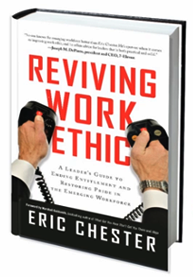

 Business Programs