Posts

5 Hotel-Ready Parking Management Companies (and How to Choose the Right Partner)

5 Hotel-Ready Parking Management Companies (and How to Choose the Right Partner) | Managing Your Business Article

Parking is now a profit center. U.S. hotels grew parking revenue 23.1 percent from 2019–2023 while posting 61.3 percent department margins—the highest of any on-property outlet. Yet only about one in five properties even reports that income, leaving millions in untapped profit.

Electric vehicles push the numbers higher. Roughly 38 percent of EV drivers have switched hotels just to access charging, and guests who plug in stay 12–20 percent longer.

In this guide, we rank six national parking operators—scoring their technology, scale, guest service, sustainability, and pricing flexibility—so you can pick the partner that maximizes revenue per available space.

How We Ranked Each Parking Partner

We built our scoring model before writing a single sentence. Interviews with hotel asset managers and parking consultants surfaced five factors that most influence net parking profit, and those became our pillars.

Technology carries the heaviest weight, 30 percent, because friction-free entry, AI pricing, and EV-charger integration now shape both revenue and guest reviews. According to FC Parking’s published technology overview, clients who roll out its cloud-based valet platform see revenue increases from the low teens up to around 30 percent and roughly a 14 percent lift in guest satisfaction scores after the system is live. That kind of measurable impact from digital tickets, text-based retrieval, and real-time labor data is what separates basic gateless systems from hotel-ready platforms, and it is the standard used when scoring each operator’s technology pillar.

Experience & scale follow at 25 percent; an operator must field trained teams in any market on short notice. Guest satisfaction counts for 20 percent, measured through public ratings, mystery-shop scores, and annual turnover. Sustainability & ESG earn 15 percent as brands ask for charger uptime and carbon data in their standards. Pricing flexibility rounds out the model at 10 percent, rewarding partners who share upside instead of locking owners into flat fees.

5 Hotel-Ready Parking Management Companies (and How to Choose the Right Partner)

Weighting Summary  

  • Technology – 30 percent  
  • Experience & scale – 25 percent  
  • Guest satisfaction & service – 20 percent  
  • Sustainability & ESG – 15 percent  
  • Pricing flexibility – 10 percent

We cut firms that manage fewer than 10 hotel properties, outsource all labor, or lack proprietary tech. This filter removed 27 regional outfits and left the six operators profiled next. Their scores drive the ranking, and the narrative highlights where each excels so you can match culture to P&L goals.

FC Parking: Turning the Curb Into a Concierge Moment

Seattle-based parking specialist FC Parking has operated since 1998 and now serves more than 150 properties nationwide, including hotels, hospitals, and mixed-use sites. Its valets train alongside front-desk teams, so the arrival feels like your brand, not an outsourced service.

Technology hums in the background. Guests request cars by text, attendants clock in on GPS-verified phones, and managers watch live labor and revenue dashboards built in-house, so custom reports arrive fast.

Coverage keeps growing. Regional hubs in Lisle, Illinois, and Costa Mesa, California, support coast-to-coast deployments without large-operator bureaucracy. The same platform tracks EV-charger uptime next to parking yield, turning sustainability data into extra profit.

Pricing stays owner aligned. Most hotels choose revenue sharing, but flat-fee and hybrid options exist, each backed by itemized statements that make budget reviews quick.

Bottom line: Boutique-level service and enterprise-grade data make FC Parking a smart first call when RevPAS tops your priority list.

SP+ / Metropolis: Old-School Scale Meets Computer Vision

SP+ spent seven decades refining parking logistics. In May 2024, AI-vision startup Metropolis closed a $1.8 billion take-private deal for the company, creating North America’s largest parking network with more than 4,000 locations and 20,000 employees.

Metropolis is now wiring lanes with cameras that read each license plate, start the parking clock, and feed live occupancy to a pricing engine. Dynamic rates climb when demand peaks and ease during lulls, a shift that third-party studies show can lift parking revenue 10–25 percent.

Service playbooks survived the merger. SP+ still uses Forbes-style arrival scripts, cross-training valets and bell staff while the vision layer removes friction: no paper tickets, no pay-on-foot kiosks, no late-night waits. Receipts arrive by text, so guests tap once and walk away.

Scale is the safety net. SP+ manages about 390 hotels plus hundreds of airport and mixed-use sites, allowing supervisors to redeploy overnight when occupancy jumps. National labor agreements translate into predictable wage rates, a quiet win at budget time.

If you want the reach of a long-standing operator plus the upside of dynamic pricing, SP+ / Metropolis deserves a top-tier spot on your RFP list. The upfront capital outlay is real, but data clarity and incremental yield often offset fees within the first fiscal year.

ACE Parking: Legacy Muscle With a Data-Driven Core

Family-run since 1950, San Diego-based ACE Parking now manages more than 500 locations in 30 U.S. markets and employs about 4,000 team members. That depth shows when a 1,200-room convention hotel needs 50 valets on three days’ notice—you get seasoned supervisors, not temp labor.

Modern tech powers the legacy footprint. The in-house DEEP BLUE analytics suite tracks every ticket scan, revenue pulse, and labor hour in near real time. A companion mobile-pay tool, spACE, lets guests reserve parking during room booking and skip the arrival queue, plugging leakage that paper tickets miss.

Service culture stays personal. Each hotel works with a dedicated regional manager who walks the ramp weekly, audits greeting scripts, and sends clear reports that keep the GM and asset manager aligned.

Sustainability is baked in. New garages feature solar canopies and Level-3 chargers reported through the same dashboard, so ESG data flows straight into brand templates without extra spreadsheets.

ACE Parking prefers revenue-share deals but offers flat-fee or hybrid structures on request, always itemizing labor, merchant fees, and insurance so budget surprises disappear. For owners who want generational stability plus real-time data, ACE delivers a reliable middle ground between boutique flair and venture-backed disruption.

LAZ Parking: Luxury Service at National Scale

LAZ has built its reputation in office towers, but its Hospitality Services arm now works with more than 300 hotels nationwide, including several Forbes Five-Star resorts. The result is a deep valet bench and a bell-staff playbook already tuned for high-touch travelers; managers cross-train parking, bell, and banquet teams so the hand-off from curb to check-in feels smooth.

Technology stays discreet. Every ticket swipe feeds LAZ Business Intelligence, which overlays parking revenue, shuttle metrics, and bell-cart usage on one screen. Integrations with Opera, SynXis, and other PMS platforms let front-desk agents see live valet queues without tab-switching, trimming group check-in times.

Sustainability is visible. LAZ runs one of the largest EV-charging portfolios in the sector and recently announced a partnership to install 50,000 Level 2 chargers across its network. Many garages already use solar canopies, and charger uptime flows straight into ESG dashboards that asset managers can plug into brand reports.

Service culture still drives the car. The LAZ Luxury Collection trains attendants on Forbes standards for greeting cadence, luggage etiquette, and courtesy scripting. Guest reviews routinely praise professionalism over price, a telling metric when nightly rates top four figures.

Pricing remains tailored. Urban boutiques often choose a flat management fee to protect ADR optics, while resorts favor revenue sharing to capture peak-season upside. National purchasing power keeps uniforms, cones, and insurance rates below those of smaller rivals.

If your flag depends on white-glove consistency and a partner fluent in both PMS and RevPAR, LAZ Parking delivers polished hospitality backed by enterprise data.

Parking Management Company: Tech Built by Parking People

Parking Management Company (PMC) is 100 percent employee owned and employs about 7,000 associates across 246 cities in 43 states. That structure keeps turnover well below industry norms, so returning guests see the same attendants trip after trip.

Technology is home grown. PMC Valet replaces paper tickets with QR codes and live retrieval timers, while PMC Pay adds tap-to-park capability to self-park lots with no extra hardware. Managers view one dashboard that blends labor cost, dwell time, and AI pricing prompts, then adjust rates with two taps, a win for hotels chasing incremental RevPAS.

Growth remains brisk. In April 2024 PMC bought Chattanooga-based Bird Dog Parking, adding 33 hotel locations and expanding coverage across the Southeast.

Service touches echo the tech. Branded umbrellas on rainy days, pet-water stations, and shuttle drivers who double as local concierges help PMC earn above-benchmark guest-satisfaction scores (internal client surveys shared in RFPs).

Pricing adapts to the flag. Full revenue share is common for upscale brands, while limited-service hotels often choose a base fee plus a bonus tied to mystery-shop scores. Either way, itemized monthly statements prevent budget-season surprises.

You get national reach with boutique agility and valets who think like owners, so PMC belongs on any shortlist.

Towne Park: RevPAS Fanatics With a Safety-First Mindset

Towne Park began as a single valet stand in Annapolis in 1988. Today it operates in more than 300 locations across 40 states, with a strong presence in the Mid-Atlantic and Sun Belt.

Revenue comes first. Managers track RevPAS (revenue per available space) every day and use the T-Park platform to adjust drive-up rates, launch promos, or convert stalls to monthly leases when group blocks fall off. Case studies show RevPAS lifts of 20–49 percent within the first contract year.

Safety is the cultural backbone. Every valet completes “Safety First” training on traffic flow, cone placement, and ADA access, and claim ratios run 30 percent below industry averages, according to internal audits shared with clients.

Technology stays pragmatic. T-Park lets guests scan a QR code, pay, and walk away, while supervisors receive live capacity alerts so overflow never surprises the front desk. Select-service flags without on-site valet can add shuttle loops and off-site self-park under the same dashboard.

Fee models adapt. Independent hotels often prefer a flat management fee for forecast clarity, while branded properties lean on revenue splits tied to RevPAS goals. Both structures come with transparent monthly scorecards, letting asset managers audit every line.

If your property sits inside Towne Park’s core footprint and you want a partner who treats each stall like its own P&L, this RevPAS-driven team delivers.

How the Top Players Stack Up

We converted each pillar into a three-tier scale—Strong, Solid, Emerging—using thresholds published in company reports or RFP disclosures. For example, Strong technology requires at least three proprietary tools in live hotel use, while Strong sustainability demands Level-2 or faster EV chargers at a minimum of 30 percent of hotel sites.
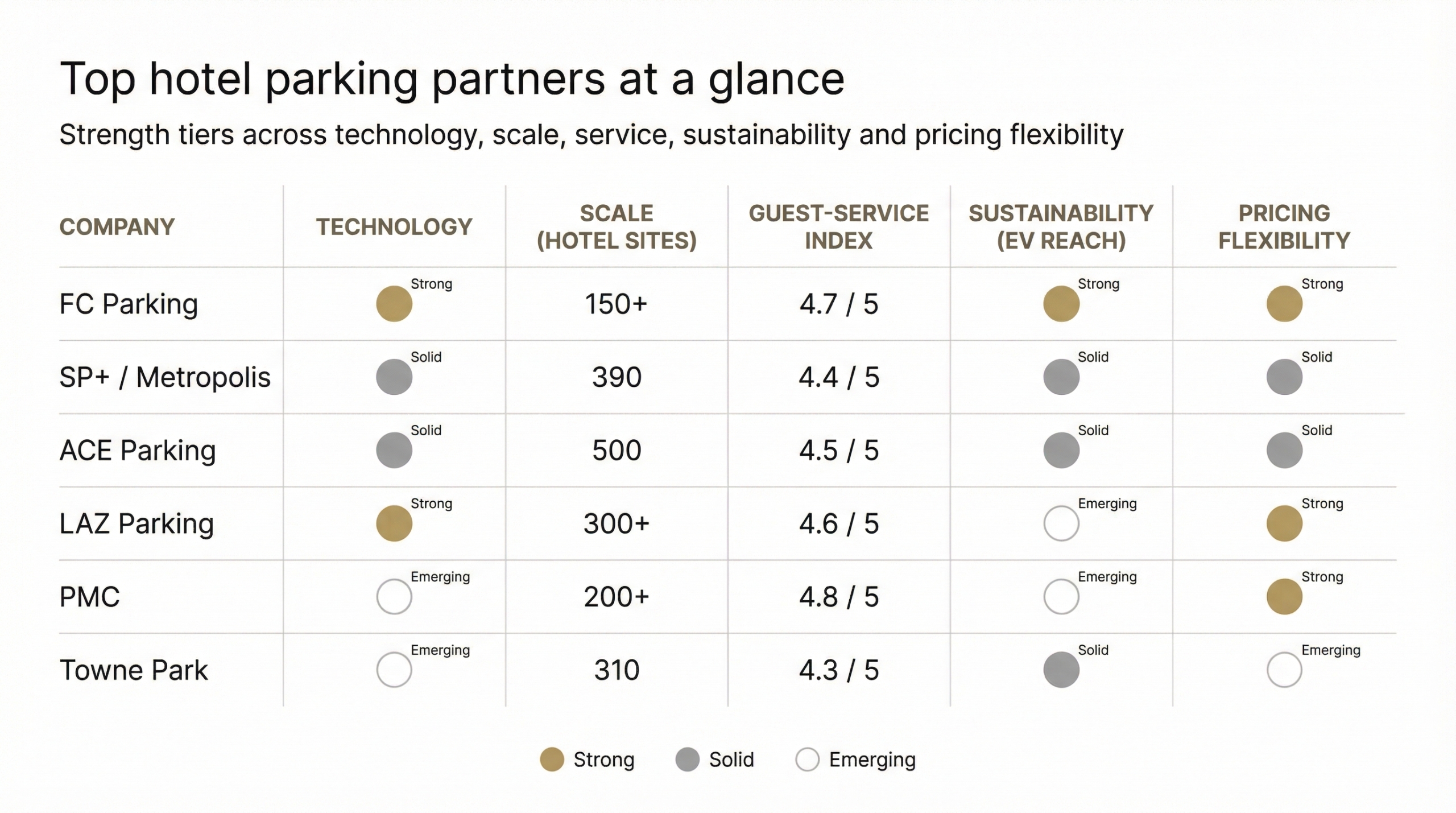
Company Technology* Scale (hotel sites) Guest-service index† Sustainability (EV reach) Pricing flexibility Key tech differentiator
FC Parking Strong 150+ 4.7 / 5 Emerging (12 %) Strong Text-in vehicle retrieval, GPS time-clocks
SP+ / Metropolis Strong 390 4.4 Solid (28 %) Solid Computer-vision LPR, AI pricing
ACE Parking Strong 500 4.5 Strong (34 %) Solid DEEP BLUE BI suite, spACE mobile pay
LAZ Parking Solid 300+ 4.6 Strong (40 %) Solid PMS-integrated BI dashboards
PMC Solid 200+ 4.8 Emerging (10 %) Solid PMC Valet ticketless system
Towne Park Solid 310 4.3 Emerging (14 %) Strong RevPAS dashboards inside T-Park

*Strong = three or more proprietary hotel-ready tools.

†Guest-service index aggregates Google, TripAdvisor, and Medallia scores.

Two insights stand out:

  • Only ACE, LAZ, and SP+ / Metropolis pair strong tech with strong sustainability, a must if your brand requires seamless EV charging.  
  • Even the largest operators now flex on deal structure, so link fees to RevPAS instead of defaulting to flat rent.

Keep this grid handy for your asset-management meeting; it turns a complex vendor debate into a one-page decision aid.

Honorable Mentions Worth a Look

  • All About Parking, Northern and Southern California: The San Francisco firm recently launched an EV-Charging Valet that rotates cars through limited plugs so every guest returns to a full battery, a smart fit for coastal resorts where charger demand exceeds supply. 
  • Valet Park of America, New England to Mid-Atlantic: Headquartered in Springfield, Massachusetts, the company is known for handwritten claim checks in wedding welcome bags and attendants who remember each guest’s football team, touches that keep review scores high.
  • AAA Parking, airport and convention corridors: Atlanta-based AAA has provided valet and self-park services for more than 65 years and now runs offices in Atlanta, Los Angeles, and South Florida, giving hotels near large airports a built-in shuttle partner.
  • Park ’N Fly, park-and-fly bundling: Best known for off-airport lots in 14 U.S. cities, Park ’N Fly can package overnight hotel valet with outbound shuttle seats, sending transient traffic to corridor hotels.

These players don’t have national footprints or deep proprietary tech, yet their local focus and specialty programs can outshine a larger operator in the right setting.

Conclusion

Choosing the right parking partner can unlock significant incremental revenue while elevating the guest experience. Use the ranking, scorecard, and honorable-mention insights above to match your property’s culture, financial goals, and sustainability requirements with the operator best equipped to deliver on all three.


The Surfaces That Speak First: How Doors and Walls Shape Commercial Spaces

The Surfaces That Speak First: How Doors and Walls Shape Commercial Spaces | StrategyDriven Article

When people approach a commercial building, they notice the surfaces before anything else. Doors, walls, and large access points set expectations right away. These elements affect how smoothly people move, how secure the space feels, and how well daily operations run. When surfaces stay in good shape, businesses avoid interruptions and protect their investments. When they fall behind, small issues turn into bigger problems.

Here are some practical maintenance, smart fixes, and thoughtful improvements that help commercial spaces function better:

Regular Door Inspections That Keep Operations Moving

Commercial doors see constant use, which makes routine checks essential. Hinges, rollers, tracks, and locking systems all need attention before they start failing. When teams inspect doors on a schedule, they catch alignment issues, worn parts, and loose hardware early. This prevents sudden breakdowns that delay staff, deliveries, or customers. Regular inspections also support security since damaged components weaken access control. Businesses that stay proactive spend less time reacting to emergencies and more time focusing on daily goals. These checkups do not take long, but they create consistency. Over time, inspections help doors last longer, operate smoothly, and support steady workflow across the entire space.

Upgrading High-Use Garage Entry Systems for Demanding Environments

Some entry points work harder than others, especially in warehouses, service centers, and retail storage areas. When older systems struggle to keep up, repeated fixes stop making sense. This is where commercial overhead garage door installation becomes part of a smarter long-term plan. Modern systems, such as insulated sectional doors and rolling steel options, support frequent use and varying load requirements. These solutions come in multiple configurations to match traffic levels, security needs, and climate conditions. Businesses benefit from smoother operation, better temperature control, and stronger materials built for heavy cycles. Upgraded systems also reduce downtime and help teams move inventory efficiently throughout the day.

Maintaining Wall Surfaces to Protect Appearance and Function

Walls take more abuse than most people realize. High-traffic areas collect scuffs, cracks, and surface damage that slowly affect both appearance and durability. Routine wall maintenance includes patching small imperfections, repainting worn sections, and sealing exposed areas. This care helps businesses present a clean, organized environment to visitors and staff. Well-kept walls also protect underlying materials from moisture and impact stress. When businesses stay ahead of surface wear, they avoid larger structural issues later. Maintenance supports long-term use while keeping spaces visually consistent. Over time, this approach saves money and prevents frequent disruptions caused by avoidable surface deterioration.

Addressing Impact Damage in Loading and Service Zones

Loading docks and service corridors face constant contact from carts, equipment, and vehicles. Walls and door frames in these areas often show dents, cracks, and stress marks first. Prompt attention to impact damage helps maintain safe movement paths and prevents materials from weakening further. When businesses repair these areas quickly, they reduce the risk of accidents and equipment damage. Reinforced panels, corner guards, and surface patching all play a role in keeping these zones functional. Consistent attention also supports smoother deliveries and fewer delays. By treating impact-prone areas as priorities, businesses keep operations flowing without unnecessary interruptions.

Improving Insulation to Control Interior Conditions

Insulation plays a major role in how commercial spaces perform throughout the year. Walls and doors without proper insulation allow temperature swings that affect staff focus and stored materials. Improving insulation helps regulate interior conditions and supports consistent performance. Businesses that invest in better insulation often notice steadier indoor environments and lower strain on heating and cooling systems. This improvement also reduces noise transfer between work zones. Over time, insulation upgrades protect surfaces from condensation and moisture buildup. When insulation supports both walls and entry systems, businesses gain better control over daily conditions without relying on constant adjustments.

Maintaining Fire-Rated Walls and Doors for Safer Spaces

Fire-rated walls and doors require regular checks to stay effective. Seals, closures, and surface integrity all matter when these systems serve their purpose. Businesses should inspect fire-rated components to confirm they close properly and show no gaps or damage. Maintaining these systems supports compliance and protects occupants during emergencies. It also reduces liability concerns that arise when safety features fail inspections. Routine attention keeps these elements ready without disrupting daily activity. When businesses treat fire-rated surfaces as ongoing priorities, they create safer environments while avoiding last-minute fixes that often cost more and cause stress.

Managing Noise Through Targeted Wall Treatments

Noise control often gets overlooked in commercial spaces, yet it affects productivity and communication. Walls without proper sound control allow noise to travel between offices, work zones, and customer areas. Adding sound-dampening panels or upgrading wall materials helps reduce distractions. Businesses that address noise concerns often see better focus and clearer conversations. These improvements also support privacy in meeting rooms and service counters. Managing sound does not require major reconstruction. Targeted treatments offer practical solutions that fit existing layouts. Over time, improved acoustics create calmer environments that support steady work without constant interruptions.

Preventing Moisture Damage at Entry Points and Walls

Moisture poses a serious risk to walls and door frames, especially near exterior entry points. Small gaps, cracks, or failing seals allow water to enter and cause gradual damage. Businesses should monitor these areas and reseal joints as needed. Preventing moisture intrusion protects interior finishes and reduces mold risk. It also preserves structural materials that weaken when exposed to water over time. Regular checks after seasonal weather changes help catch problems early. By keeping surfaces dry and sealed, businesses protect their spaces from hidden damage that often leads to expensive corrections later.

Using Protective Coatings to Extend Surface Life

Protective coatings add an extra layer of defense for walls and doors in busy commercial settings. These coatings resist scratches, stains, and wear from constant contact. Businesses that apply protective finishes reduce the frequency of surface touch-ups and repainting. Coatings also make cleaning easier, which supports consistent upkeep without extra effort. Over time, this approach extends the life of surfaces and keeps them looking professional. Choosing the right coating depends on traffic levels and exposure conditions. When applied correctly, protective finishes support durability while helping spaces maintain a polished appearance.

Doors and walls do more than define boundaries in commercial spaces. They support movement, safety, and daily efficiency. When businesses maintain, repair, and improve these surfaces with intention, they protect both function and long-term value. Each area discussed plays a role in keeping operations steady and environments professional. Thoughtful attention today prevents larger issues tomorrow. By focusing on practical care and informed decisions, businesses create spaces that work reliably, adapt to demands, and support growth without constant disruption.

How Ceramic Coatings Help Preserve Vehicle Appearance Long-Term

How Ceramic Coatings Help Preserve Vehicle Appearance Long-Term | StrategyDriven Managing Your Business Article

Maintaining a vehicle’s appearance over time can be a challenge, as exposure to sunlight, road debris, and environmental contaminants gradually wears down paint and finishes. Traditional waxing and regular washing provide some protection, but they often require frequent reapplication and may not prevent microscopic damage that accumulates over time. For car owners looking to extend the lifespan of their vehicle’s exterior, more advanced protective measures have become increasingly popular.

One such solution is ceramic coating, which forms a durable, transparent layer over the paint to resist scratches, oxidation, and other forms of damage. For those considering professional services, options such as ceramic coating for cars in Maple Shade, NJ, offer long-lasting protection that reduces maintenance while preserving the vehicle’s original shine. By creating a barrier against environmental stressors, ceramic coatings help vehicles maintain a polished and well-cared-for look for years.

Understanding Ceramic Coatings

Ceramic coatings consist of advanced liquid polymers, carefully applied to your car’s paintwork by detailers or skilled DIYers. Once cured, these coatings create a physical and chemical bond with the paint, forming a semi-permanent barrier. Unlike waxes or sealants that degrade with washing and weather, ceramic coatings maintain their protective strength for years with minimal reapplication needed.

At a microscopic level, this hard, glass-like layer smooths out imperfections in the paint, making particle adhesion more difficult and creating the signature sleek, glossy look. The science behind these coatings not only preserves aesthetics but also actively defends against environmental hazards.

Protection Against Environmental Contaminants

Every day, threats to your vehicle, such as dust, salt, tree resin, bird droppings, and road debris, may seem minor—but over time, they can cause stains, corrosion, and irreversible paint damage. Ceramic coatings create a sacrificial barrier that resists penetration by these contaminants, making them much easier to clean away before they have a chance to mar your car’s finish.

This shield is particularly valuable during seasonal changes, when falling leaves, increased rainfall, and road chemicals accelerate deterioration. For vehicle owners seeking reliable solutions, searching for “automotive ceramic coating near me” can connect them with local providers who apply these protective layers, helping cars maintain their original luster while reducing the frequency of washes and upkeep.

UV Ray Defense

Sunlight and intense ultraviolet rays pose continuous threats to a car’s exterior. Prolonged exposure can lead to paint fading, oxidation, and a dull appearance. Ceramic coatings include UV inhibitors that deflect these rays, providing a barrier that protects the paint underneath. Regular UV protection is crucial for maintaining a vehicle’s new-like appearance over time, particularly in sunny environments or for cars parked outside.

Hydrophobic Properties for Easier Maintenance

One of the most celebrated benefits of ceramic coatings is their strong hydrophobic effect—meaning they repel water and prevent residue buildup. Rain and rinse water bead up and roll right off, taking dirt, dust, and debris with them. As a result, cars treated with ceramic coatings stay cleaner and are far easier to wash, significantly reducing time spent on scrubbing and detailing. For owners who value convenience and longevity, this property alone transforms car care routines.

Enhanced Scratch Resistance

While ceramic coatings can’t prevent all types of damage, they do add a noticeable layer of hardness to your car’s clear coat. This helps defend against everyday micro-abrasions, swirl marks from improper washing, and incidental scratches in parking lots. It’s an extra layer of protection, not a force field—larger impacts or sharp objects can still cause damage, but routine wear and tear is significantly reduced. This enhanced level of protection makes ceramic coatings a smart first line of defense.

Longevity and Cost-Effectiveness

The investment in ceramic coatings pays dividends over time. With proper professional application, a ceramic coating can last several years—far outpacing waxes that may last only weeks or months. This durability means less frequent reapplications, saving money on both supplies and labor. More importantly, a preserved and protected finish translates directly to better resale value; a cleaner, glossier car commands a higher price on the used market, ensuring your upfront investment yields long-term returns.

Professional Application and Maintenance

To extract the maximum benefit from ceramic coatings, proper application is key. Most vehicle owners trust certified detailing professionals, who have the training and equipment to deliver even coverage and optimal curing conditions. Following installation, gentle maintenance is recommended. This includes foam washing every one to two weeks with pH-neutral shampoo, using soft cloths or mitts to avoid abrasion, and periodic inspections to spot any touch-up needs. A regular, hands-off approach preserves the hydrophobic and UV-resistant effects for as long as possible.

Conclusion

Ceramic coatings have revolutionized the landscape of automotive preservation, giving car owners newfound confidence in their paint protection and long-term appearance. By blocking contaminants, repelling water, deflecting harsh sunlight, and enhancing scratch resistance, they offer a forward-thinking investment for anyone who values convenience, aesthetics, and the long-term value of their vehicle. With proper professional service and maintenance, ceramic coatings ensure your car’s original brilliance endures against the test of time and environment.

5 Key Systems Every Growing Water Bottling Facility Needs

5 Key Systems Every Growing Water Bottling Facility Needs | StrategyDriven Article

Growth in a water bottling facility is not just about producing more bottles. It changes how water is treated, how lines are managed, how quality is maintained, and how downtime is controlled. As demand rises, small inefficiencies multiply into major losses.

Equipment that once handled volume comfortably may begin to fail under pressure. Manual processes slow output and increase risk. Facilities that grow successfully do not rely on speed alone. They rely on strong systems that scale with demand. These systems must work together to ensure consistency, safety, and efficiency across the entire operation.

Below are five essential systems that every growing water bottling facility must strengthen to support long-term, sustainable production.

1. Water Treatment and Filtration Infrastructure

Water treatment is the foundation of any bottling operation. As production volume increases, treatment systems must process higher flow rates without compromising water quality. A system designed for lower capacity may fail to remove contaminants consistently when demand rises.

Effective treatment infrastructure includes multiple filtration stages, such as sediment filtration, carbon filtration, and purification methods like reverse osmosis or UV treatment. Each stage must be sized correctly to match production output. If filtration capacity lags behind filling speed, water quality becomes inconsistent, creating compliance risks.

Monitoring is equally important. Growing facilities require real-time tracking of water parameters such as turbidity, mineral content, and microbial levels. Automated monitoring reduces reliance on manual checks and allows early detection of issues. Redundancy also becomes critical. Backup filters and parallel treatment lines prevent shutdowns during maintenance or unexpected faults.

Without scalable treatment systems, downstream equipment suffers. Fillers clog faster. Cleaning cycles increase. Product consistency drops. Strong treatment infrastructure protects both product quality and equipment lifespan as production scales.

2. Bottling and Filling Operations

Filling operations define production efficiency. As output grows, manual or semi-automatic filling quickly becomes a bottleneck. Inconsistent fill volumes, slow cycle times, and frequent stoppages disrupt line balance and increase waste.

Automated filling systems address these issues by maintaining precise fill levels at higher speeds. Sensors control volume accuracy, while enclosed filling environments reduce contamination risks. As facilities scale, filling systems must integrate smoothly with upstream treatment and downstream packaging.

Evaluating equipment such as a drinking water filling machine becomes essential during expansion. Manufacturers like Sunswell are often assessed for integrated filling solutions that support hygienic design, consistent throughput, and reduced manual handling. The goal is not maximum speed, but a stable output that aligns with treatment capacity and packaging flow.

Maintenance access also matters. Fillers operating at higher speeds experience greater mechanical stress. Systems must allow easy cleaning, quick part replacement, and predictable servicing schedules. Without this, downtime increases sharply as volume grows.

3. Packaging and Sealing Workflow

Packaging systems must scale alongside filling operations. As output increases, any mismatch between filling speed and packaging capacity creates congestion. Bottles may accumulate, seals may fail, or labels may misalign under pressure.

Effective packaging systems focus on accuracy and repeatability. Sealing mechanisms must apply consistent pressure to prevent leaks without damaging containers. Labeling systems must maintain placement accuracy even at higher speeds to ensure traceability and compliance.

Material handling is another critical factor. Conveyors, accumulators, and transfer points must be designed to handle increased volume smoothly. Poor handling causes jams, scuffing, and breakage, all of which slow production and increase waste.

As facilities grow, packaging workflows must remain flexible. Changes in bottle size, cap type, or label design should not require extensive downtime. Modular packaging systems allow facilities to adapt without disrupting overall production, supporting both efficiency and future expansion.

4. Quality Control and Compliance Monitoring

Higher output increases quality risk. A single deviation can affect thousands of bottles instead of hundreds. Manual inspection methods that once worked become unreliable at scale.

Growing facilities need layered quality control systems. In-line inspection detects fill level errors, cap defects, and seal failures in real time. Automated sampling systems monitor water quality continuously rather than intermittently. Data logging ensures traceability across batches.

Compliance documentation also becomes more complex as volume grows. Facilities must maintain accurate records for audits, recalls, and regulatory reporting. Digital quality management systems reduce errors and improve response time during inspections.

Proactive monitoring prevents costly recalls. Early detection allows corrective action before large volumes are affected. Quality systems must evolve from reactive checks to predictive control as production scales.

5. Production Planning and Maintenance Management

Downtime is one of the most expensive risks in a growing bottling facility. Unplanned maintenance disrupts schedules, delays deliveries, and increases labor costs.

Effective planning systems focus on preventive maintenance rather than reactive repair. Equipment service intervals are tracked based on usage rather than time alone. Critical spare parts are stocked to avoid extended shutdowns. Maintenance tasks are scheduled during planned downtime instead of peak production.

Production planning also plays a role. Output targets must align with equipment capacity, staffing levels, and maintenance cycles. Overloading systems to meet demand often leads to breakdowns that erase short-term gains.

Facilities that plan proactively experience fewer disruptions. Equipment lasts longer. Output remains stable. Growth becomes predictable rather than chaotic.

Conclusion

Growth in water bottling is driven by systems, not shortcuts. Treatment, filling, packaging, quality control, and maintenance must scale together to support higher output without sacrificing reliability. Each system reinforces the others. Weakness in one creates pressure across the entire operation.

Facilities that invest in system-level improvements early gain long-term stability. They reduce downtime, protect quality, and maintain control as demand rises. Sustainable growth comes from planning, integration, and disciplined execution—not speed alone.

Get Back to Business: How to Offload Complex IT to the Experts

Get Back to Business: How to Offload Complex IT to the Experts | StrategyDriven Managing Your Business Article

Does this sound familiar? You’re trying to finalize a critical business proposal, but you’re interrupted by an employee whose email isn’t working. Later, you’re pulled away from a strategic planning session to troubleshoot a network connection issue. For many small business owners and managers, being the default IT support person is a frustrating and time-consuming reality.

This isn’t just an annoyance; it’s a direct threat to your business. Every hour you spend on technology problems is an hour not spent on sales, customer service, or innovation. More importantly, makeshift IT solutions often leave dangerous security gaps. According to Accenture, an estimated 43% of cyberattacks are aimed at small businesses, but just 14% feel prepared to defend themselves.

The solution isn’t to work harder at managing your technology. It’s to strategically offload that complexity to a team of experts, freeing you to focus on what you do best: running and growing your business.

Key Takeaways

  • Recurring IT problems, unpredictable tech costs, and nagging security anxieties are clear signs that your current IT approach is hindering business growth.
  • Partnering with a Hartford managed expert provides predictable budgeting, enterprise-level cybersecurity, and proactive support that prevents issues before they disrupt your operations.
  • Offloading IT tasks frees up you and your team to focus on strategic initiatives, customer service, and revenue-generating activities.
  • The right IT partner acts as a strategic advisor, speaking in plain English and aligning technology directly with your specific business goals.

Is Your In-House IT Holding Your Business Back? 5 Telltale Signs

If you’re on the fence about your current IT situation, these common pain points often signal that it’s time for a change. Recognizing them is the first step toward reclaiming your focus and protecting your bottom line.

1. Unpredictable and Rising IT Costs: Your technology budget feels more like a guessing game. One month is quiet, but the next brings a massive, unexpected invoice for an emergency server repair or software license renewal. This reactive, break-fix model makes financial planning nearly impossible and often costs more in the long run than a proactive approach.

2. Your Team is Wasting Valuable Time: Think about the cumulative hours your staff loses each week to slow computers, printer malfunctions, or software glitches. This “shadow IT” work pulls them away from their core responsibilities, drains morale, and creates a significant drag on overall productivity.

3. Nagging Cybersecurity Worries: You hear about threats like ransomware and data breaches in the news and wonder if your business is adequately protected. Without a dedicated security expert, it’s difficult to know if your backups are reliable, your firewalls are configured correctly, or your employees are trained to spot phishing attempts. This constant uncertainty is a heavy burden for any business leader.

4. You Lack a Strategic IT Roadmap: Your technology decisions are driven by what’s broken, not by what will help your business succeed. You’re replacing hardware when it fails and buying software to solve immediate problems, but there’s no long-term vision for how technology can improve efficiency, enhance customer service, or create a competitive advantage.

5. You’re Drowning in Technical Jargon: You find yourself acting as the middleman between different vendors—your internet provider, your software supplier, your phone system company—trying to translate technical language you don’t fully understand. It’s an exhausting and inefficient way to manage a critical business function.

These recurring distractions don’t just hurt morale; they pull focus from strategic work and directly impact the bottom line. Moving beyond the strain of these technical complexities requires transforming reactive maintenance into a guaranteed outcome. This transformation is driven by deploying comprehensive IT support in Hartford that moves beyond reactive troubleshooting, delivering 24/7 proactive monitoring, continuous infrastructure optimization, and expert strategic guidance to safeguard business continuity and drive measurable operational efficiency.

The Strategic Advantage: 3 Core Benefits of Outsourcing Your IT

Offloading your technology management isn’t just about fixing problems. It’s about transforming IT from a source of frustration into a strategic asset that fuels growth. Here are the three core advantages you gain.

Predictable Costs and a Healthier Bottom Line

The most immediate benefit of partnering with a managed IT provider is the shift from a chaotic, variable spending model to a predictable one. Instead of paying for emergency repairs as they happen, you pay a flat monthly fee for comprehensive support. This all-inclusive model covers everything from routine maintenance and helpdesk support to strategic consulting.

This predictability makes budgeting simple and eliminates the shock of surprise invoices. Furthermore, because a managed provider’s business model is built on keeping your systems running smoothly, they are incentivized to prevent problems. Proactive maintenance, security patching, and system monitoring significantly reduce the risk of costly downtime that can bring your business to a halt.

Gain Enterprise-Grade Cybersecurity

For a small business, building an internal cybersecurity defense that can stand up to modern threats is incredibly difficult and expensive. When you partner with a managed IT expert, you instantly gain access to a dedicated team of security professionals and a suite of advanced tools that are typically out of reach for SMBs.

This includes 24/7 network monitoring, advanced firewall management, proactive software patching, and employee security awareness training. This multi-layered approach not only protects your sensitive business and client data but also helps you meet industry and regulatory compliance requirements. It secures your operations and safeguards the reputation you’ve worked so hard to build.

Reclaim Your Focus and Boost Productivity

This is the ultimate goal. When your technology works seamlessly, your team can perform their jobs without frustrating interruptions. Slow computers, network outages, and software bugs are no longer a daily drag on efficiency. Productivity naturally rises when the tools people rely on are reliable.

More importantly, outsourcing frees you and your key personnel from the role of accidental IT managers. You can fully dedicate your time and energy to strategic initiatives, client relationships, and revenue-generating activities. A true IT partner helps you leverage technology to achieve your goals, turning it into a catalyst for growth. As research from the U.S. Chamber of Commerce shows, businesses that adopt more technology are substantially more likely to have grown, reinforcing the need for that technology to be expertly managed.

Conclusion: Stop Managing IT and Start Growing Your Business

Managing complex technology in-house is a constant drain on your most valuable resources: time, focus, and energy. Every moment spent dealing with a technical glitch is a moment stolen from activities that actually grow your Hartford business. It’s an unsustainable model that limits your potential and exposes you to unnecessary risks.

By strategically offloading this complexity to a dedicated team of experts, you do more than just solve IT problems. You simplify your operations, secure your assets, and unlock your team’s full productive potential. You transform technology from a frustrating liability into a powerful strategic asset. It’s time to get back to business.