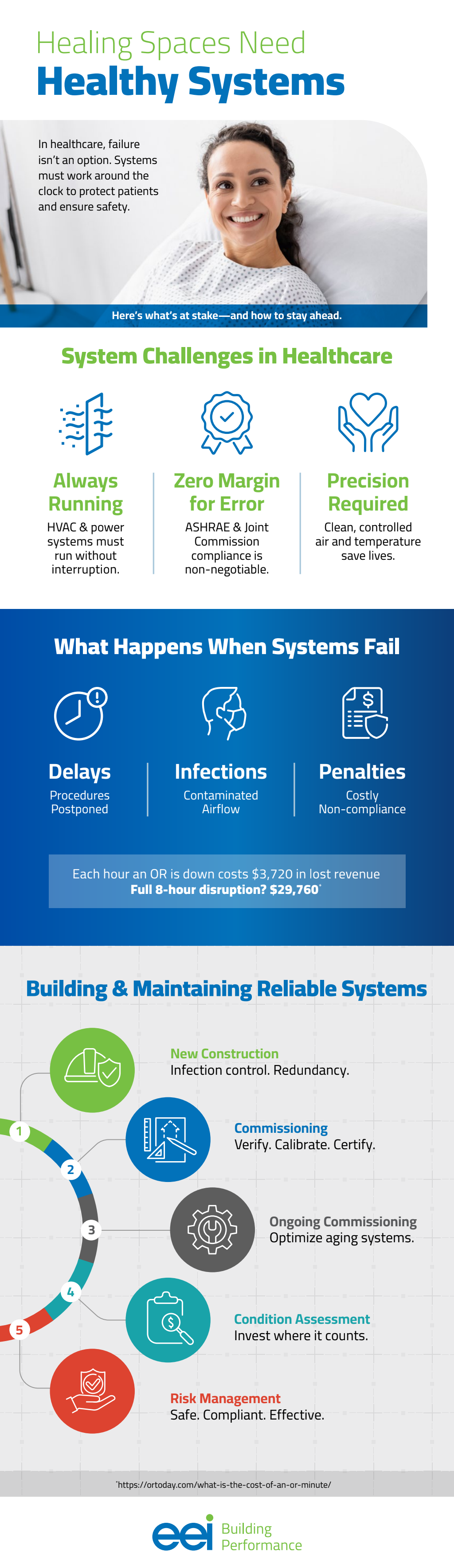
Healthcare facilities are built to support healing, deliver precise care, and protect the safety of both patients and staff. Behind every well-functioning hospital or clinic, however, is a complex network of infrastructure systems that make this care possible. HVAC, electrical systems, pressure controls, and filtration all play a foundational role in maintaining quality care. When any of these systems underperform or fail, the effects are felt immediately and throughout the organization.
Downtime in a healthcare setting is more than a minor disruption. It directly affects patient outcomes, staff safety, and operational stability. Hospital infrastructure operates under some of the most demanding conditions found in any commercial environment. Around-the-clock occupancy, highly sensitive medical equipment, strict air quality requirements, and constantly changing usage levels place significant strain on HVAC and power systems. Unlike many other buildings, healthcare facilities have little tolerance for variation. Small changes in temperature, humidity, or ventilation can influence recovery, raise infection risks, or delay critical procedures.
Building Resilience Through Design and Monitoring
Reliable infrastructure begins with thoughtful, proactive planning. Long before a facility opens, design decisions such as mechanical zoning, built-in redundancy, filtration strength, and space pressurization shape how resilient systems will be over time. These features must be customized to the function of each area. Operating rooms, isolation spaces, laboratories, and waiting areas all require different environmental conditions to support safe and effective care.
What happens after construction is just as important. Continuous commissioning, system monitoring, and responsive maintenance help ensure infrastructure performs as intended throughout its lifespan. Healthcare environments change rapidly as facilities expand, new equipment is introduced, and clinical workflows evolve. Infrastructure must be flexible enough to adjust to these changes. Investments in diagnostics, building analytics, and performance-based service agreements help keep systems aligned with care delivery needs.
Collaboration across teams is also essential. Facility managers, engineers, infection prevention specialists, and clinical staff each bring valuable perspectives that help ensure systems function effectively in real-world conditions, not just on paper. How systems are operated and maintained is just as critical as how they are designed.
The objective is an environment that supports clinical work rather than complicating it. When infrastructure performs reliably, healthcare professionals are free to focus on patient care. When systems fail, even briefly, attention shifts toward managing disruptions instead of delivering treatment. For this reason, infrastructure should not be viewed as a background expense, but as a strategic investment that protects the core mission of healing.
To dive deeper into how environmental systems underpin patient care, see the accompanying visual guide on healthcare infrastructure performance from Engineering Economics, a decarbonization consulting service.
https://www.strategydriven.com/wp-content/uploads/IMG_1329.jpeg10001500StrategyDriven - Sponsored Contenthttps://www.strategydriven.com/wp-content/uploads/SDELogo5-300x70-300x70.pngStrategyDriven - Sponsored Content2026-01-29 11:58:162026-01-29 11:58:16Healing Spaces Need Healthy Systems: Why Infrastructure Reliability Is Critical in Healthcare
Cleanliness in restaurants is often judged by what guests can see at a glance. Shiny floors, wiped counters, and stocked restrooms create the impression of care. But real sanitation goes much deeper than surface appearance. When underlying hygiene practices are overlooked, small issues can quietly develop into serious risks that affect customer health, employee safety, and a restaurant’s reputation.
Every food service operation faces ongoing cleaning challenges. What separates successful restaurants from those that struggle is how consistently those challenges are addressed. Minor warning signs, such as sticky floors or empty soap dispensers, may seem insignificant on their own. In reality, they often point to lapses in cleaning routines or accountability. When these early indicators are ignored, they create opportunities for more serious sanitation problems to take hold.
When Small Issues Grow
Problems like lingering drain odors, grease buildup in kitchen areas, or mold forming in grout are signals that deeper cleaning needs are being missed. These conditions affect more than aesthetics. They can compromise air quality, increase slip hazards, and create environments where bacteria thrive. As time passes, addressing these issues becomes more complex and more costly.
Customers may not always be able to identify the source of the problem, but they notice when a space feels unclean or poorly maintained. Staff members feel it too, as working conditions become less safe and less efficient.
Escalating Risks to the Business
Major sanitation failures rarely happen without warning. Pest infestations, food contamination, or health code violations typically result from patterns of neglect that build over time. These situations can force temporary closures, trigger inspections, and damage relationships with both customers and regulators.
The financial consequences are significant, but the long-term reputational impact can be even harder to overcome. A single negative review or photo shared online can influence countless potential customers. Rebuilding trust after such incidents often takes far more effort than maintaining proper sanitation from the start.
Preventing Problems Before They Surface
Preventative cleaning strategies are one of the most effective ways to reduce risk. Regular professional cleaning and disinfection help address areas that daily routines may miss. This includes deep cleaning restrooms and kitchens, maintaining drains to reduce odor and bacterial growth, and disinfecting high-touch surfaces with commercial-grade solutions.
Partnering with experienced commercial cleaning services adds consistency and expertise, helping restaurants stay ahead of problems rather than reacting to them.
In an industry where customer confidence plays a critical role in success, cleanliness is not just a compliance requirement. It is a foundation of trust. Restaurants that invest in thorough, proactive hygiene practices create safer environments, protect their reputation, and give customers a reason to return with confidence.
Explore the full breakdown of how minor sanitation lapses can evolve into serious hazards in the resource below from Enviro-Master, a gym cleaning service.
https://www.strategydriven.com/wp-content/uploads/IMG_1326.jpeg10001500StrategyDriven - Sponsored Contenthttps://www.strategydriven.com/wp-content/uploads/SDELogo5-300x70-300x70.pngStrategyDriven - Sponsored Content2026-01-29 11:34:132026-01-29 11:34:13The True Impact of Neglected Cleanliness in Restaurants
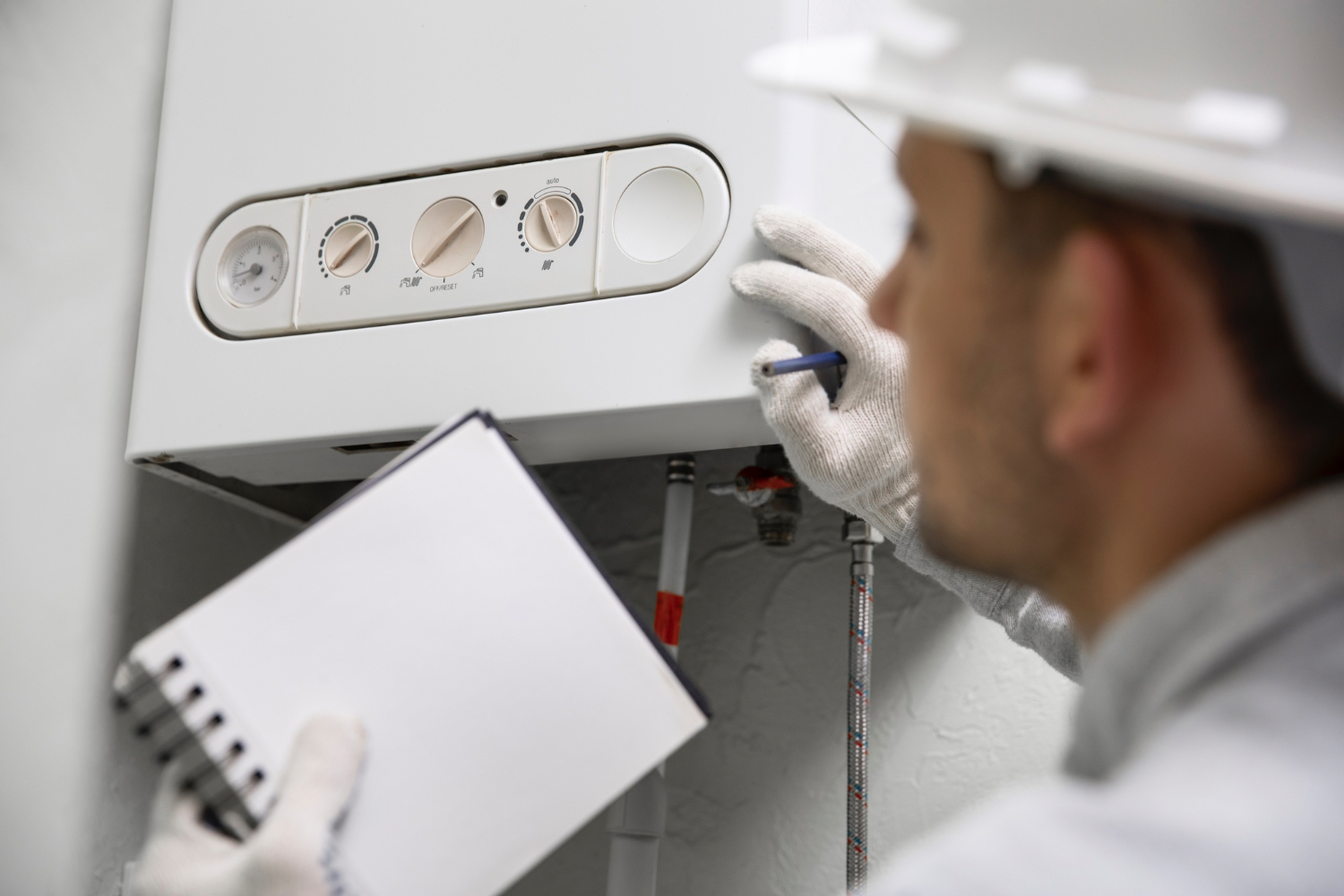
Heating systems don’t fail in isolation, they operate inside buildings that either help them work efficiently or quietly sabotage their performance. Many heating repair calls trace back to problems that aren’t mechanical at all, but structural. Inadequate insulation is one of the most common hidden causes behind comfort complaints, rising energy bills, and repeated system failures. Insulation determines how hard a heating system has to work, how long it lasts, and whether comfort is even achievable. That’s why insulation and heating systems should always be planned together, not treated as separate decisions.
How Does Insulation Affect Heat Transfer
Insulation slows heat transfer by resisting the natural movement of heat from warm areas to cold ones. In winter, heat is constantly trying to escape a building through walls, ceilings, floors, and framing. Insulation works like a thermal brake, it doesn’t stop heat loss entirely, but it dramatically reduces how fast it happens.
Without enough insulation, heat moves freely through building materials, increasing overall building heat loss and forcing the heating system to replace that lost energy over and over again. Every building is constantly losing heat, but insulation sets the speed limit on that loss. Without it, indoor warmth drains so fast that no heating system can ever “catch up.” With proper insulation, the heat you pay for stays inside longer, temperatures stay more stable, and the building needs far less mechanical heating to remain comfortable.
Most people think insulation creates warmth. It doesn’t. It controls how quickly comfort leaks out. That difference, maintaining vs chasing temperature, is what separates comfortable buildings from expensive, frustrating ones and directly shapes heat loss in buildings, as well as how often systems need furnace maintenance to keep up.
Heat Loss in Buildings and the Role of Inadequate Insulation
The biggest heat loss in buildings typically happens at attics and roofs, exterior walls, floors over unheated spaces, ductwork running through unconditioned areas, and air leaks around penetrations and framing. Inadequate insulation turns these areas into escape routes.
Warm air rises, so poorly insulated attics are especially costly, heat pours out at the top of the building. Thin or poorly installed wall insulation allows cold surfaces to pull heat from indoor air, creating drafts and cold spots even when the thermostat says everything’s fine. Heat loss in buildings doesn’t happen evenly; it concentrates at the building’s weakest points.
Anywhere insulation is thin, compressed, missing, or interrupted becomes a thermal exit ramp. Building heat loss funnels toward those spots because physics always chooses the path of least resistance. That’s why homeowners feel cold ceilings before cold floors, drafty rooms far from the furnace, or one room that never feels right. It’s not random discomfort, it’s predictable heat flow driven by inadequate insulation.
The Impact of Insulation on Heating Costs
The impact of insulation on heating costs shows up in two ways: immediately and permanently. Right away, better insulation lowers the amount of energy needed to maintain indoor temperatures. Over time, it also protects your budget by reducing how often heating equipment has to cycle on and off. That means less fuel consumption, lower utility bills every month, and slower wear on expensive system components.
Heating costs don’t rise because systems get worse, they rise because buildings leak energy every hour they’re occupied. Inadequate insulation increases baseline building heat loss, forcing systems to run longer and harder than necessary. Improving insulation permanently reduces heat loss in buildings, leading to fewer heating cycles, less fuel burned each season, and slower wear on equipment.
Unlike mechanical equipment, insulation doesn’t break down quickly or become obsolete. Once it’s properly installed, it keeps paying for itself year after year, often for the life of the building. Mechanical systems depreciate. Insulation doesn’t. That’s why insulation upgrades often outlast multiple heating system replacements while continuing to reduce the long-term impact of insulation on heating costs.
Why Inadequate Insulation Weakens Heating System Performance
A heating system is designed to maintain temperature, not constantly fight massive heat loss in buildings. When insulation is poor, the system is forced into damage-control mode, running longer, cycling more frequently, and struggling to keep up during cold weather. A heating system can only replace heat at a fixed rate, and inadequate insulation can lose heat faster than the system can supply it.
Even the most advanced, high-efficiency heating system can’t perform well if the building shell is leaking heat faster than the system can replace it. When that happens, the system isn’t “underpowered”, it’s being asked to do the impossible. It runs longer, cycles harder, and still fails to deliver comfort, leading to uneven temperatures, higher energy use, more frequent breakdowns, and a shorter equipment lifespan.
This is why furnace replacement without addressing inadequate insulation often feels disappointing: the problem wasn’t the equipment, it was the building heat loss it was fighting against.
Why Heating Duct Insulation Matters for Efficiency and Comfort
Uninsulated or poorly insulated ducts lose heat before warm air ever reaches the living space, especially when they run through attics, crawlspaces, or garages. Without proper heating duct insulation, ducts act like radiators in the wrong place, releasing heat into those spaces. By the time warm air reaches the room, it’s already cooled, increasing overall heat loss in buildings.
Ducts are often treated as neutral pathways. They’re not. Poor heating duct insulation directly contributes to uneven room temperatures and higher energy use, even when airflow is strong.
Proper heating duct insulation reduces building heat loss, improves overall system efficiency, and delivers warmer air more consistently with fewer temperature swings between rooms, while also helping prevent condensation issues. In short, heating duct insulation ensures the heat you generate actually reaches the people you’re trying to keep comfortable, at the temperature it was designed to deliver.
Insulation First When Choosing the Best Heating System for New Construction
Choosing the best heating system for new construction starts with insulation, because insulation determines how much heating power the building actually needs. If insulation is poor, designers often compensate by installing larger, more expensive systems. Bigger equipment masks heat loss temporarily, but increases upfront costs, operating costs, and long-term maintenance, all while still delivering inconsistent comfort.
When insulation is addressed first, the building requires less heat overall. That allows for smaller, more efficient systems that run smoothly, last longer, and cost less to operate from day one. The best heating system for new construction isn’t the biggest one, it’s the one sized for a building with controlled heat loss.
It’s easier to build a quiet, efficient system when the building itself isn’t fighting against it. That’s what separates a properly designed system from one that struggles from day one.
How Insulation Levels Affect Building Heat Loss and System Size
Higher insulation levels directly reduce building heat loss, which lowers the heating load of the building. Lower heating loads allow for smaller furnaces or heat pumps, reduced duct sizes, lower installation costs, and more precise temperature control.
Insulation doesn’t just reduce heat loss in buildings, it reshapes the load curve. Better insulation flattens temperature swings, reducing peak demand during the coldest hours. That allows for smaller systems that run longer, steadier cycles instead of short, wasteful bursts.
Oversized systems caused by underestimated insulation performance tend to short-cycle, waste energy, and create uncomfortable temperature swings. Right-sized systems paired with proper insulation operate more efficiently and predictably. Right-sized systems don’t feel dramatic, they feel boringly comfortable. That’s usually the sign insulation was done right.
The Risks of Ignoring Heat Loss in Buildings During System Planning
Ignoring heat loss in buildings leads to design decisions based on guesswork instead of physics. When building heat loss is ignored, decisions are based on square footage instead of actual thermal performance, often resulting in oversized heating equipment, high energy bills, inconsistent comfort, noise, temperature swings, premature system failure, and costly retrofits later.
Oversized systems tend to short-cycle, use more energy without delivering better comfort, and fail sooner than they should. Worst of all, once the system is installed, insulation problems become invisible, and expensive to fix.
Once a building is finished, fixing inadequate insulation is far harder and more expensive than doing it right upfront. Accounting for heat loss in buildings during planning ensures the heating system works with the building, not against it, for decades to come. Planning for heat loss upfront is the difference between a system that merely runs and one that actually works well for decades.
https://www.strategydriven.com/wp-content/uploads/IMG_1310.jpeg10001500StrategyDriven - Sponsored Contenthttps://www.strategydriven.com/wp-content/uploads/SDELogo5-300x70-300x70.pngStrategyDriven - Sponsored Content2026-01-27 20:36:262026-01-27 20:36:26Why Insulation and Heating Systems Should Be Planned Together
Businesses need to upgrade to stay relevant, but have you ever thought about what you should be focusing your hard-earned capital on? Most people focus on offices, software, or customer-facing spaces, but what about the places where they store their goods?
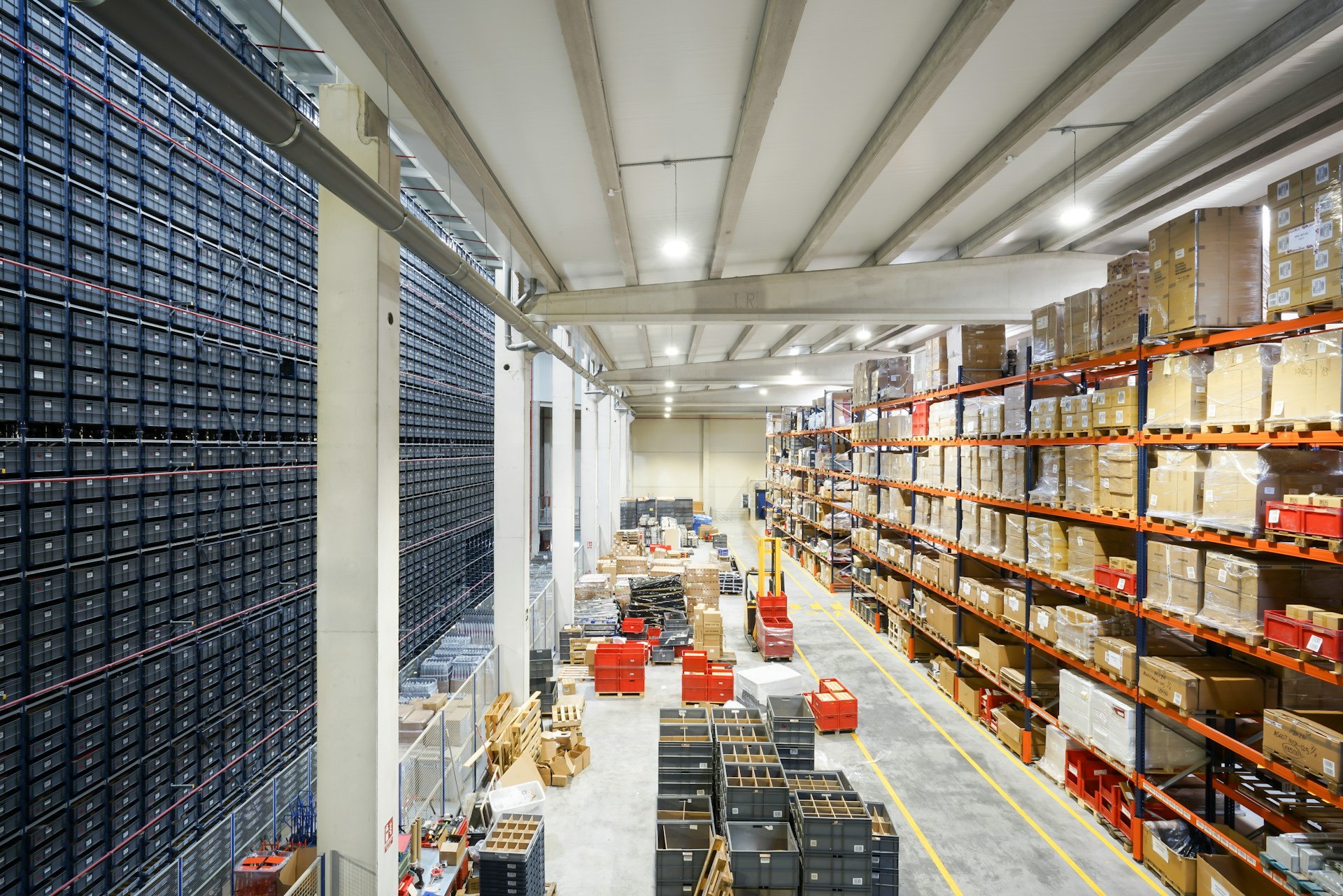
Warehouses are often treated as purely functional, something that just needs to work well enough to keep things moving. The problem with that mindset is that warehouses play a huge role in efficiency, safety, and scalability, and so ignoring them can quietly slow down the entire operation.
So how do you convince yourself that your warehouse deserves just the same attention and investment as the rest of your business? Let’s talk about it.
Warehouses Directly Affect Daily Performance
A warehouse is both a storage space and a place where your stock moves around, especially if you’ve got a lot of products to choose from. Your inventory moves, orders are fulfilled, and timelines are either met or missed, so having outdated layouts, equipment, or systems can create bottlenecks that negatively affect your entire business. This leads to your staff spending more time working around limitations instead of doing their jobs efficiently.
That’s why upgrading your warehouse operations often leads to noticeable improvements in speed, accuracy, and morale. When processes flow smoothly, teams work better, mistakes decrease, and customers feel the impact through faster and more reliable service.
Small Upgrades Can Make a Big Difference
Not every improvement requires a complete overhaul. Sometimes, targeted upgrades have the biggest impact. Improving lighting, reorganising storage, or updating access points can immediately improve safety and productivity. These changes often reduce downtime and make daily tasks easier for staff.
Infrastructure upgrades matter too. Features like modern warehouse roll up doors improve security, speed up loading and unloading, and help regulate temperature. These practical improvements support smoother operations without disrupting the entire facility.
Planning Now Prevents Bigger Problems Later
Many warehouse issues don’t appear overnight, but rather, they build up slowly over time as volumes increase and processes become more complex and intricate. So if you’re waiting until your space, equipment, or systems fail before you make any changes, you’re walking into a common business trap that will almost certainly lead to rushed decisions and higher costs, especially as you’re scrambling to get your services back online.
But that’s where future-proofing warehouses comes in to save the day. When you start planning for growth, flexibility, and new technologies, you’re helping your business adapt without the worry of major disruption that would effectively shut you down. Thinking about scalable layouts, adaptable storage systems, and updated infrastructure makes it a lot easier for you to respond to upgrades and changes later on, thus avoiding the typical issues that come with growth.
Upgrading Warehouses Supports Long-term Growth
Warehouses are a core part of business operations, not an afterthought. When they’re upgraded alongside offices and technology, the entire operation becomes more resilient. Efficiency improves, risks decrease, and teams are better equipped to handle growth.
Treating warehouse upgrades as strategic investments rather than expenses helps businesses stay competitive. When your warehouse works as hard as the rest of your operation, everything runs more smoothly.
https://www.strategydriven.com/wp-content/uploads/IMG_1274.jpeg12811920StrategyDriven - Sponsored Contenthttps://www.strategydriven.com/wp-content/uploads/SDELogo5-300x70-300x70.pngStrategyDriven - Sponsored Content2026-01-19 20:06:412026-01-19 20:06:41Why Your Warehouse Deserves the Same Upgrades as the Rest of Your Business Operation
Ever felt like your business is spinning its wheels—working hard but still somehow stuck in neutral? That moment when orders keep coming, employees keep moving, but nothing seems to move forward? It’s a familiar story across industries, from warehouses to manufacturing to logistics, where daily hustle often hides the cracks in the system. In this blog, we will share what really goes into improving operations that don’t just run—but actually get better.
Beyond Efficiency: The Shift Toward Resilience
Operational improvement used to be all about efficiency. Cut waste, streamline processes, maximize output. Lean manufacturing, Six Sigma, continuous improvement—all focused on shaving off seconds and squeezing out waste. But then the world got complicated. Supply chain meltdowns, labor shortages, rising fuel prices, climate disruptions—you name it, and it’s impacted production and delivery over the last few years.
Today, efficiency alone isn’t enough. Businesses are learning that resilience is just as critical. It’s not about how fast you move on a good day. It’s how well you adapt on a bad one. Improving operations now means planning for disruption, not just perfection.
That shift shows up in how facilities invest. Take storage, for instance. When warehousing gets tight and demand spikes, many businesses now buy shipping container units to add space without expanding their building footprint. These containers aren’t just useful for overflow—they’re durable, portable, and easy to repurpose. Some companies use them to stage goods during seasonal volume shifts; others use them as mobile hubs during reorganization. With supply chain volatility and real estate pressure rising, these practical tools help operations stay flexible without requiring massive capital investment. The result isn’t just more space—it’s more control, and in a world where planning feels like a gamble, control is an asset.
People and Processes: The Core Drivers of Change
No matter how digital or data-driven operations get, the biggest friction still comes down to people and process. The problem isn’t usually that a worker doesn’t want to perform. More often, it’s that the process they’re following hasn’t kept up with reality. Or worse, no clear process exists at all.
Businesses that improve operations long-term are the ones that build systems around how people actually work—not how managers think they should. That means observing floor traffic, checking task handoffs, and asking employees where they lose time or duplicate effort. Frontline workers often spot inefficiencies that dashboards never catch. And yet, they’re the last ones invited into strategy sessions.
Standard operating procedures aren’t sacred texts. They should change. They should evolve. And the best improvements often come from discomfort—those moments when teams say, “This doesn’t make sense anymore.” Listening to that feedback, capturing it, and acting on it builds both better processes and more engaged workers.
Onboarding and cross-training also play a role. High turnover isn’t just an HR issue—it’s an operational one. When only a few employees know how to run a line, load a truck, or reset a system, performance becomes fragile. Cross-training doesn’t just create flexibility. It creates operational stability that holds up when sick days or resignations come.
Technology Can Help, But Only If It Fits
There’s a tendency to think of software and automation as the golden ticket to operational excellence. But not every tech solution is a good fit, and not every problem can be solved by an app. What works in a 300,000-square-foot warehouse might be total overkill for a 10-person fabrication shop. Or worse, it might make things slower.
Technology should solve real friction, not just add complexity. That could mean something as advanced as AI-assisted inventory forecasting—or something as simple as replacing a whiteboard with a live shared spreadsheet. The right tool depends on the problem, the team, and the speed at which your operations can absorb change.
When it does fit, though, tech can transform. Predictive maintenance sensors reduce machine downtime. Mobile scanning improves inventory accuracy. Even small upgrades like voice-directed picking systems can shave hours off daily work. But it only works if leadership commits to implementation. Half-launched tools—or worse, tech that gets deployed without training—usually end up abandoned or ignored.
Measurement Should Drive Action, Not Just Reports
Every operation tracks metrics. Units per hour, cost per unit, error rates, downtime—it’s all logged. But the real question is: what happens to the numbers once they’re collected? Too often, data gets reviewed in meetings, nodded at, and then forgotten until the next cycle.
Data should point directly to action. If errors spike on second shift, what changes on the floor next week? If returns are up, what training follows? Measurement isn’t about reporting for reporting’s sake. It’s about creating a feedback loop that moves.
Companies that improve operations consistently often have visible dashboards that frontline teams can see and understand. They use simple indicators—color-coded targets, daily goals, trend lines. And they pair data with context. Why did output drop yesterday? What changed? Treating numbers as conversation starters rather than verdicts leads to smarter adjustments and stronger engagement.
Improvement is Ongoing—But It Needs Milestones
Operational improvement never really ends. There’s always a new variable, a new system, a new curveball. But that doesn’t mean it should feel like an endless marathon with no finish line. Setting real milestones helps teams stay motivated and shows progress when the day-to-day feels repetitive.
That might mean setting quarterly goals around reducing lead time or hitting new accuracy benchmarks. It could involve piloting a new system in one department before a full rollout. Or it might be as simple as publicly celebrating a line that hits 30 days with zero safety incidents.
Progress should be tracked, not assumed. And wins—big or small—should be shared. When people see what’s improving and how their work contributes, they become part of the process, not just subjects of it.
In the end, improving operations isn’t a one-size-fits-all formula. It’s a mix of common sense, real feedback, solid planning, and flexibility to change course when something better comes along. It’s about making systems stronger, not just faster. And it’s about remembering that behind every process, there are people trying to do their jobs well—if only the system would let them.
https://www.strategydriven.com/wp-content/uploads/IMG_1270.jpeg8531279StrategyDriven - Sponsored Contenthttps://www.strategydriven.com/wp-content/uploads/SDELogo5-300x70-300x70.pngStrategyDriven - Sponsored Content2026-01-16 09:52:522026-01-16 09:52:52What Goes Into Improving Industry Operations
 A VETERAN OWNED SMALL BUSINESS |




 Business Programs