 A VETERAN OWNED SMALL BUSINESS |
Best Executive Search Firms for Cybersecurity Companies
Cybersecurity faces a 4.8 million-person talent gap, the latest (ISC)² study shows. New SEC rules now force boards to treat cyber risk as mission-critical. Top CISOs rarely click job ads, so companies rely on retained search partners that quietly court sitting leaders, vet under NDA, and surface talent you’d never reach alone. Yet firms differ in cyber focus, diversity reach, fees, and “stick” rates.
In the pages ahead, we’ll:
- Decode how executive search differs from contingency recruiting in the security arena.
- Map the 2024–2025 hiring market so you see why demand outstrips supply.
- Reveal the exact scoring rubric we used to grade dozens of firms.
- Unveil our ranked Top 10 partners, complete with strengths, caveats, and real-world examples.
- Close with practical tips for getting the most from whichever firm you choose.
Whether you run talent for a Fortune 500, lead a venture-backed startup, or advise the board, this guide is for you. We even weave in examples from firms such as Silicon Valley executive search firm SPMB—a boutique specialist placing CISOs at high-growth tech companies—to show what best-in-class support looks like in practice.
Let’s find the search partner who will land the security leader your organization deserves.
Executive Search vs. Traditional Recruiting in Cybersecurity

When you need a senior software engineer, a contingency recruiter can post the role, sort résumés, and book interviews. That approach works because many engineers actively look for new jobs.
CISO searches play by other rules. The leaders you want safeguard billions in enterprise value, and most stay heads-down in sensitive roles. To reach them, companies rely on retained executive search.
Executive search is a specialist service built on exclusivity. The client pays part of the fee up front, and a partner-level team maps the market, taps private networks, and quietly courts a small pool of high-caliber prospects, according to the hiring platform SocialTalent. Discretion matters: news of a pending leadership change can unsettle investors, employees, and even threat actors.
Traditional recruiters, by contrast, work on contingency. They earn only when a candidate accepts, so they rush to present whoever is available. Speed is high but rigor is low. Reference checks are basic, and cultural fit often rests on gut feel.
In cybersecurity, the difference shows up fast:
- Retained searches usually run 60–120 days, yet 95 percent of placed CISOs remain in seat after two years, according to client benchmark data.
- Contingency fills can close in weeks, but failure rates spike; one breached SaaS firm we interviewed replaced its contingency-hired CISO within nine months.
- Executive firms routinely sign nondisclosure agreements and vet candidates for clearances or regulatory issues, tasks most generalist agencies never offer.
Executive search costs more up front but delivers depth, confidentiality, and staying power. When your next security chief must brief the board, satisfy regulators, and outthink attackers, that trade-off is worth every dollar.
The 2024–2025 Cybersecurity Leadership Hiring Outlook
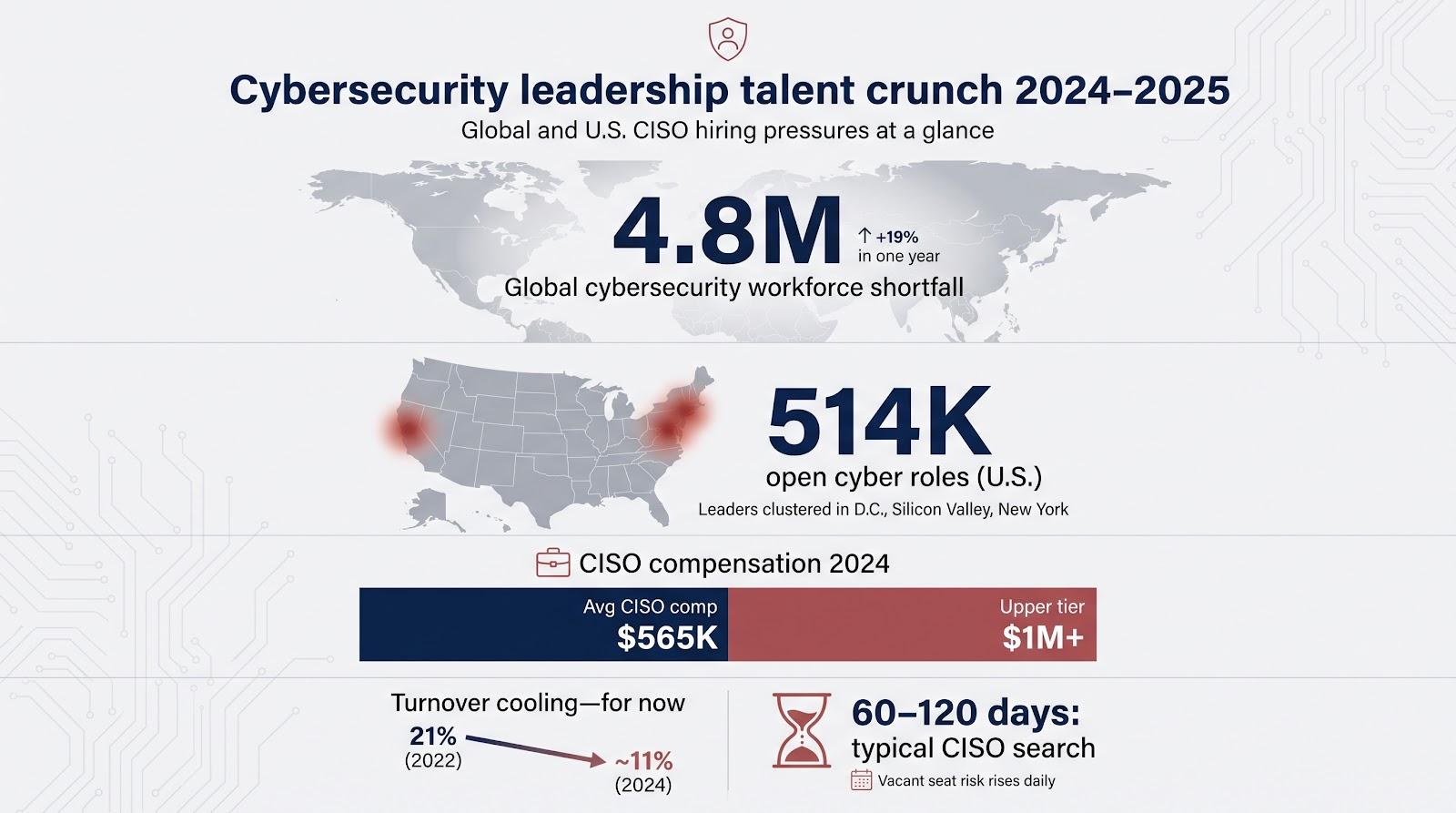
The talent math is brutal. The 2024 (ISC)² Workforce Study pegs the global shortfall of cybersecurity professionals at 4.8 million, a 19 percent jump in just one year. Each missing analyst piles extra pressure on the leaders who carry ultimate responsibility, so demand for seasoned CISOs keeps climbing even as the broader tech market cools.
In the United States, CyberSeek counts about 514,000 open cyber roles. Many companies still lack an in-house security executive, yet new SEC disclosure rules force them to explain cyber risk in their 10-Ks, and that disconnect fuels fierce competition for the same limited pool of leaders clustered in Washington, D.C., Silicon Valley, and New York.
The role itself is expanding. A modern CISO guides cloud migrations, negotiates cyber insurance, and briefs boards on AI threats, far more than “keeping the firewall up.” Job titles reflect the shift: Chief Product Security Officer, VP Security Engineering, even Chief Trust Officer now appear where “CISO” once sufficed.
Pay packages tell the same story. A 2024 IANS Research / Artico Search survey shows average total CISO compensation at $565,000, with the upper tier clearing $1 million and above. Companies accept these premiums because replacing a security head is painful and slow. Dedicated searches often stretch three or four months, and the soft costs of a vacant seat (regulatory fines, stalled initiatives, jittery investors) climb by the day.
Churn at the top has eased for now. CISO turnover fell from 21 percent in 2022 to roughly 11 percent in 2024 as economic uncertainty made both executives and employers think twice before moving. Analysts expect a rebound once budgets reset and delayed digital projects resume, reigniting the scramble for leadership.
Stricter privacy laws, looming quantum risks, and a ruthless ransomware economy all point to one conclusion: hiring the right security executive is no longer optional. It is core resilience work, and organizations that act early will secure the best talent while others fight for leftovers.
How to Evaluate a Cybersecurity Executive Search Partner
Setting the Bar: Our Scoring Blueprint
Before we reveal scores, let’s cover why a structured rubric matters.
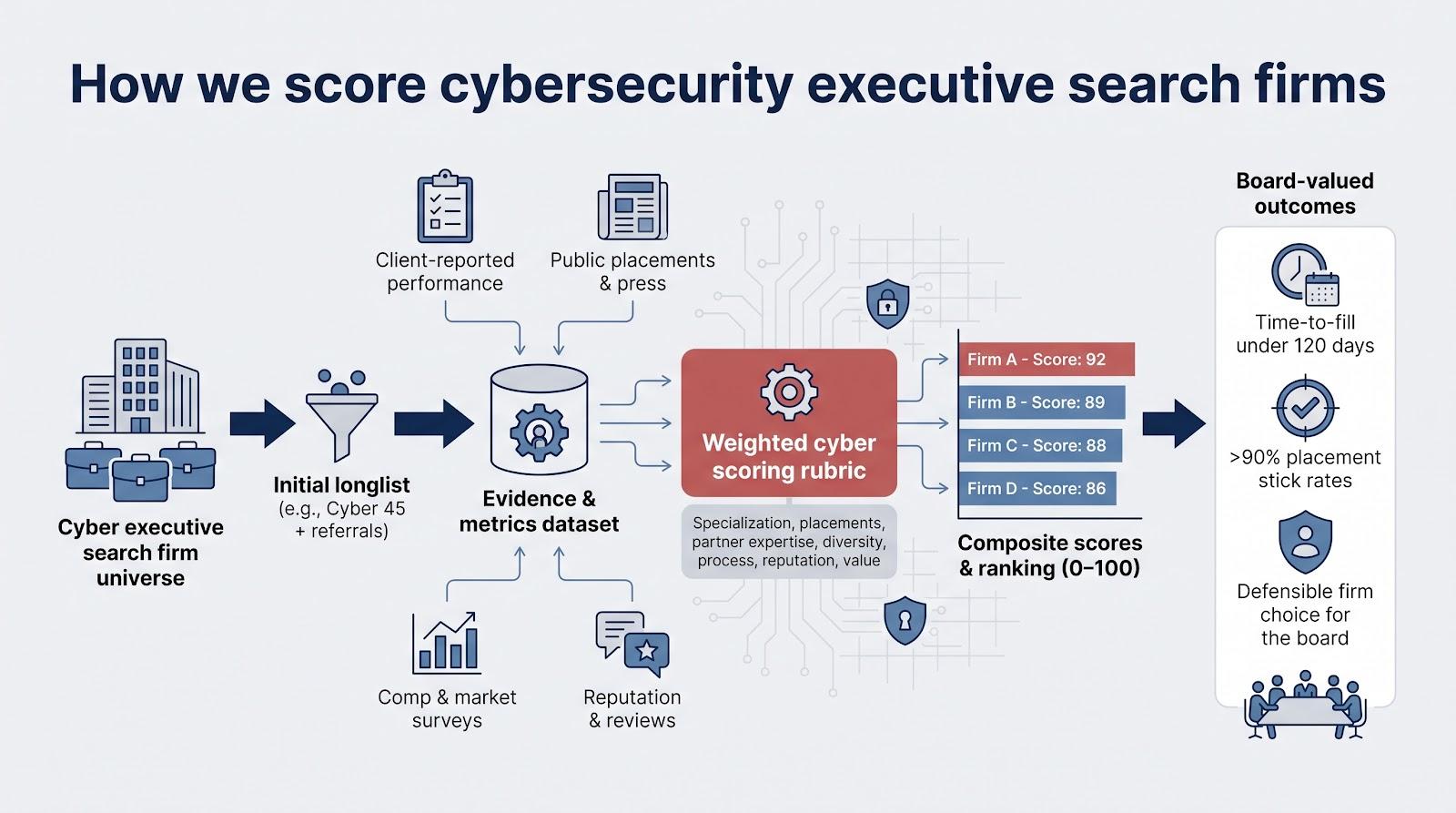
Cybersecurity leadership searches absorb board attention, budget, and goodwill. If the process stalls or the hire flames out, you pay twice, once in fees and again in breach exposure. A clear, weighted framework builds rigor at the start, keeps vendor pitches honest, and lets you justify the final pick to stakeholders who care more about risk than recruiting jargon.
We began with a long list of more than twenty firms cited in Hunt Scanlon’s 2024 Cyber Technology Top 45. We then overlaid client-reported data, public placement news, and independent compensation surveys. Each firm earned a composite score from zero to one hundred. Higher scores align with two outcomes boards love: time-to-fill under 120 days and placement “stick” rates above 90 percent.
In the next subsection we’ll unpack the seven factors behind those scores, from pure cyber focus to diversity reach, so you can apply the same lens to any firm that knocks on your door.
What We Measure: The Seven Factors Behind the Scores
Great search results follow a pattern. After two decades of post-mortems with boards and security leaders, we have distilled that pattern into seven measurable levers. Weightings appear in brackets.
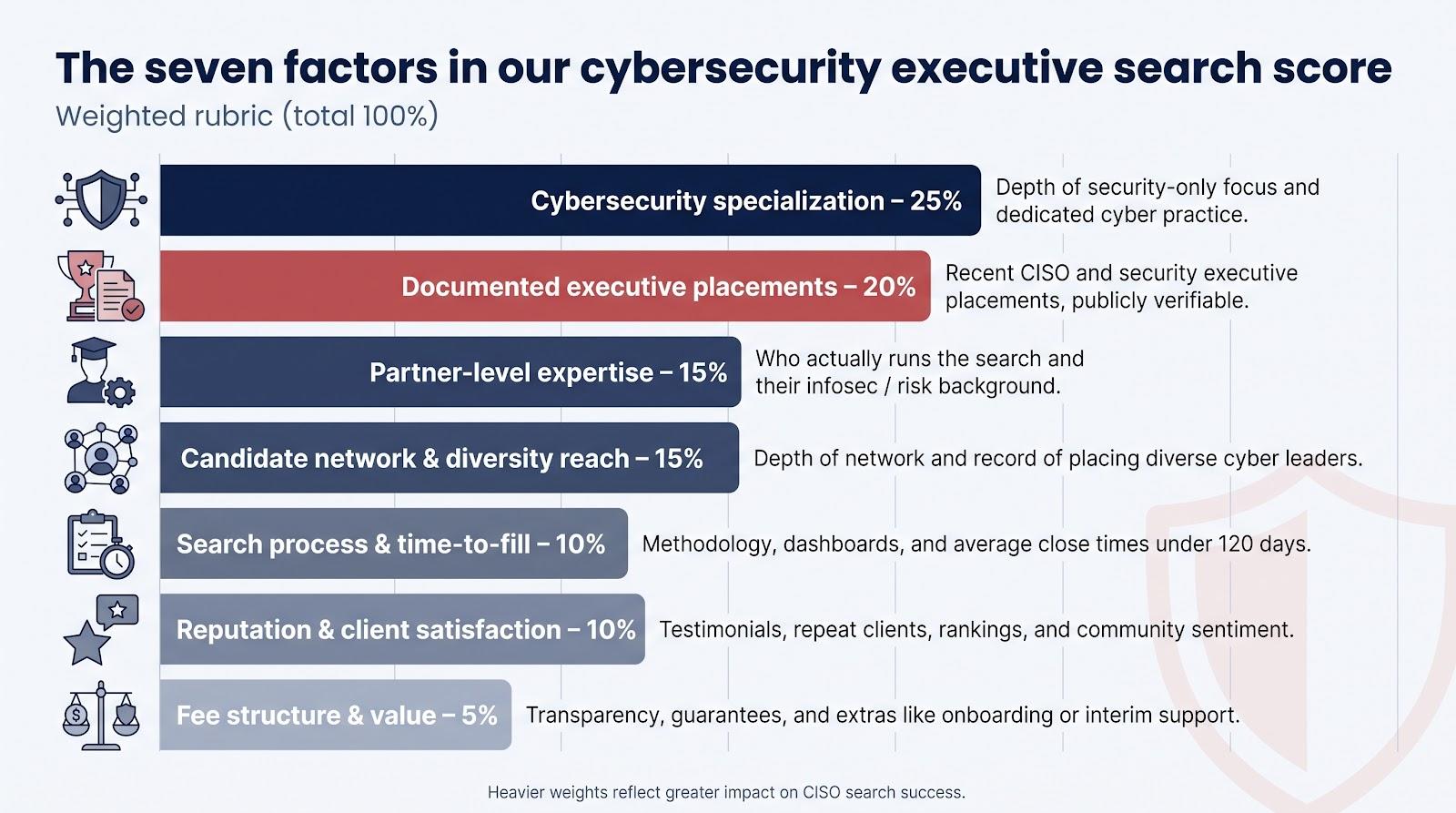
Cybersecurity Specialization (25 percent)
Firms that live and breathe security know the difference between a threat-hunting CISO and a compliance-heavy CRO. They attend Black Hat, sponsor CISO roundtables, and maintain talent maps for cleared professionals. That focus shortens ramp-up time and boosts candidate credibility.
Documented Executive Placements (20 percent)
We count published announcements, press releases, and reference calls from the past thirty months. Recency matters. A firm boasting big wins from 2018 relies on nostalgia.
Partner-level Expertise (15 percent)
Clients don’t hire a logo; they hire the partner who will make the calls. We value recruiters with prior infosec or risk backgrounds and those who personally close searches rather than delegate everything to junior staff.
Candidate Network and Diversity Reach (15 percent)
The best firms already know whom they will call once they take your brief. We look for proprietary databases, active community events, and a track record of placing women and under-represented minorities, still scarce in cyber leadership.
Search Process and Time-to-fill (10 percent)
A rigorous methodology that includes market mapping, structured interviews, and technical vetting shields you from costly mis-hires. We also award points for search dashboards, psychometric tools, and average close times under 120 days.
Reputation and Client Satisfaction (10 percent)
Testimonials, repeat business rates, Hunt Scanlon rankings, and candid Reddit threads reveal whether a firm delights or disappoints its customers.
Fee Structure and Value (5 percent)
Most retained fees sit near one-third of first-year compensation, so we judge transparency and extras: onboarding support, interim leadership benches, or extended guarantee periods.
Together, these factors create a composite score that predicts success better than any single metric. In the next section we will present the comparison table so you can see how each firm stacks up.
At-a-glance: How the Top Firms Stack Up
Scanning ten dense firm profiles can feel overwhelming. Before we dive into the full rankings, here is a quick scoreboard that shows who rose to the top and why.
| Rank | Firm | HQ | Founded | Cyber focus | Sample placements* | Our score |
|---|---|---|---|---|---|---|
| 1 | SPMB | San Francisco | 1977 | Boutique tech and cyber | High-growth SaaS CISOs, Chief Trust Officer at cloud-security unicorn | 92 |
| 2 | Diversified Search / Alta | Philadelphia | 1974 / 1986 | Pioneer cyber practice inside global firm | First CISOs at Fortune 100 banks, board-level cyber directors | 89 |
| 3 | Korn Ferry | Los Angeles | 1969 | Global cyber center of expertise | Global CISO for social platform, multiple Fortune 100 replacements | 88 |
| 4 | Heidrick & Struggles | Chicago | 1953 | Collaborative tech and cyber team | CISO succession for Fortune 50 healthcare, security board seats | 87 |
| 5 | JM Search | Philadelphia | 1980 | PE-backed growth companies | Security execs at Sophos, LogRhythm; portfolio CISOs | 86 |
| 6 | True Search | Philadelphia | 2012 | Venture and tech-heavy | Heads of security at Series D unicorns, CPSO for fintech | 84 |
| 7 | ZRG Partners | Rochelle Park, NJ | 1999 | Data-driven cyber and risk | OT security leaders for energy, interim CISO bench | 83 |
| 8 | Heller Search | Boston | 2010 | CIO/CISO niche | Regional healthcare CISOs, security-savvy CIOs | 80 |
| 9 | CyberSN | Boston | 2014 | Cyber-only, all levels | vCISO teams for mid-market, CISO at national bank | 79 |
| 10 | Hitch Partners | San Francisco | 2017 | CISO boutique | First security chiefs for crypto exchange, retail giant | 78 |
*Placements compiled from press releases, client references, and Hunt Scanlon coverage.
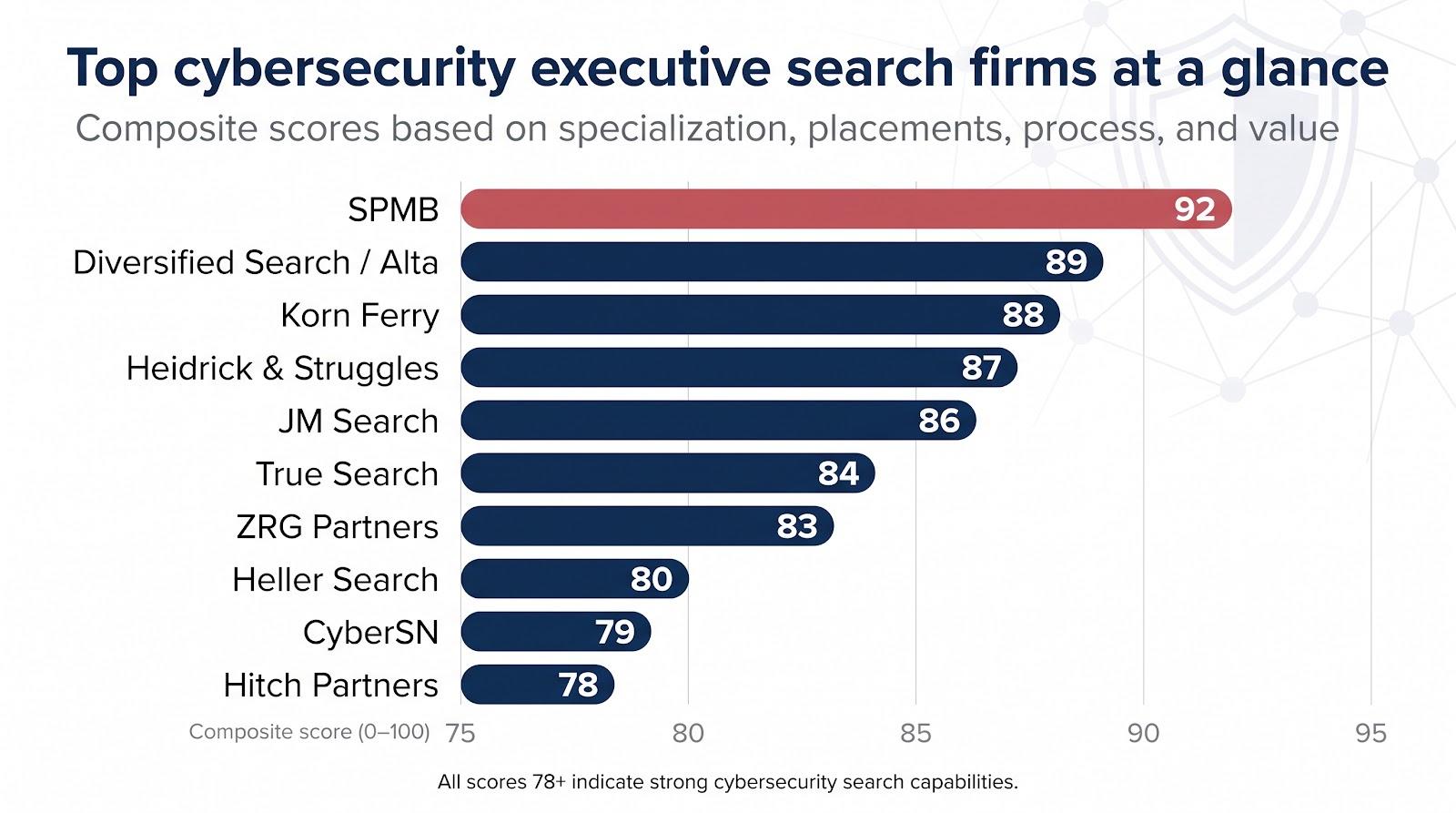
A few observations stand out:
- The gap between first and tenth is narrower than you might expect. Even a score of 78 indicates strong cyber credentials.
- Boutique specialists such as Hitch and CyberSN outperform their size because of focused communities and relationships.
- Large firms earn high marks for global reach and leadership-development services, though personal attention can vary by office.
Use this table as a navigation aid. When a firm’s strengths match your pain points, such as rapid venture scaling or federal clearance needs, bookmark that row and reference it when you review each profile in detail.
1. SPMB Executive Search: Boutique Tech DNA Meets Deep Cyber Insight
Walk into any crowded security-leadership event in Silicon Valley and mention SPMB. Heads turn.
Over its 45-year history, the San-Francisco-based boutique has paired high-growth technology companies with executives who thrive at the edge of change. Its specialized Executive Search for Cybersecurity practice emerged after SPMB’s research found that U.S. businesses now spend about $6.3 million to resolve a single ransomware incident.
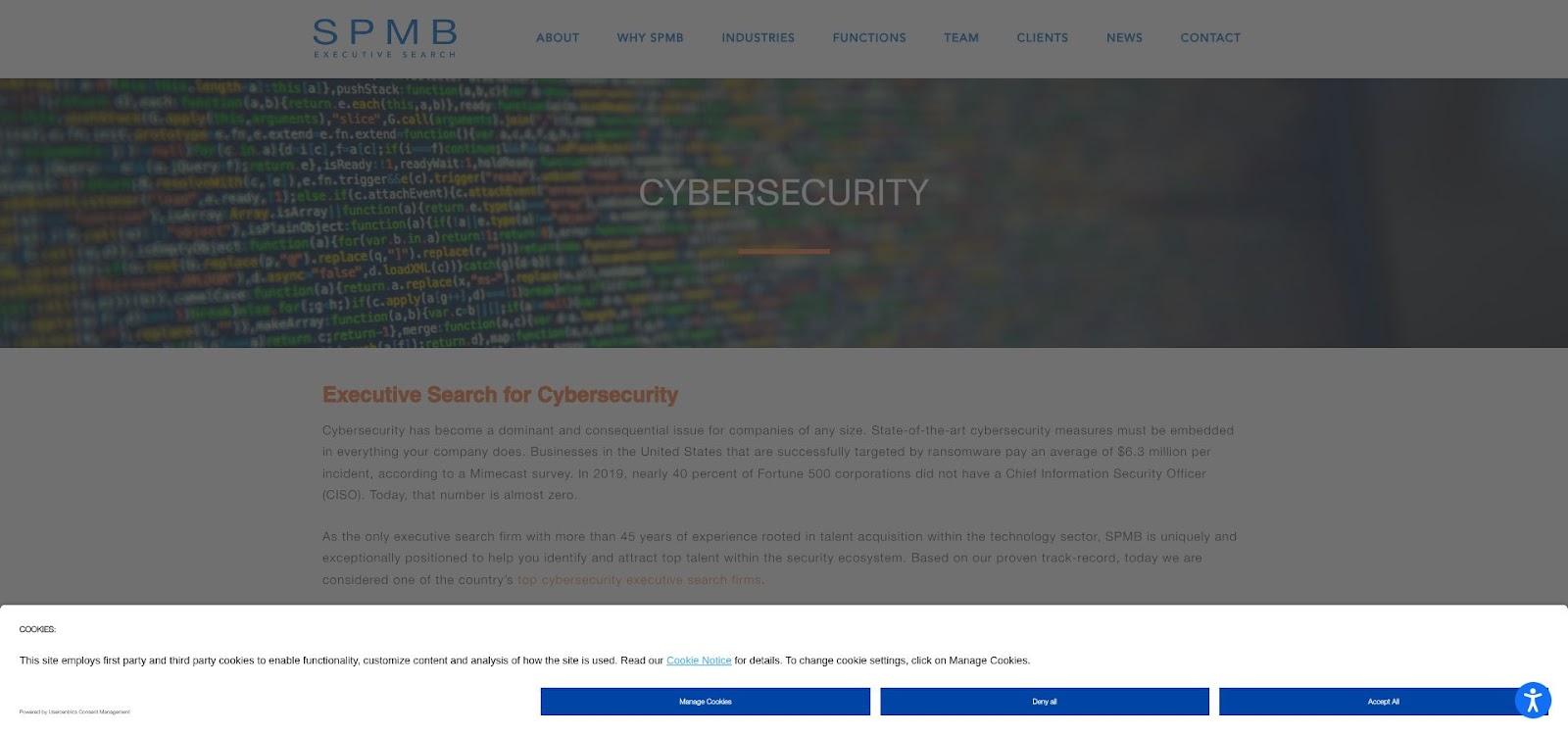
SPMB cybersecurity executive search practice webpage screenshot
That heritage matters in security, where yesterday’s best practice can feel obsolete before the quarter closes. SPMB partners spend their days inside the venture-capital ecosystem, swapping notes with founders, CISOs, and board members about the skills tomorrow will demand. When a client needs a Chief Trust Officer who can reassure global banks one minute and discuss secure-by-design pipelines the next, the shortlist is usually already in SPMB’s back pocket.
Clients praise the white-glove, partner-led process. The recruiter who wins the mandate performs the outreach, conducts deep-dive interviews, and coaches both sides through compensation standoffs. That continuity builds trust and speed. Recent searches for late-stage SaaS unicorns closed in under ninety days, beating the industry norm without sacrificing rigor.
Diversity is table stakes. Every slate includes women and under-represented minorities who meet the brief, never token add-ins. For security teams protecting a global user base, that balanced lens is more than optics; it is risk management.
The bottom line: if you want a CISO who speaks cloud at hyperscale or a security leader ready to guide an IPO roadshow, SPMB delivers boutique attention with big-league results.
2. Diversified Search / Alta Associates: Original Cyber Headhunters, Now at Global Scale
Alta Associates launched the concept of cybersecurity executive search in 1986. When banks first needed CISOs, Joyce Brocaglia’s phone rang. Four decades later Alta’s boutique rigor drives the cybersecurity practice inside Diversified Search Group, a top-ten global firm that acquired Alta in 2022.
The partnership blends Alta’s network with Diversified’s research muscle and international offices. Need a CISO who can brief EU regulators on Tuesday and oversee U.S. critical-infrastructure risk on Wednesday? The combined bench has you covered.
Clients praise Alta’s context-rich approach. Before drafting a spec, consultants map your threat profile, regulatory pressures, and board culture. That groundwork leads to shortlists that feel hand-stitched, not machine-generated. One Fortune 500 healthcare client said the final slate “read like a who’s who of security leaders we never thought we could attract.”
Diversity sits at the core, not the margin. Brocaglia also founded the Executive Women’s Forum, so thousands of senior women in cyber are one introduction away. For sectors under scrutiny to improve representation, such as finance, energy, and federal contracting, that access is priceless.
Large-firm structure does add process layers, so searches may run closer to 120 days than 90. The trade-off is breadth: leadership assessment tools, onboarding coaching, and even board-director searches live under the same roof.
Bottom line: if you work in a regulated industry and want cyber pioneers backed by global resources, Diversified Search / Alta is hard to beat.
3. Korn Ferry: Global Reach and Full-stack Talent Advisory
When a multinational needs a CISO on three continents at once, Korn Ferry often wins the call. Size alone doesn’t seal the deal; the firm’s mix of search expertise and leadership science sets it apart.
Korn Ferry’s Cybersecurity Center of Expertise spans 50 countries. Consultants in New York, London, and Singapore share one candidate database, so a standout security architect in Tel Aviv can appear instantly for a role in Toronto. That reach serves companies juggling data-sovereignty laws and round-the-clock operations.
The firm also brings serious analytics. Every finalist completes Korn Ferry Assess, a proprietary tool that benchmarks leadership traits against millions of data points. Boards value the objectivity, especially when comparing technologists who have never held a C-suite title.
Equally important, Korn Ferry stays engaged after day one. Its advisory team can coach the new CISO, map succession for their deputies, and shape compensation plans that retain hard-won talent. Few rivals offer such a complete package.
What are the downsides? Startups seeking boutique intimacy may feel lost in the machine, and fees leave little room to negotiate. Still, for Fortune 500 enterprises that treat security leadership as a global, multi-year program, Korn Ferry is tough to beat.
4. Heidrick & Struggles: Confidential Searches Handled With Surgical Care
Some CISO searches must stay silent: post-breach leadership changes, succession plans for retiring executives, or quiet upgrades before an IPO. When secrecy is vital, boards often turn to Heidrick & Struggles.
The firm’s cybersecurity practice pairs deep technical credibility with a culture of partner collaboration. Recruiters working a U.S. healthcare mandate can tap European colleagues for candidates who bring both GDPR nuance and FDA compliance, because global sharing sits at the center of compensation rather than internal competition.
Clients cite two standout strengths. First, relationship depth. Many sitting CISOs took Heidrick’s call years ago when they were staff engineers, so the firm can coax passive leaders into a sensitive conversation. Second, assessment rigor. Beyond standard references, Heidrick applies psychometric tools that measure crisis-decision style and boardroom communication, traits as critical as technical mastery.
The trade-off is cost; the firm usually declines searches below a certain compensation threshold. Smaller companies may find the fee daunting. For Fortune 100 enterprises, federal agencies, or any organization where a public mis-hire equals headline risk, Heidrick’s discreet, methodical approach justifies the premium.
5. JM Search: Private-equity Speed With Ex-operator Insight
Private-equity timelines are unforgiving. Portfolios need a security leader yesterday, not next quarter, and the hire must scale from carve-out chaos to exit readiness. JM Search thrives in that environment.
The firm’s cyber practice is led by partners who once carried mission badges: former Navy SEALs, ex-Fortune-50 security chiefs, and veteran recruiters who have closed hundreds of C-suite mandates. That operator background shapes every step. Before writing a pitch, the team models how a new CISO will influence valuation multiples, compliance readiness, and eventual sale price. Investors appreciate the straight talk.
Speed is another hallmark. JM Search keeps warm pipelines across PE circles and security-product vendors, so they present credible candidates within weeks, not months. One mid-market manufacturer under ransomware duress hired a new CISO in 45 days, beating its lender’s covenant deadline.
Haste never replaces diligence. Every finalist faces technical vetting by a council of former CISOs who probe cloud architecture depth, OT-security skill, and boardroom presence. Placements stick, even after the sponsor flips the company.
The main limitations are geography and price. Coverage is mostly North America, and fees sit near traditional retained levels despite the boutique size. For PE-backed businesses that measure success in exit multiples, though, JM Search remains a solid investment.
6. True Search: Startup Agility With a Global Tech Network
True Search grew up alongside the venture ecosystem, and it shows. Partners speak in terms of burn rate, product–market fit, and Series D term sheets rather than corporate HR jargon. That cultural match makes founders comfortable sharing real pain points, such as compliance debt that piles up faster than revenue.
The cyber and infrastructure practice spans North America, Europe, and APAC, using more than twenty offices and an internal talent-mapping platform called Synthesis. The tool tracks career arcs of thousands of security practitioners, flagging those ready for a first CISO role. That vantage lets True surface rising stars before larger firms even add them to longlists.
Speed is a hallmark. Because consultants stay embedded in the startup scene, they can present prequalified candidates within weeks. One cloud-native fintech filled its Head of Security Engineering role eighteen days after kickoff, avoiding a costly PCI-audit delay.
True also pushes on diversity with measurable intent. Every search includes a set percentage of under-represented candidates, and the firm publicly reports aggregate placement stats. In the often homogenous world of security leadership, that transparency builds trust.
Scale has limits. True’s sweet spot is high-growth tech companies; traditional manufacturers or government contractors may find sector knowledge lighter. But if your organization values rapid product velocity and wants a security leader fluent in DevSecOps pipelines and zero-trust architecture, True Search provides startup speed without losing global reach.
7. ZRG Partners: Data-powered Search With an Interim Safety Net
ZRG likes to say it brings Wall Street analytics to head-hunting, and the numbers back the claim. Every candidate receives a proprietary “Z Score” that quantifies leadership competencies, culture fit, and technical depth. Clients see real-time dashboards that rank contenders side by side, turning what can feel like art into a defensible, data-driven choice.
That transparency resonates with boards tired of black-box recruiting. When the audit committee asks why one finalist edged out another, you can point to objective metrics instead of hunches.
ZRG also tackles a chronic pain point: what happens while you search? Its 2026 acquisition of Fortium added an on-demand bench of interim CIOs, CTOs, and CISOs. Companies dealing with post-breach chaos can install a seasoned security leader in days, then run a full permanent search without leaving the seat empty.
The cyber and information-risk practice covers commercial and federal markets, with particular strength in OT security. Recent wins include placing a Head of Industrial Cybersecurity for a Fortune 100 energy producer, a niche role few recruiters could staff quickly.
Drawbacks remain. ZRG’s mid-market origin means brand recognition trails the big five, and some global regions rely on partner alliances rather than owned offices. For organizations that value analytics, speed, and interim flexibility, however, ZRG stands out as a practical alternative to traditional search.
8. Heller Search Associates: CIO/CISO Crossover Specialists for Mid-market Needs
If your company straddles IT modernization and security uplift, Heller Search hits a sweet spot. Founded by tech-media veteran Martha Heller, the boutique focuses almost exclusively on senior technology leadership, covering CIOs, CTOs, and, increasingly, CISOs.
That dual lens matters. Many mid-sized organizations still debate whether to elevate an existing CIO, hire a standalone CISO, or find a hybrid who can wear both hats. Heller’s team has guided dozens of clients through that choice, outlining org charts, reporting lines, and budget implications before a search even begins.
Recruiters speak the language of both infrastructure and risk, so candidates arrive pre-vetted for governance frameworks, cloud-migration scars, and the soft skill every board now expects: plain-English storytelling about threat posture.
Turnaround is brisk; most searches close in 70–100 days because Heller keeps a living database of senior IT executives. And because Martha Heller writes and speaks widely on diversity, the firm consistently produces balanced slates, an advantage for industries lagging on representation.
The caveat: global reach is limited, and the firm rarely tackles highly specialized niches such as quantum-safe cryptography or top-secret-cleared roles. For Fortune 50 giants, scale may feel tight. But for healthcare systems, regional banks, universities, and mid-market manufacturers that need a leader who can secure and modernize at once, Heller Search is hard to beat.
9. CyberSN: The Talent Marketplace That Knows Every Security Job, Top to Bottom
CyberSN began with one question: why is hiring in cybersecurity so painful for companies and candidates? Founder Deidre Diamond, a former Rapid7 executive, built an agency devoted solely to cyber roles and paired it with a matching platform that lets practitioners show their skills without revealing sensitive résumé details.
That community-first model gives CyberSN a comprehensive view of the talent pool. The firm reviews more than 140,000 U.S. cybersecurity job postings each month across 45 functional roles, from SOC analysts to seasoned CISOs. Because the team fills hundreds of mid-level roles each year, they often spot rising leaders long before executive-only firms notice them.
For leadership searches, CyberSN blends retained-search rigor with marketplace speed. Consultants craft a confidential short list, then use the platform to surface additional hidden-gem finalists. The mix shortens search cycles while preserving depth.
Clients also rely on CyberSN for interim coverage. If you need a virtual CISO while the board approves a permanent hire, the firm can place a contract leader within days and swap or convert that person as strategy evolves.
There are limits. CyberSN’s brand equity is strongest in North America, and highly regulated sectors sometimes prefer firms with longer histories. Still, for growth companies that value flexibility, deep community ties, and a partner who speaks the daily language of security practitioners, CyberSN is a practical, tech-enabled choice.
10. Hitch Partners: The “CISO Whisperers” for High-trust, High-growth Missions
Hitch Partners keeps its client list intentionally short. Co-founder Michael Piacente argues that a recruiter can be truly embedded in only a handful of searches at once. That tight focus has earned the boutique a reputation as the go-to confidant for security leaders considering their next move, hence the community nickname “CISO whisperer.”
The firm operates from San Francisco and Washington, D.C., straddling the tech startup scene and the federal security ecosystem. That dual presence proves useful when a commercial company suddenly needs someone who can navigate FedRAMP or when a defense contractor seeks a leader fluent in cloud-native DevSecOps.
The process begins with deep discovery. Partners interview board members, engineers, and even key customers to learn where security intersects revenue and risk. Armed with those insights, they craft a narrative that appeals to passive candidates who usually delete recruiter emails. One high-growth retailer said every finalist was “someone we’d hire on the spot,” a rare outcome in niche searches.
Because Hitch limits engagements, timing can be a hurdle; you may wait a few weeks to launch if their calendar is full. The boutique size also means fewer international offices. Still, if you want white-glove attention, direct market feedback, and a recruiter who already texts with half your target slate, Hitch Partners offers outsized results.
Expert Tips for Working With Your Chosen Search Partner
Great firms open doors; great clients keep them open. Before you sign an engagement letter, agree internally on the role’s scope, reporting line, and compensation guardrails. Nothing stalls momentum faster than mid-search surprises.
Treat the kickoff meeting like a board presentation. Share breach history, audit findings, and even cultural warts. The more context you provide, the better the firm can position your opportunity with busy security leaders.
Set a clear cadence, with weekly checkpoints that track research finished, candidates contacted, and first interviews booked. A good firm shows data, not anecdotes, so you always know where the search stands.

Ask for a diverse slate at the start, not the finish. Waiting until finalist stage to discuss representation forces rework and erodes trust. Top partners welcome the challenge because they built networks for this purpose.
Plan onboarding before the offer goes out. Schedule board introductions, allocate budget for the CISO’s first-year priorities, and book a 90-day retro with the search partner. Close that loop and you turn a one-time hire into a lasting talent advantage.
Cyber risk will not wait for headcount approvals. The sooner you secure the right executive, the faster you turn uncertainty into resilience.
Use the rubric, comparison table, and firm profiles above as your playbook. Short-list two or three partners that fit your industry, geography, and budget, then run a disciplined RFP grounded in the criteria we outlined.
Need a head start? Download our free Executive Search Firm RFP Checklist to keep conversations focused and apples-to-apples. Share it with your HR and board colleagues, and walk into vendor meetings knowing exactly what questions drive results.
Choose well, invest in onboarding, and revisit the partnership when it’s time to strengthen the layers beneath your new CISO. Great search firms become strategic allies long after the placement papers are signed.
Here’s to building a leadership bench that keeps attackers guessing and stakeholders sleeping soundly.
Related content from StrategyDriven










 Business Programs

Leave a Reply
Want to join the discussion?Feel free to contribute!