 A VETERAN OWNED SMALL BUSINESS |
Best Microsoft Dynamics 365 Implementation Partners for Manufacturing and Distribution
Choosing the wrong Dynamics partner can stall production, bleed cash, and leave planners flying blind. The right partner turns Microsoft’s platform into a competitive engine—syncing shop-floor data with supply-chain forecasts, slashing downtime, and arming every supervisor with real-time insight.
We wrote this guide for operations and IT leaders who build things, move things, and can’t risk false starts. In 2026, agentic AI threads through every Dynamics 365 module, automating demand sensing, adaptive scheduling, and customer promises that stick—so selecting a partner that already embeds this capability is now table stakes.
Over the past eight weeks we sifted through Microsoft award lists, Clutch and G2 reviews, Reddit war stories, and first-hand customer debriefs. We scored more than 40 firms on vertical depth, delivery record, Microsoft credibility, innovation, and value. The ten that rose to the top form the ranked list that follows.
You’ll meet niche specialists who live and breathe factory workflows, global SIs ready to roll out to 40 plants, and one partner—famous for rock-solid ERP implementation for Manufacturing and Distribution—that tops our chart for sheer industry focus.
Read on, compare quickly, and walk away knowing exactly whom to invite to your RFP. Short paragraphs keep the pace brisk; clear criteria keep the advice practical. Let’s find the partner that keeps your lines running and customers smiling.
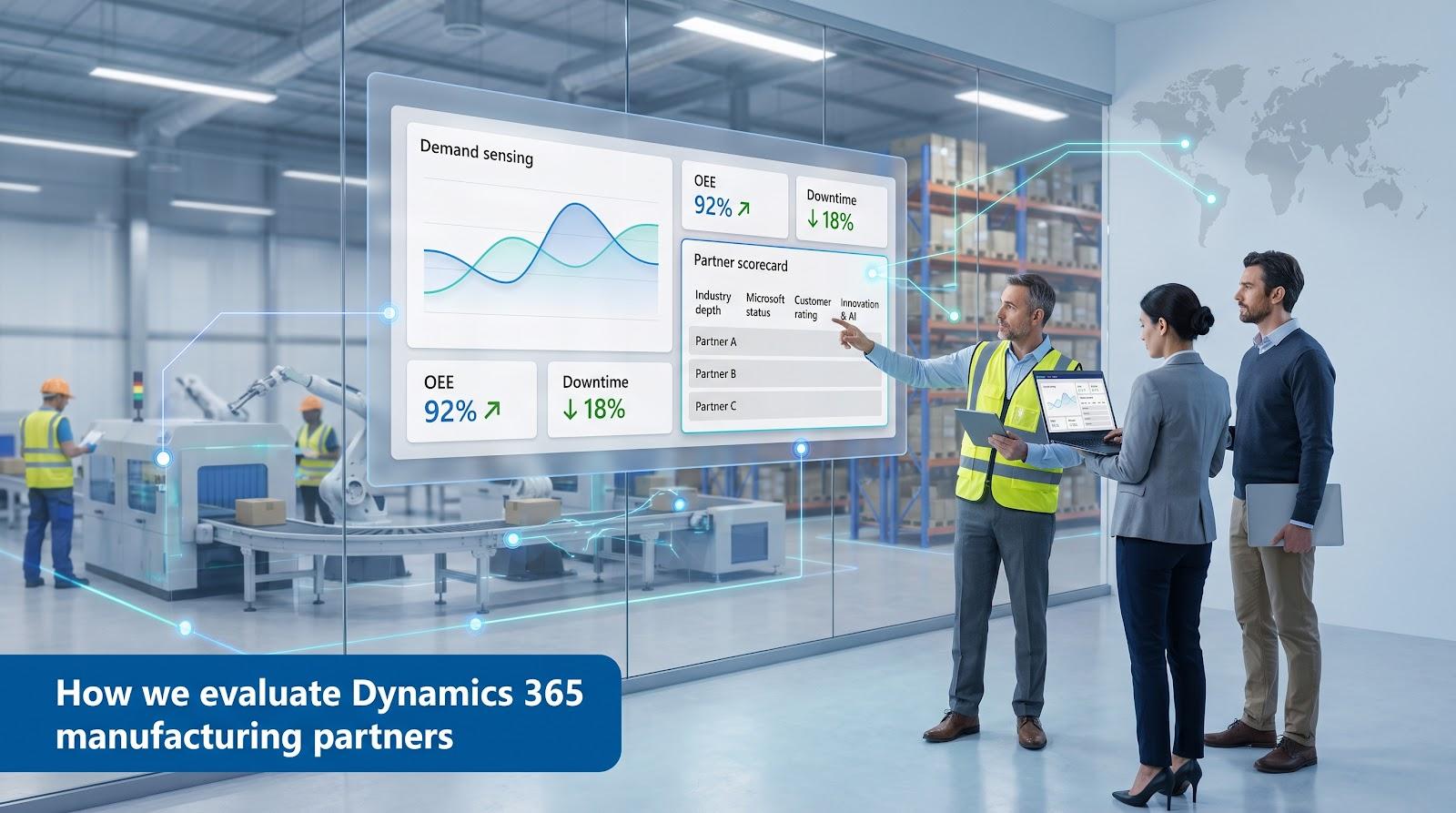
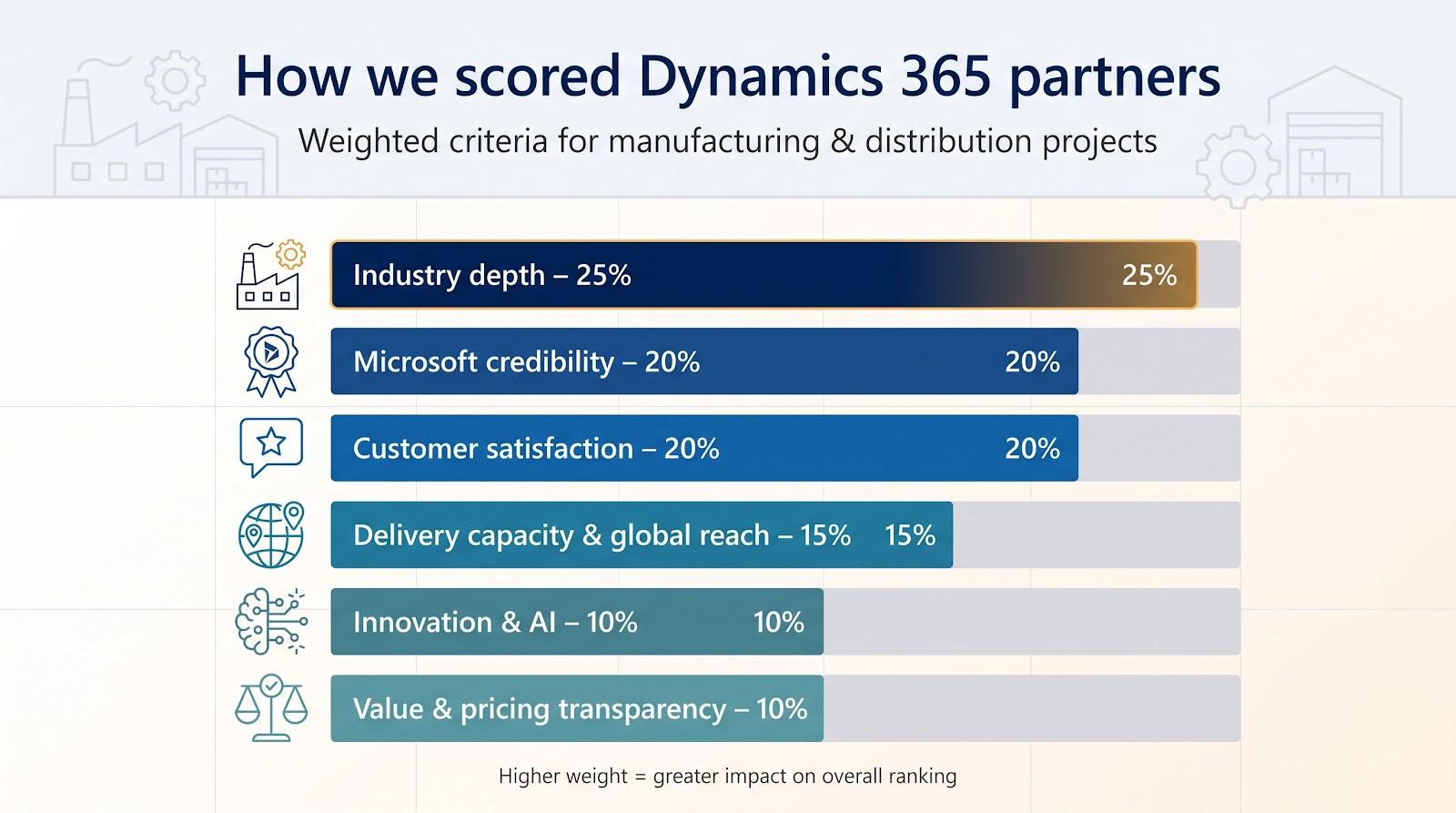
We didn’t settle for marketing claims. We built a simple scorecard that measures what matters to manufacturing and distribution leaders: proven vertical depth, real-world success, and forward-looking tech muscle.
First, we checked industry depth. A partner that tackles kanban re-planning or cold-chain traceability every week understands your headaches on day one. We counted recent go-lives, sector awards, and pre-built accelerators aimed at plant or warehouse workflows.
Second, we validated Microsoft credibility. Inner Circle recognition and the new Solutions Partner badges show the firm keeps its consultants current and has Microsoft’s ear when issues surface. Certifications alone don’t prove execution; they signal access to product teams and early features, which is critical when agentic AI now permeates every Dynamics module.
Third, we weighed customer satisfaction. Star ratings on Clutch and G2 are imperfect yet revealing: consistent 4.6+ averages across 30 or more reviews suggest a repeatable playbook, not lucky anecdotes. We also read unfiltered Reddit threads where practitioners praise partners who “stay engaged once the system is live” and warn that mega-integrators “charge a premium yet staff juniors.”
Finally, we factored delivery capacity, innovation, and value. Can the firm roll out to five continents without burning budgets? Are its architects already embedding Copilot demand sensing or low-code mobile apps? Does pricing stay transparent after change requests? Each criterion earned a weighted score; the totals drive the ranking you’re about to see.
With the ground rules clear, let’s meet the partners who passed this stress test.
1. MCA Connect: Built for Manufacturing, Not Just ERP
You won’t spend weeks explaining takt time or lot traceability. MCA Connect focuses exclusively on manufacturing and distribution. Its ERP Implementation for Manufacturing and Distribution program channels that focus through the Connected Blueprint™ methodology to replace fragmented legacy systems with a unified Dynamics 365 backbone, often delivering visible efficiency gains within six weeks.
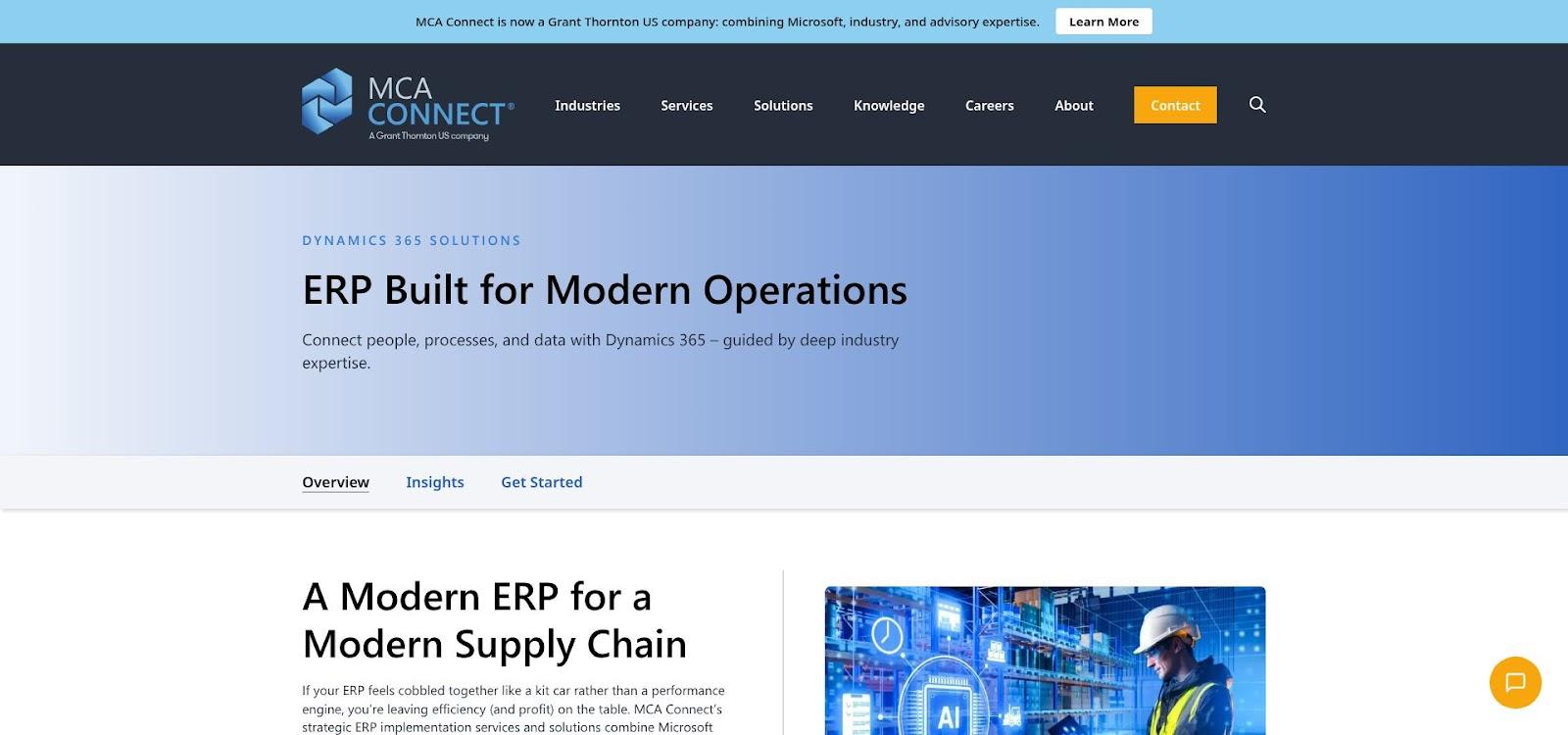
MCA Connect Dynamics 365 ERP implementation for manufacturing and distribution screenshot
Microsoft keeps handing the firm trophies for a reason. In 2023 it received the US Partner of the Year award for Dynamics 365 Supply Chain and appeared on the global finalist list the same day. That recognition matters when a production-stopping bug needs escalation to Redmond.
Customers rely on MCA’s pre-configured templates (Automotive, Industrial Equipment, Complex Assembly) to cut blueprint time. One food-packaging client reported getting 85 percent of its warehouse processes out of the box, then used the saved budget for predictive-maintenance analytics.
The consultants you meet in presales are the ones who arrive on Monday. The bench is smaller but more senior, which rewards companies that want architects on the floor, not junior coders on video calls.
Pricing sits in the upper-mid tier, yet CFOs we interviewed say overruns are rare because scope stays tight. If you need a plant-ready system, not a generic ERP shell, MCA Connect is the partner to beat.
2. Hitachi Solutions: Global Muscle With IoT-powered Insight
When your factories span continents and your product data lives in half a dozen systems, scale matters. Hitachi Solutions brings a 3,500-strong team backed by a parent company that builds bullet trains and power grids. That industrial pedigree shows up in project rooms: consultants talk OEE and MES integrations before they mention licenses.
Hitachi’s secret weapon is its IoT and AI labs. These teams connect machine sensors to Dynamics 365 Supply Chain, then surface real-time alerts for line supervisors. One automotive customer cut unplanned downtime by 18 percent after Hitachi wired predictive-maintenance models into work-order flows.
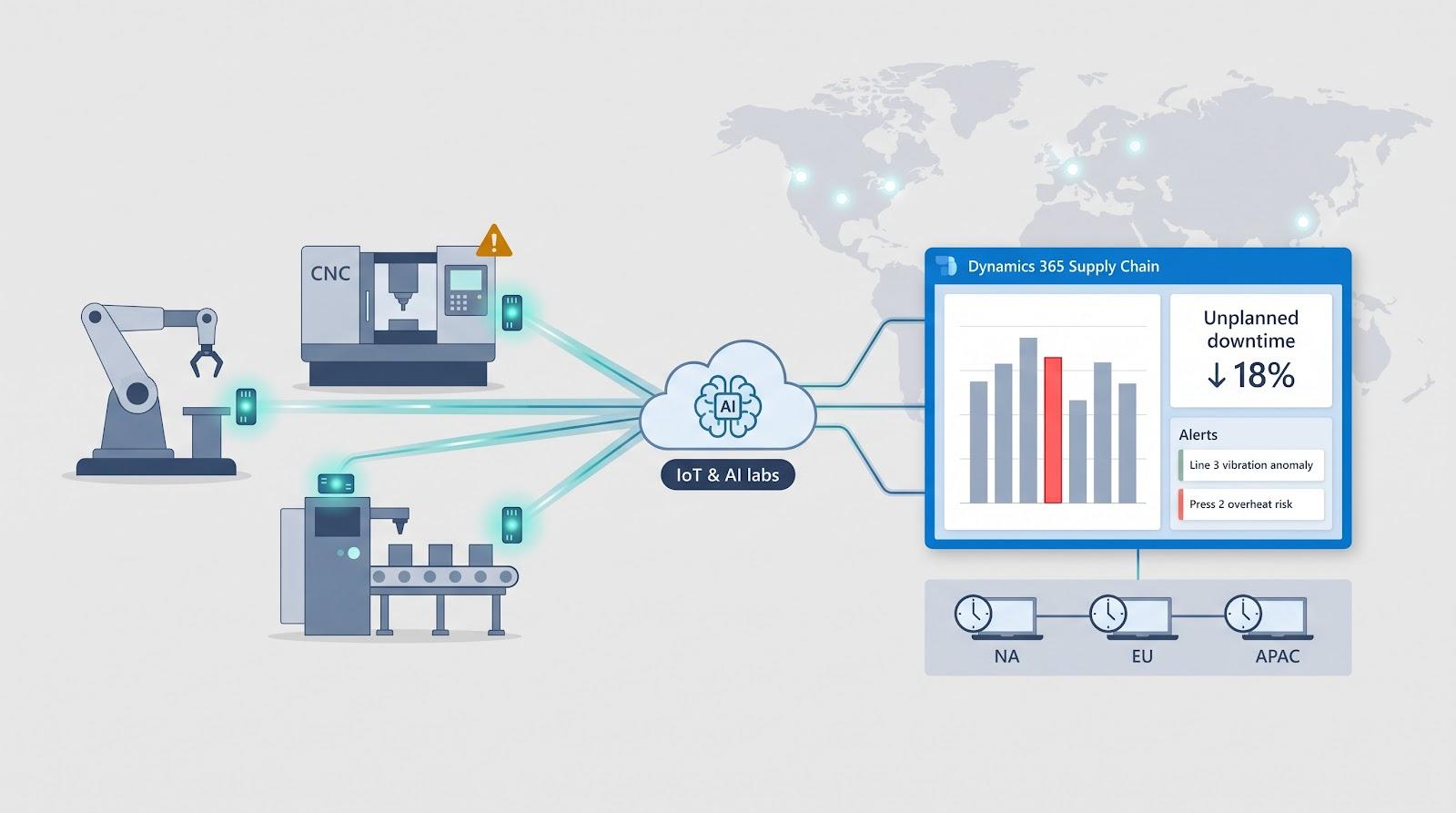
Global reach means follow-the-sun support. North-American architects kick off a solution, European engineers refine local tax rules, and an APAC data squad trains Copilot models while you sleep. That orchestration keeps multisite rollouts moving even when customs delays hardware on one side of the world.
Expect enterprise rigor. Statements of work run hundreds of pages, governance meetings follow a set cadence, and price tags reflect the bench strength. Mid-market manufacturers sometimes feel the weight of that process, yet Fortune 500 operations directors call it insurance against project drift.
If you need a partner that can harmonize forty plants, four languages, and a flood of sensor data without flinching, Hitachi Solutions earns its spot near the top.
3. Avanade (Accenture): Enterprise Rollouts at Warp Scale
When corporate boards demand a synchronized ERP across dozens of subsidiaries, Avanade deploys a large, seasoned team. As a joint venture between Accenture and Microsoft, it taps both firms’ budgets and R&D pipelines to stretch the limits of Dynamics 365.
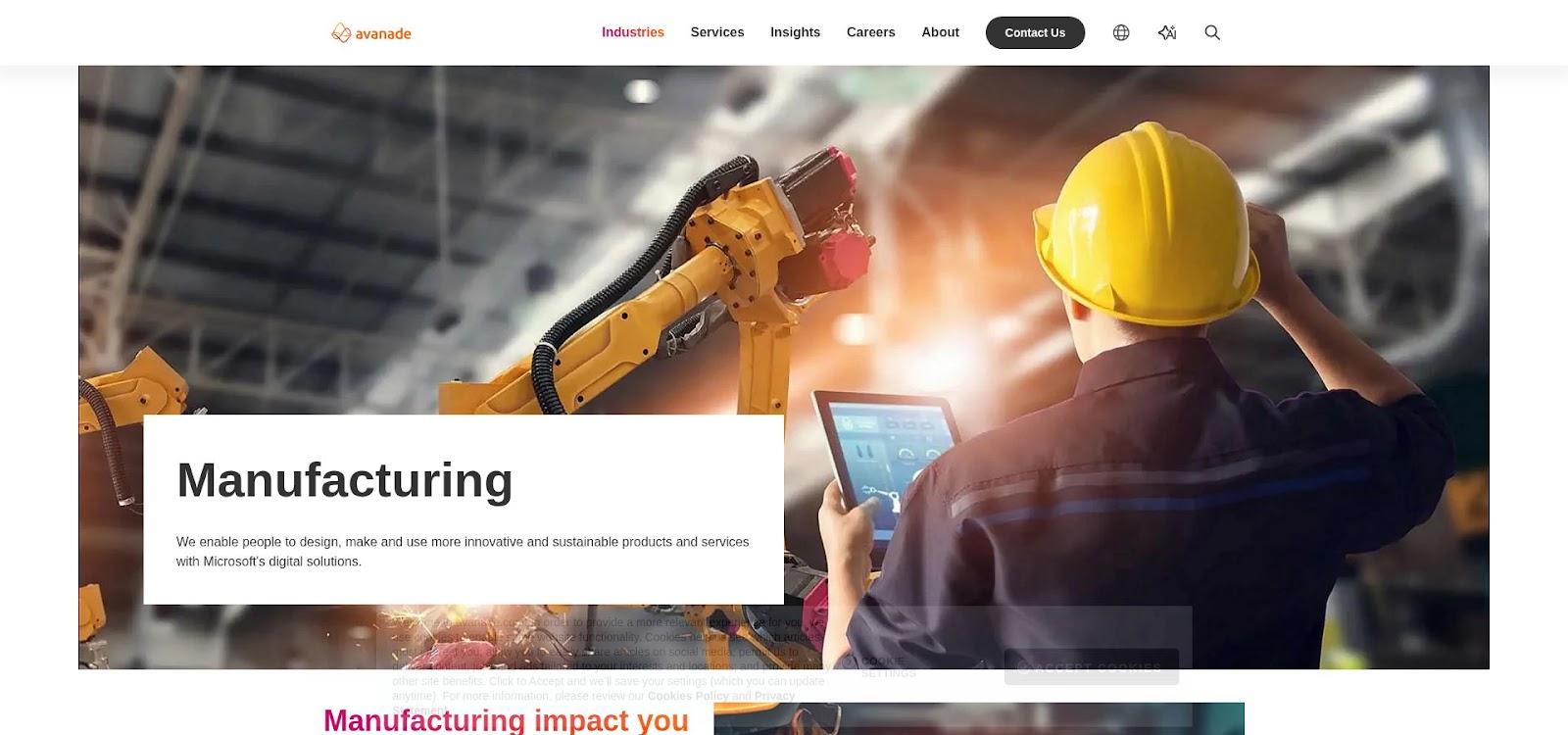
Avanade Microsoft Dynamics 365 manufacturing solutions website screenshot
Customers feel the scale immediately. Avanade prototypes in dedicated innovation centers, pulls real production data into sandboxes, and assigns each workstream to a specialist guild—finance, supply chain, customer engagement, analytics. That guild model keeps expertise sharp even on programs topping 1,000 users.
Large does not mean slow. Avanade’s accelerators compress design cycles. A high-tech manufacturer in California moved from blueprint to first-plant go-live in ten months, despite more than twenty legacy integrations. Consultants credit a library of pre-configured Copilot scenarios—demand spikes, late supplier alerts, predictive cash forecasting—that drop straight into the build.
The flip side is cost. CIOs joke the quote needs pagination. Mid-market firms can feel lost in Accenture’s service pyramid, and Reddit veterans advise confirming you are a strategic account or risk seeing senior architects disappear after kickoff.
Still, for global manufacturers that need strict governance, multilingual compliance, and direct access to Microsoft engineering escalations, Avanade remains the heavyweight of choice.
4. HSO: Process Discipline for Mid-market Manufacturers
HSO occupies a sweet spot: big enough to staff cross-border rollouts, focused enough that your project still matters to the C-suite. Born in the Netherlands, the firm has spent three decades refining ERP for equipment makers, apparel brands, and industrial distributors across Europe and North America.
Clients praise HSO’s playbook. Every phase follows the same rhythm—vision workshop, fit-gap, sprint, retro—so momentum never stalls. A UK steel processor said the predictable cadence kept forty stakeholders aligned and delivered go-live only two days off the original plan.
Methodology alone does not win medals; industry IP does. HSO’s Excellerate templates preload Dynamics with make-to-order BOM rules, rental contract logic, and warehouse wave picking. That head start slashes configuration hours and reduces testing cycles.
Governance is rigorous. Steering committees meet bi-weekly, risks rank red-amber-green, and change requests enter a digital portal for full traceability. Some smaller teams find the process heavy, yet most agree it prevents the scope creep that wrecks budgets elsewhere.
If you value on-time, on-budget delivery over shiny slide decks, HSO’s process discipline makes it a reliable co-pilot for your next plant or distribution-center upgrade.
5. Sunrise Technologies: Fashion-fast ERP With Global Support 365
Seasonal collections, colorways, and last-minute retailer demands give apparel and consumer-goods manufacturers zero margin for ERP delays. Sunrise Technologies built its reputation by delivering Dynamics go-lives that match that retail clock speed.
The firm’s Quick Start template seeds Dynamics 365 with size-color matrices, style hierarchies, and omnichannel allocation rules on day one. Implementation teams skip months of base configuration and move straight to testing critical edge cases, such as split POs across contract factories or flash-sale inventory reservations.
Sunrise is boutique by headcount, yet its follow-the-sun service desk spans every time zone through Global Support 365. Brands running overnight e-commerce drops report getting functional help before shoppers notice a glitch.
The client list reads like an industry showcase: outdoor gear, denim, luxury cosmetics. One accessories brand replaced three legacy systems with Sunrise’s stack and trimmed order-to-ship time by 22 percent during its first holiday peak.
The trade-off is scope discipline. Quick Start favors best-practice flows, so heavily engineered production processes can extend timelines. If your business mirrors most retail-driven manufacturers—dynamic styles, multichannel fulfillment, global suppliers—Sunrise turns Dynamics into a runway-ready platform sooner than most.
6. Columbus Global: Process Manufacturing Specialist With European Reach
Regulatory detail can derail even the best-planned ERP. Columbus Global built its business mastering those details for food, beverage, and process manufacturers across Europe and North America.
The firm’s ColumbusFood solution—now reborn on Dynamics 365—drops recipe management, lot traceability, and quality-hold workflows into your sandbox on day one. Compliance teams value the built-in audit trails; plant managers like skipping custom code.
Cross-border rollouts run smoothly because Columbus pairs a central program office with local consultants who know every VAT nuance and labeling rule. A Scandinavian dairy cooperative credited that model for trimming three months from its multi-country deployment.
Columbus also bridges front and back office. CRM, e-commerce, and Power BI arrive under one statement of work, giving distributors a single throat to choke when customer promises slip. Mid-size firms appreciate the one-stop shop without Avanade-level fees.
The company is quieter about bleeding-edge AI, yet recent projects show Copilot-driven demand planning running beside traditional MRP. For manufacturers who prize regulatory confidence and end-to-end visibility over hype, Columbus Global delivers sturdy results.
7. RSM US: Finance-first Clarity for Mid-market Makers
Strong operations crumble if the books do not balance. RSM approaches Dynamics 365 from a CPA’s perspective, ensuring every production order, transfer, and rebate rolls cleanly into financial statements.
That lens matters for manufacturers juggling tight margins and audit scrutiny. RSM teams focus on revenue-recognition rules, landed-cost allocations, and tax nuances long before go-live rehearsals. Controllers sleep easier; CFOs avoid year-end surprises.
The firm excels at upgrades. Thousands of NAV, GP, and AX clients have used RSM migration playbooks to reach Business Central or Finance & Supply Chain without data-loss drama. One plastics processor moved 12 years of transaction history and closed its first month in the new system four days faster than before.
Delivery stays personal. Project teams cap at eight to ten consultants, blending on-shore finance specialists with near-shore developers to keep rates predictable. Customers value the continuity: the architect who scopes fixed-asset rules often remains for post-go-live optimization.
RSM is not a pure AI laboratory. If predictive demand sensing tops your wish list, look higher in this ranking. For mid-market manufacturers seeking solid accounting and steady guidance, RSM provides uncommon financial diligence wrapped in practical ERP know-how.
8. Argano: Data-driven Transformation for High-tech Manufacturing
Argano may be a new brand, yet its core—Arbela Technologies—carries two decades of manufacturing DNA. The merger folded in analytics, CX, and low-code talent, giving mid-enterprise manufacturers a single partner fluent in both PLC tags and Power BI dashboards.
Argano’s calling card is actionable data. Before configuring a single field in Dynamics 365, consultants map every critical KPI—throughput, first-pass yield, warranty cost—into the data model. That discipline pays off when Copilot needs clean signals for anomaly alerts.
On the shop floor, Argano deploys accelerators for engineering change, advanced warehousing, and IoT-fed quality checks. An aerospace firm used those packs to cut non-conformance investigations from days to hours.
Team size sits comfortably between boutique and behemoth. You get named architects, yet enough bench depth to cover vacations without project pauses. Pricing lands mid-table, and Argano often bundles post-go-live analytics sprints so value keeps compounding.
If your board values real-time visibility as much as transaction processing, Argano turns Dynamics into a data-rich control center rather than just an ERP backbone.
9. Western Computer: Business Central Mastery for Small-to-mid Manufacturers
Not every plant needs a global systems integrator. Western Computer specializes in right-sizing Dynamics 365 Business Central for companies that count shop-floor staff in the hundreds, not thousands.
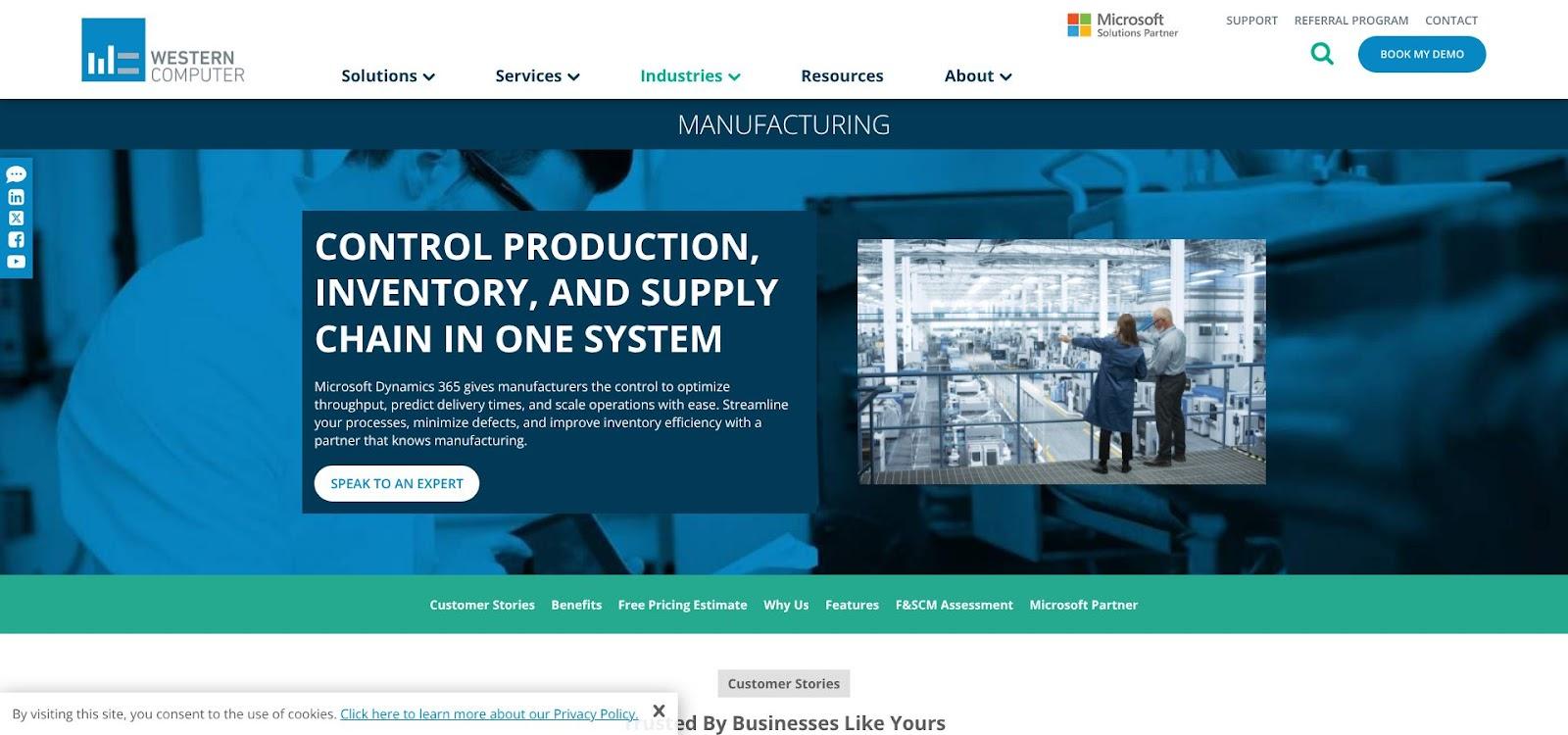
Western Computer Dynamics 365 manufacturing and Business Central solutions screenshot
Consultants speak lean manufacturing fluently. During discovery they walk the floor, map Kanban poles, and trim wasted screens before writing the first line of configuration. The payoff: simpler routings, faster material picks, and users who recognize their daily rhythm in the new system.
Customers highlight two differentiators. First, Western’s migration toolkit lifts years of NAV or GP history—serial numbers, lot attributes, posted documents—without crushing data budgets. Second, its support program pairs each client with a named Customer Success Manager who tracks KPIs long after go-live.
That service ethic drives ratings. Western averages 4.6 stars on G2 across more than 200 verified reviews, the highest score of any SMB-focused partner in this list. One electronics assembler praised the team for keeping the project on budget and answering late-night calls when its first physical count went live.
Limitations remain. The firm excels in Business Central; if you plan to leap straight into Finance & Supply Chain for complex global operations, choose a heavyweight. For growth manufacturers seeking quick wins, Western delivers enterprise rigor without the enterprise price.
10. HCL PowerObjects: Field Service Finesse and User-first Training
Many manufacturers sell more than products; they sell uptime. PowerObjects excels at getting service technicians to the site with the right part, the right history, and an app that works offline.
Rooted in Dynamics CRM, the firm layers Field Service and Customer Insights expertise onto core ERP projects. That front-to-back view is valuable for equipment builders that track warranties, dispatch engineers, and invoice contracts from the same platform.
Enablement sets PowerObjects apart. The PowerSuccess program includes admin coaching and short video libraries, so super-users stop logging tickets and start solving issues internally. One industrial-pump maker cut external support hours by 40 percent within six months of go-live.
Global capacity comes through parent HCL, yet project pods stay small and familiar—a mix of local consultants and offshore developers that keeps budgets stable. Customers call the time-zone hand-offs transparent; code ships overnight while on-shore leads handle design and change control.
If post-sale service drives your margin and your workforce thrives on self-service learning, PowerObjects can turn Dynamics 365 into a fully connected service platform.
How the Top Partners Stack Up at a Glance
You have met the leaders one by one. Now see them side by side.
The matrix below distills the traits that manufacturing buyers ask about most—industry depth, typical project size, Microsoft recognition, global reach, and customer sentiment. Read it left to right to spot patterns fast: MCA Connect dominates vertical focus, Avanade towers on global reach, while Western Computer leads satisfaction in the SMB lane.
| Partner | Vertical focus | Microsoft status | Project size sweet spot | Global delivery | Avg. customer rating* |
|---|---|---|---|---|---|
| MCA Connect | 100 % manufacturing & distribution | Inner Circle, 2023 US POY Supply Chain | Mid → Large | Americas + EMEA | 4.8 |
| Hitachi Solutions | High (discrete, IoT) | Inner Circle, multiple POY | Large enterprise | Global (40+ countries) | 4.5 |
| Avanade | Medium (multi-industry) | Inner Circle, Advanced Specializations | Mega enterprise | Global (60+ countries) | 4.0 |
| HSO | High (equipment, apparel) | Inner Circle | Upper-mid → Large | NA + EU + APAC | 4.4 |
| Sunrise Tech | High (apparel, CPG) | Solutions Partner | Mid-market | NA + EU + Asia | 4.6 |
| Columbus Global | High (process, food) | Inner Circle | Mid-market | EU-led global | 4.3 |
| RSM US | Medium (finance-first) | Solutions Partner | SMB → Mid | US + CAN | 4.4 |
| Argano | High (high-tech, aero) | Inner Circle via Arbela | Mid-enterprise | NA + EMEA | 4.5 |
| Western Computer | Medium (SMB manufacturing) | Solutions Partner | SMB | US nationwide | 4.6 |
| PowerObjects | Medium (service-centric) | Solutions Partner | SMB → Mid | Global via HCL | 4.3 |
*Ratings combine G2 and Clutch where available, rounded to one decimal.
Niche Specialists Worth Your Shortlist
Big names are not the only route to success. A few laser-focused partners solve very specific manufacturing puzzles better than anyone else. Consider these three when their niche matches your bottleneck.
iNECTA: Food & Beverage Purity
From catch weight to allergen audits, food ERP demands quirks many generalists miss. iNECTA’s Business Central add-on installs recipe management, lot traceability, and FDA compliance reports as soon as the database spins up. Mid-sized seafood, produce, and meat processors report go-lives measured in months, not years.
Syvantis: Hands-on care for Under-$50 M Plants
Small manufacturers often fear becoming a “practice project” at large consultancies. Syvantis keeps teams tight—one architect, one developer, one trainer—so every call is with someone who knows your chart of accounts. Clients cite predictable bills and weekend availability as lifesavers during cut-over.
Scales Group: Nordic Localisation Minus the Pain
If your roadmap includes Sweden, Denmark, or Norway, local payroll, VAT, and language packs can derail schedules. Scales Group, founded by former Columbus IT veterans, owns those localisations and pairs them with standard Finance & Supply Chain rollouts. Multinationals running phased European expansion rely on Scales to land the first site cleanly, then template the rest.
Next Steps: Turn a Shortlist Into a Signed, Successful Partnership
Lists are useful; due diligence wins projects.
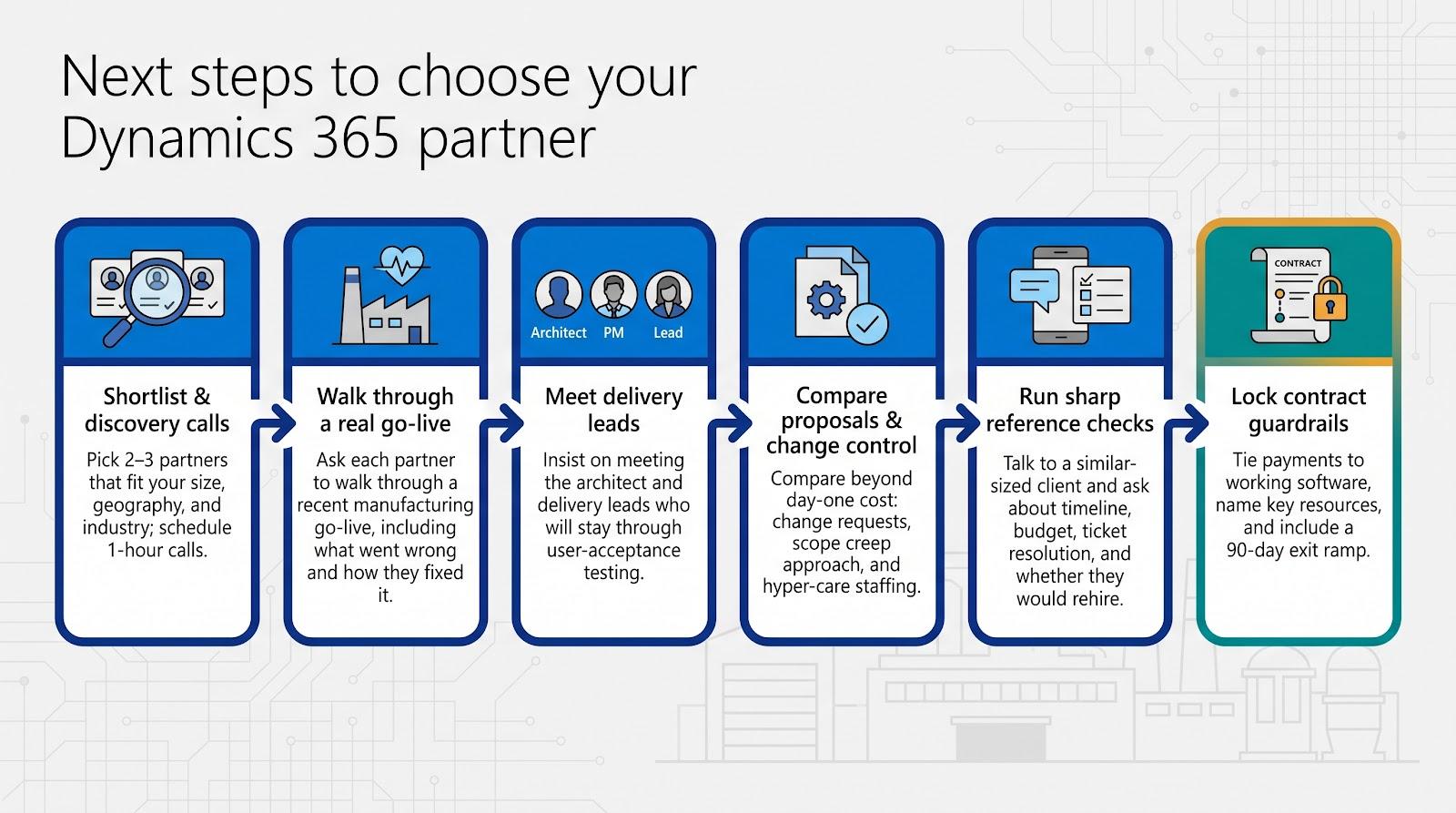
Start by scheduling one-hour discovery calls with two or three partners that match your size, geography, and industry focus. Ask each team to walk through a recent manufacturing go-live, including the recovery steps when things went wrong. You will learn more from their fix stories than their victory laps.
Before proposals land, insist on meeting the actual delivery leads. The architect who sketches your data model today should still be in the room when user-acceptance testing starts. Partners that hesitate here often swap seniors for juniors once the contract is signed.
When the quotes arrive, compare more than day-one cost. Review how each partner prices change requests, handles scope creep, and staffs hyper-care. A low bid that doubles after two change orders is costlier than a firm estimate with a solid contingency.
Keep your reference checks sharp. Talk to a client whose revenue and plant count mirrors yours, not a global outlier that flatters the partner. Ask three questions:
1. Did the partner finish within 10 percent of the original timeline and budget?
2. How fast did support tickets resolve after go-live?
3. Would you hire them again without competitive bidding?
Finally, lock success into the contract. Tie milestone payments to working software, include a named-resource clause for key roles, and agree on a 90-day exit ramp if either side misfires. Clear guardrails protect both teams and keep momentum high.
Do this groundwork now and the partner you choose will not just deploy Dynamics 365; it will amplify the way your factory, warehouse, and customers already work while opening doors to the AI-driven possibilities ahead.








 Business Programs
Leave a Reply
Want to join the discussion?Feel free to contribute!