 A VETERAN OWNED SMALL BUSINESS |
What Tools Are Most Effective for Advanced Merchandising Strategies?

Why Should Retailers Transition to AI-Driven Merchandising Tools?
For years, digital merchandising relied on a dangerous mix of intuition, static rules, and manual spreadsheets. Retailers would manually curate category pages, pin popular products to the top, and hope for the best.
In 2026, this approach is no longer viable. Consumer expectations have shifted dramatically toward hyper-personalization. According to research by Accenture, 84% of consumers are interested in personalized products, and many are willing to pay a premium for them. When brands fail to deliver accurate, relevant experiences, the consequences are immediate: 76% of consumers view brands negatively when they receive inaccurate or irrelevant information in advertising and messaging.
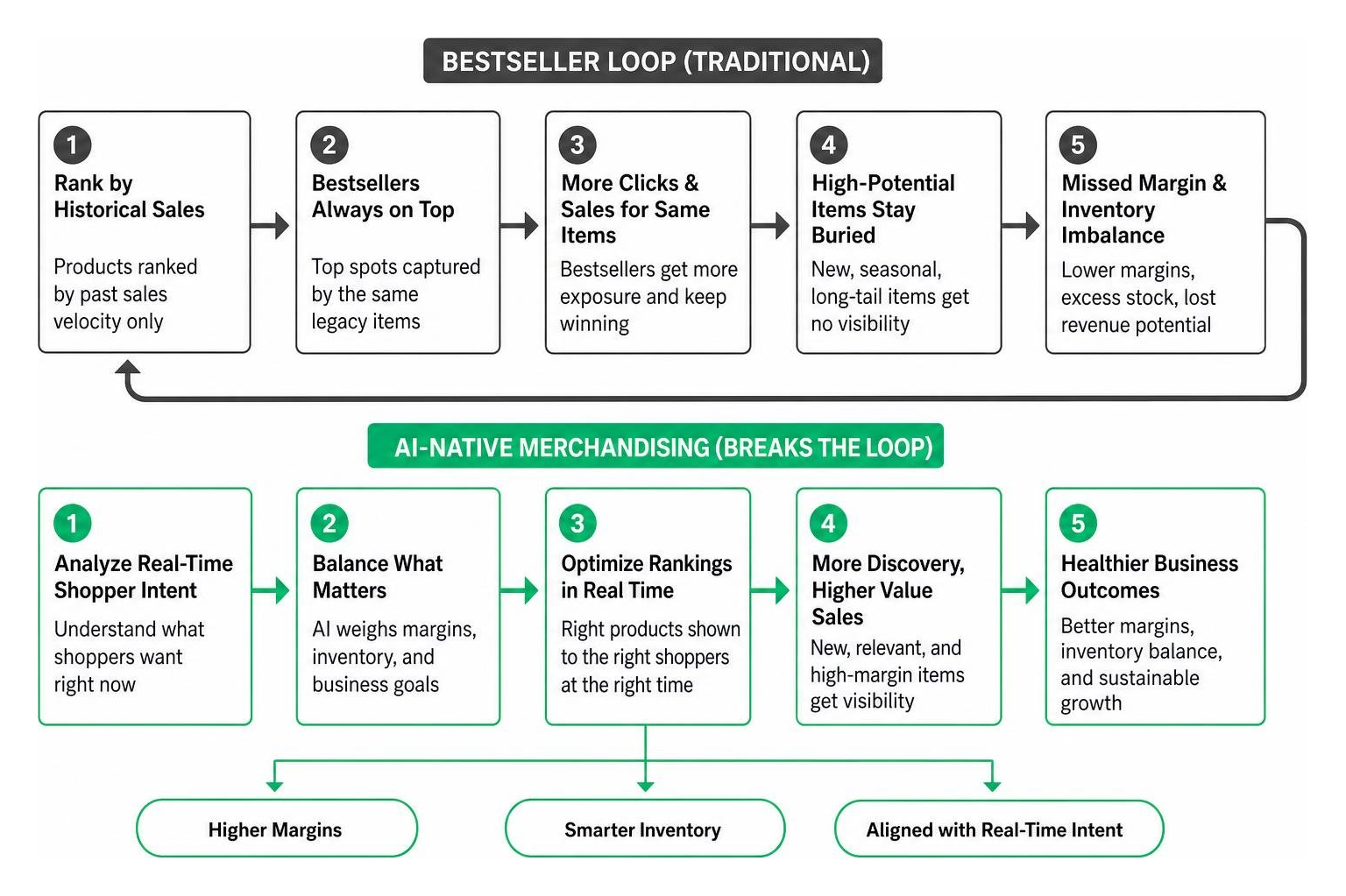
Traditional eCommerce setups often trap retailers in a self-defeating “bestseller loop.” This occurs when a merchandising system automatically ranks products solely by historical sales velocity. Because these legacy items sit at the top of category pages, they continue to gather clicks and sales, while high-margin new arrivals, seasonal items, and long-tail inventory remain buried on page three where no one can find them.
Advanced, AI-driven merchandising tools break this loop by analyzing real-time shopper intent alongside business metrics. Instead of relying on static, historical data, these tools dynamically balance automated machine learning algorithms with granular merchant controls—such as boosting, burying, pinning, and slotting—to align what the shopper wants with what the business needs to sell.
Increasing Average Order Value (AOV) and Conversion Rates
Advanced merchandising tools do more than just clean up search results; they actively drive larger basket sizes. By utilizing predictive bundling and “Complete the Look” recommendations on product detail pages (PDPs), these systems suggest highly relevant, complementary items based on what other customers bought or what visually matches the current product.
At checkout, instead of showing generic impulse items, smart systems display “Don’t Forget” and “Complete Your Order” prompts. These recommendations are generated in real time, analyzing the exact combination of items in the shopper’s cart to suggest low-barrier, high-margin accessories that naturally boost AOV.
Streamlining Internal Merchandising Operations
Manual category sorting is an operational bottleneck. Merchandisers historically spent hours every week dragging and dropping product tiles, updating out-of-stock listings, and setting up seasonal promotions across hundreds of collection pages.
AI-driven automation eliminates this tedious manual labor, saving teams up to 7 hours of manual work per day. By replacing static spreadsheets with visual drag-and-drop interfaces that sync instantly with live product data, commercial teams can manage multiple categories at once, preview layouts in real time, and focus on high-impact creative styling and strategic campaign planning rather than repetitive operational tasks.
What Key Features Define an Effective Advanced Merchandising Tool?
To build a high-performing commerce experience, retailers must select tools that go beyond basic keyword matching and rigid, rule-based sorting. Modern merchandising requires a platform capable of processing massive amounts of data instantly to deliver a unified, multi-channel experience.
| Feature / Capability | Traditional Rule-Based Tools | AI-Native Discovery Platforms |
|---|---|---|
| Data Processing Latency | Batch updates (hourly, daily, or weekly) | Real-time stream processing (sub-second) |
| Personalization Depth | Broad demographic segments or static rules | 1:1 dynamic personalization based on real-time intent |
| Inventory Awareness | Manual burying or basic out-of-stock rules | Automated AI substitutions and margin-optimized boosting |
| Manual Effort Required | High; constant rule creation and spreadsheet management | Low; self-learning algorithms guided by strategic guardrails |
An effective merchandising tool must differentiate between a first-time visitor and a returning loyal customer. By capturing intent-rich clickstream data, historical purchase patterns, and real-time browsing behavior, the platform can dynamically adjust homepage banners, category page layouts, and search grids on the fly. For instance, if a returning customer has previously browsed and purchased outdoor gear, the homepage can automatically highlight seasonal rain jackets and hiking boots, while a first-time visitor is greeted with a broader, trend-based catalog display.
Real-Time Inventory and Catalog Integration
Few things frustrate online shoppers more than clicking on an item only to find it is out of stock at checkout. Advanced merchandising tools integrate directly with your inventory management systems to prevent this.
When stock levels drop below a certain threshold, the system automatically buries those SKUs or suggests real-time AI substitutions that match the shopper’s original intent. Conversely, if a retailer has overstocked or high-margin SKUs, the tool can strategically boost these items to prominent positions on search and category pages—without breaking search relevance or compromising the user experience.
Omnichannel Support and Conversational Search
Modern commerce is inherently omnichannel. Shoppers expect a consistent experience whether they are browsing on a desktop, using a mobile app, or interacting with digital kiosks in a physical store.
Furthermore, search behavior has evolved from robotic keyword inputs to conversational queries. With 142 million individuals utilizing voice search technology and 50% of the US population employing it, merchandising tools must feature advanced Natural Language Processing (NLP) capabilities. This allows the system to interpret complex, conversational language (e.g., “warm brownish jacket for rainy spring weather”) and return accurate, visually matching results rather than empty search pages.
How Do You Successfully Integrate and Configure Merchandising Tools?
Implementing an advanced merchandising solution requires a structured approach to ensure it integrates seamlessly with your existing eCommerce tech stack—including your Product Information Management (PIM) system, ERP, and frontend discovery layers.
Establishing a Robust Data Foundation
Before configuring any frontend personalization rules, you must build a clean, unified data foundation. This involves aggregating product data, inventory levels, profit margins, and customer segments into a single source of truth.
To support international growth, ensure your chosen platform supports robust data structures, including multilingual pricing, currency-aware logic, and customizable data keys. A clean data foundation ensures that your AI algorithms are making recommendations based on accurate, up-to-date business metrics.
Setting Strategic Merchandising Rules
While AI handles the heavy lifting of daily optimization, commercial teams must retain control to steer the platform toward business goals. Retailers should configure global and category-specific rules to support seasonal promotions, product launches, and supplier agreements.
By using flexible “boost and bury” parameters, you can highlight strategic SKUs or campaign items across search results, category pages, and recommendation carousels simultaneously, ensuring your marketing efforts are fully aligned with your digital storefront.
Continuous Monitoring, A/B Testing, and Optimization
Merchandising is not a “set-it-and-forget-it” project. To maximize your return on investment, you must continuously monitor performance and run guided experiments.
Use built-in analytics dashboards to set up A/B tests comparing different sorting logics—such as testing a margin-optimized collection layout against a bestseller-focused layout. Track critical Key Performance Indicators (KPIs), including:
- Click-Through Rate (CTR) on category and search pages
- Conversion Rate of search users versus non-search users
- Average Order Value (AOV) driven by recommendation modules
- Sell-Through Rate of newly launched or promoted collections
- Dwell Time on visual and interactive product displays
Regularly reviewing these insights allows you to refine your merchandising rules and ensure your storefront remains optimized for both customer satisfaction and profitability.
How Is AI-Native Search Transforming the Future of Product Discovery?
As we progress through 2026, the landscape of eCommerce merchandising is undergoing a massive shift. Traditional keyword-matching search engines—which rely on exact text matches and manual synonym lists—are being replaced by AI-native search technologies that understand the true intent behind a shopper’s query.
The Role of Personalized LLMs in Merchandising
The future of advanced merchandising lies in vector search and large language models (LLMs) trained specifically on a retailer’s unique catalog, brand voice, and customer behavior. Unlike generic search tools, an AI-native platform like Marqo uses machine learning to build a deep, semantic understanding of your products.
When a shopper searches for “beach wedding guest attire,” a traditional search engine might look for products containing those exact keywords, often returning zero results. An AI-native search platform, however, understands the concept of “beach wedding” and automatically surfaces lightweight fabrics, pastel maxi dresses, and linen suits—even if those products aren’t explicitly tagged with the word “wedding.”
By implementing Personalized AI merchandising tools like Marqo’s AI-native search platform, retailers can deliver highly accurate, context-aware product discovery that naturally boosts conversion rates, reduces search abandonment, and maximizes customer lifetime value.
Visual AI and Automated Tagging
Another major breakthrough is the integration of computer vision and Visual AI. Instead of relying on manual product tagging—which is slow, inconsistent, and prone to human error—Visual AI automatically scans catalog images to identify and tag attributes like style, cut, color variations, and patterns.
This automated enrichment of product metadata powers more precise filtering, highly accurate “Shop the Look” recommendations, and advanced visual search capabilities, allowing shoppers to upload an image or screenshot to instantly find matching items in your catalog.
Frequently Asked Questions About Advanced Merchandising Tools
1. What is the difference between eCommerce merchandising and traditional retail merchandising?
eCommerce merchandising focuses on dynamic, data-driven digital experiences. It uses real-time algorithms, personalized search, automated recommendation carousels, and dynamic collection sorting to tailor the storefront for individual shoppers. In contrast, traditional retail merchandising centers on physical store environments, focusing on window displays, shelf placement (such as placing profitable items at eye level), store layouts, and in-person sensory engagement.
2. How do merchandising tools prevent lost sales from out-of-stock items?
Advanced merchandising tools integrate directly with real-time inventory management systems. When an item or specific variant goes out of stock, the tool automatically buries it on category and search pages to prevent shopper frustration. Additionally, advanced platforms can display real-time AI substitutions—suggesting highly similar, in-stock products that match the customer’s size, color, and style preferences—to keep the shopper on the path to purchase.
3. Why is a unified commerce experience platform better than using multiple single-point apps?
Using multiple single-point apps for search, personalization, and recommendations often leads to data silos, conflicting product displays, and high frontend latency caused by multiple third-party JavaScript snippets. A unified commerce experience platform connects your customer, product, and content data in a single real-time engine. This ensures that your personalization rules, search results, and inventory-aware merchandising strategies work in perfect harmony, while significantly improving site speed and SEO performance.
Conclusion
Advanced merchandising is the intersection of customer-centric personalization and strategic business execution. In a retail landscape where consumers expect instant relevance, relying on static bestseller lists and manual spreadsheet management is a recipe for lost revenue.
By transitioning to AI-driven merchandising tools, retailers can automate tedious operational workflows, eliminate the “bestseller loop,” and dynamically optimize their storefronts for higher conversions, improved AOV, and healthier margins. The key to success lies in choosing a platform that balances powerful AI automation with flexible, intuitive merchant controls, allowing your commercial teams to steer the technology toward your business goals.
As technologies like vector search, visual AI, and personalized LLMs continue to redefine product discovery, investing in a modern, AI-native search and discovery platform like Marqo is the most effective way to future-proof your eCommerce tech stack and turn every browse into a buy.









 Business Programs

Leave a Reply
Want to join the discussion?Feel free to contribute!