 A VETERAN OWNED SMALL BUSINESS |

Organizational Accountability – Moral Hazard
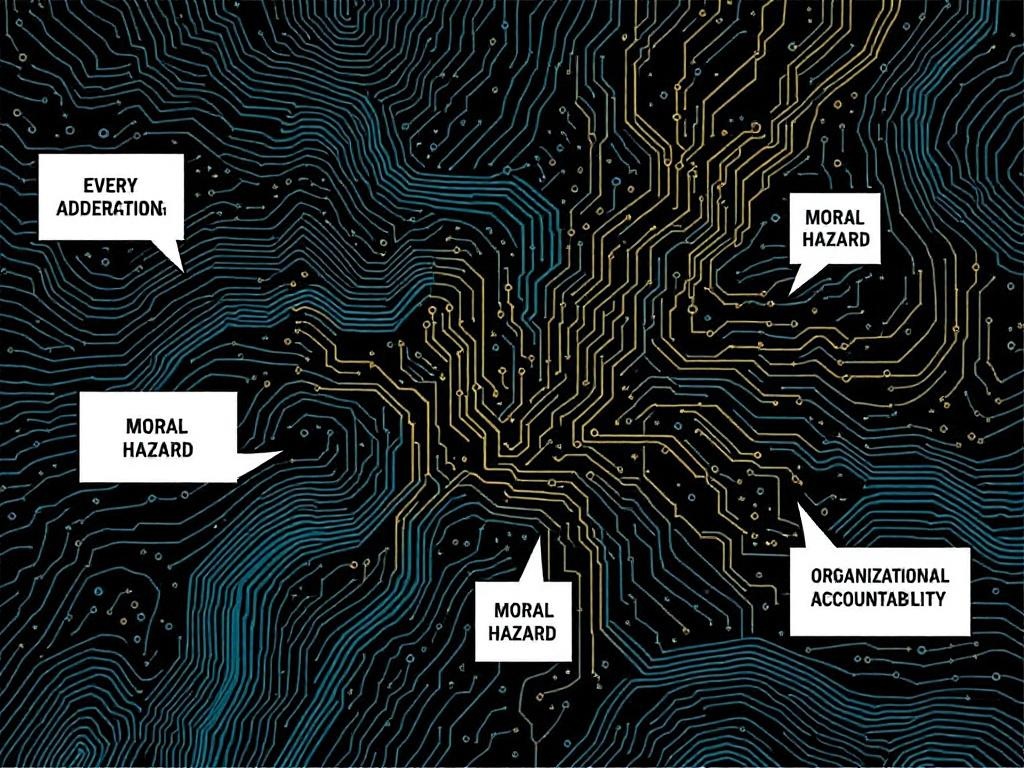
Moral hazard in organizations occurs when decision-makers enjoy rewards and prestige from risky choices while others absorb the costs — shareholders lose value, employees lose jobs, or taxpayers fund bailouts. I’ve observed this dynamic create a fundamental breakdown in organizational accountability, where the people who control resources don’t bear the full consequences of their actions, encouraging behavior that serves individual interests at the expense of long-term organizational health.
Key Takeaways
- Moral hazard emerges when decision-makers take excessive risks because another party bears the costs, enabled by information asymmetry and incomplete contracts.
- Organizations can reduce moral hazard through performance-based accountability systems that align incentives with long-term, risk-adjusted outcomes rather than short-term gains.
- Transparent metrics and data accountability dashboards expose where behavior diverges from policy, allowing stakeholders to detect and challenge opportunistic risk-shifting.
- Leadership behavior shapes 84% of accountability culture, yet 80% of people associate accountability with punishment rather than ownership and support.
- Effective accountability balances clear consequences with psychological safety, encouraging disclosure of risks and errors rather than driving information underground.
When Organizations Don’t Pay the Price: Understanding Moral Hazard and Accountability
Moral hazard describes a situation where an individual or organization has an incentive to take greater risks because another party bears most or all of the costs. Consider an immediate organizational example: executives paid for short-term share price performance can take excessive financial risks knowing generous severance packages protect them, while shareholders and employees absorb losses when those bets fail. This misalignment creates incentives that work against long-term organizational interests.
Moral hazard appears when decision-makers enjoy bonuses, prestige, or short-term gains while shareholders, employees, customers, or taxpayers absorb the downside through job losses, defective products, or bailouts. The phenomenon is fundamentally linked to information asymmetry and incomplete contracts, making it hard or costly to monitor behavior and assign full responsibility. Decision-makers exploit the fact that others can’t see or verify their actions until after consequences materialize.
I view moral hazard as a form of ex post opportunism — self-interested behavior after an agreement is in place, to the detriment of the other party. It’s not simply normal self-interest; it’s “self-interest seeking with guile” that deters parties from relying on one another as much as would be efficient. This opportunistic behavior creates friction in relationships and transactions, raising costs and reducing trust.
Organizational accountability serves as the antidote by reducing moral hazard through aligning decision-makers’ incentives with long-term organizational and stakeholder outcomes. Improved monitoring, transparency, and consequences help close the gap between who decides and who pays. I position moral hazard as both an economic and ethical issue: economically it causes inefficiency and waste; ethically it enables irresponsible behavior because decision-makers don’t bear full consequences of their actions.
Three conditions create the environment for moral hazard to flourish. First, divergent interests exist between actors — executives want bonuses while shareholders want sustainable returns. Second, a transaction or relationship activates those interests, such as employment contracts or loan agreements. Third, difficulty or costliness in monitoring whether parties honor terms creates high monitoring costs that make oversight impractical.
The concept of agency costs captures the full price organizations pay for moral hazard. Agency costs sum to three components: agents’ guarantee or bonding costs such as performance guarantees and risk retention; principals’ monitoring costs including audits, oversight, and reporting systems; and residual loss from remaining misaligned behavior that can’t be eliminated cost-effectively. Even with investment in monitoring and bonding, some opportunistic behavior persists because perfect oversight is impossible or prohibitively expensive.
Contrasting “normal self-interest” with “opportunistic self-interest with guile” clarifies the distinction. Everyone pursues their interests, but moral hazard involves deliberately exploiting information advantages to shift risk or hide actions. This pattern originated in the insurance industry, describing how insurance coverage can lead insured parties to take fewer precautions or more risks. Someone insured against theft may not bother installing an alarm system.
The connection flows logically through these stages: information asymmetry leads to incomplete contracts, which enable opportunistic behavior, which generates agency costs, which create the need for accountability mechanisms. This sequence explains why organizational moral hazard is a central issue in managerial economics and corporate governance, especially where managers control resources they don’t fully own. Shareholders can’t observe every executive decision, creating gaps that executives might exploit.
| Condition | Organizational Example |
|---|---|
| Divergent interests | “Heads I win, tails shareholders lose” executive bonus plan tied only to upside |
| Transaction/relationship | Employment contract giving manager discretion over capital allocation |
| Costly monitoring | Complex derivative trading desk where supervisor can’t verify each trade’s risk in real time |
Agency costs manifest in concrete ways throughout organizations. The cost of internal audit represents a monitoring cost — money spent verifying that managers use resources appropriately. Deferred compensation serves as a bonding cost, with executives posting their own future earnings as a guarantee against short-term manipulation. Yet even with robust audits and deferred pay, some managers still engage in empire-building or avoid difficult decisions, representing the residual loss that persists despite controls.
Where Moral Hazard Hides: Classic Domains and the Accountability Gap
Moral hazard surfaces predictably in insurance and risk management contexts. Once insured, individuals or firms may reduce precautions because they know losses are covered. A company with generous liability coverage might become lax about taking precautions to avoid or minimize losses, cutting back on safety training or equipment maintenance. The insured party enjoys cost savings from reduced precautions while the insurer bears increased risk.
Corporate governance provides fertile ground for moral hazard dynamics. Directors and executives may take excessive risks or prioritize personal rewards — bonuses, status, stock options — over long-term organizational health. An executive compensated primarily through quarterly earnings targets faces little personal downside from strategies that inflate near-term profits but create fragility. When the strategy unravels years later, that executive may have already moved on with accumulated bonuses intact.
The financial sector and bailouts illustrate moral hazard at systemic scale. Institutions that expect to be “too big to fail” may assume governments or taxpayers will absorb catastrophic losses, encouraging aggressive leverage and risk-taking. Before the financial crisis, many large banks operated with extreme leverage ratios, confident that their size and interconnectedness guaranteed rescue. Expectations of rescue transformed risk calculations, making bets that would be irrational for institutions bearing full downside suddenly appear attractive.
Employment relationships create another domain where moral hazard operates. Employees might exert less effort or take inappropriate risks if they believe the organization will bear consequences such as legal liability or reputational damage. A salesperson who promises unrealistic delivery dates to close deals doesn’t personally face customer lawsuits when the company fails to deliver; the legal department and company reputation absorb that cost.
Comparing before and after behaviors reveals the mechanism clearly. A firm’s safety practices before generous liability coverage typically include rigorous protocols and inspections. After obtaining coverage, management might view safety investment as less urgent since insurance caps the financial downside. Precautions decline not because risks changed, but because who pays for accidents changed.
Where consequences for poor decisions are minimal, decision-makers become more likely to take excessive risks or shift costs. I’ve identified several common organizational patterns. Executives rewarded for short-term metrics like quarterly earnings or share price pursue strategies that create long-term fragility. Leaders shield high performers from consequences of misconduct because of perceived value, signaling that results matter more than methods. Cross-functional work where no single owner is clearly accountable for outcomes leads to risk or blame-shifting, with each function assuming others are monitoring.
Uncertainty and difficulty in verifying behavior expand the scope for moral hazard. Complex financial products make it nearly impossible for boards to assess whether traders are taking prudent risks. Distributed teams working across time zones and business units create verification challenges where no one can confirm whether individuals honored commitments. Moral hazard becomes especially salient when “monitoring actions or verifying reported information is costly or impossible,” increasing risk of opportunistic behavior that goes undetected until failure occurs.
The cause-effect narrative runs directly from structural weaknesses to moral hazard events. Low monitoring capability combines with unclear accountability structures and perverse incentives to produce opportunistic risk-taking. This risk-taking eventually materializes as moral hazard events — losses, scandals, regulatory violations — that harm stakeholders who weren’t making the decisions.
Consider an anonymized case: a product development project failed after eighteen months and significant investment. Post-mortem analysis revealed no single leader had clear accountability for the business case. Engineering assumed Marketing validated customer demand; Marketing assumed Finance approved the economics; Finance assumed Engineering confirmed feasibility. Each function took on riskier assumptions than they would have if personally accountable, creating a collective moral hazard where the organization bore the cost but no individual faced consequences.
Organizations can be mapped along a simple maturity model for moral hazard risk. “Reactive/blame” cultures show the highest risk — when failures occur, leaders seek scapegoats rather than examining incentive structures, driving information underground and perpetuating conditions for moral hazard. “Compliance-only” cultures reduce some risk through formal controls but don’t address underlying incentive misalignments. “Ownership and learning” cultures show the lowest moral hazard risk by combining clear accountability with psychological safety, transparent metrics, and incentives aligned with long-term outcomes.
Building Accountability Systems That Actually Work: Metrics, Incentives, and Culture
Organizational accountability represents the expectation and practice that individuals and units answer for their decisions and results, with clear consequences, transparency, and alignment to shared goals. This isn’t merely a compliance exercise; it’s a fundamental mechanism for managing moral hazard by ensuring decision-makers bear appropriate consequences for their choices. I define effective accountability as the intersection of clear expectations, visible performance, and fair consequences.
Accountability is a leadership-driven phenomenon. Research shows that 84% of respondents cited the way leaders behave as the single most important factor influencing accountability in their organizations. Leaders who model accountability — admitting mistakes, following through on commitments, accepting consequences — create environments where others do the same. Conversely, leaders who deflect blame or ignore their own standards signal that accountability is performative rather than real.
The accountability culture is often misunderstood and feared. A striking 80% of people see accountability as punishing rather than supportive. This perception creates a paradox: organizations need accountability to reduce moral hazard, yet framing it punitively drives the information hiding and blame-shifting that enable moral hazard. I’ve found that reframing accountability from “finding who’s at fault” to “ensuring ownership and support” changes how people respond.
The business case for accountability extends beyond moral hazard reduction. Firms with highly engaged employees outperform those with weak engagement by up to 202% in overall performance. Accountability systems done well — with clear expectations, fair metrics, and constructive feedback — foster engagement rather than fear. Employees who know what’s expected, can track their progress, and receive support to improve demonstrate higher commitment and performance.
Comparing the 84% leadership influence statistic with the 80% “punishment” perception reveals a critical gap. Leaders shape accountability culture, yet most people experience accountability as a negative.


 Business Programs

Leave a Reply
Want to join the discussion?Feel free to contribute!