 A VETERAN OWNED SMALL BUSINESS |

Best Carbon Accounting Software for US Businesses in 2026

A customer questionnaire, a board summary and a lender’s data request can all send a finance team back to the same records: utility bills, fuel logs, purchasing extracts and supplier responses. Those records often sit in different departments, and nobody agrees on who owns the final number.
Carbon accounting software brings that data into one place, and it has become part of how many companies put sustainable business practices into measurable terms.
Bottom line: The right platform depends on what you need to report, who owns the data and how your company buys software. The five platforms below appear in reading order, not ranked order. Each fit label is an editorial judgment based on vendor product and pricing pages reviewed in October 2026, not hands-on testing.
Set Your Selection Criteria First
Before comparing features, agree on four things with the people who will supply and use the data.
- Reporting purpose. List the outputs you owe: a supplier questionnaire, a board summary, a lender request or a regulatory disclosure. Note which emissions each must cover.
- Scope 1 covers fuel your company burns directly.
- Scope 2 covers purchased electricity, steam, heat and cooling.
- Scope 3 covers the value chain, including purchased goods, travel and freight, and often requires supplier data.
- Data ownership. Name an owner for each source. Facilities may hold utility bills, fleet management holds fuel logs, and purchasing holds vendor spend. This affects user licenses and approval workflows.
- Calculation evidence. Ask to trace a reported figure back to its source document, activity quantity and emission factor. An emission factor converts an activity, such as gallons of fuel, into emissions. Check what the audit trail keeps when someone corrects an approved figure.
- Integration fit. A general claim of ERP connectivity doesn’t confirm compatibility with your system. Test the relevant connector with your own data during evaluation.
Quick Comparison
| Platform | Editorial fit | Published pricing | Main item to verify |
|---|---|---|---|
| Persefoni | Starting a first inventory | Free Pro plan; Advanced by quote | Which features are add-ons |
| Sweep | Multi-entity programs and supplier data | Request a quote | Package scope and frameworks needed |
| Watershed | Detailed Scope 3 measurement | Request a proposal | What human review covers |
| Microsoft Sustainability Manager | Microsoft-centered environments | US12,000 per tenant per month | Scope 3 coverage by tier |
| Salesforce Net Zero Cloud | Companies already on Salesforce | Growth edition published | Scope 3 coverage by edition |
1. Persefoni
Best fit: A company building its first repeatable inventory before committing a budget.
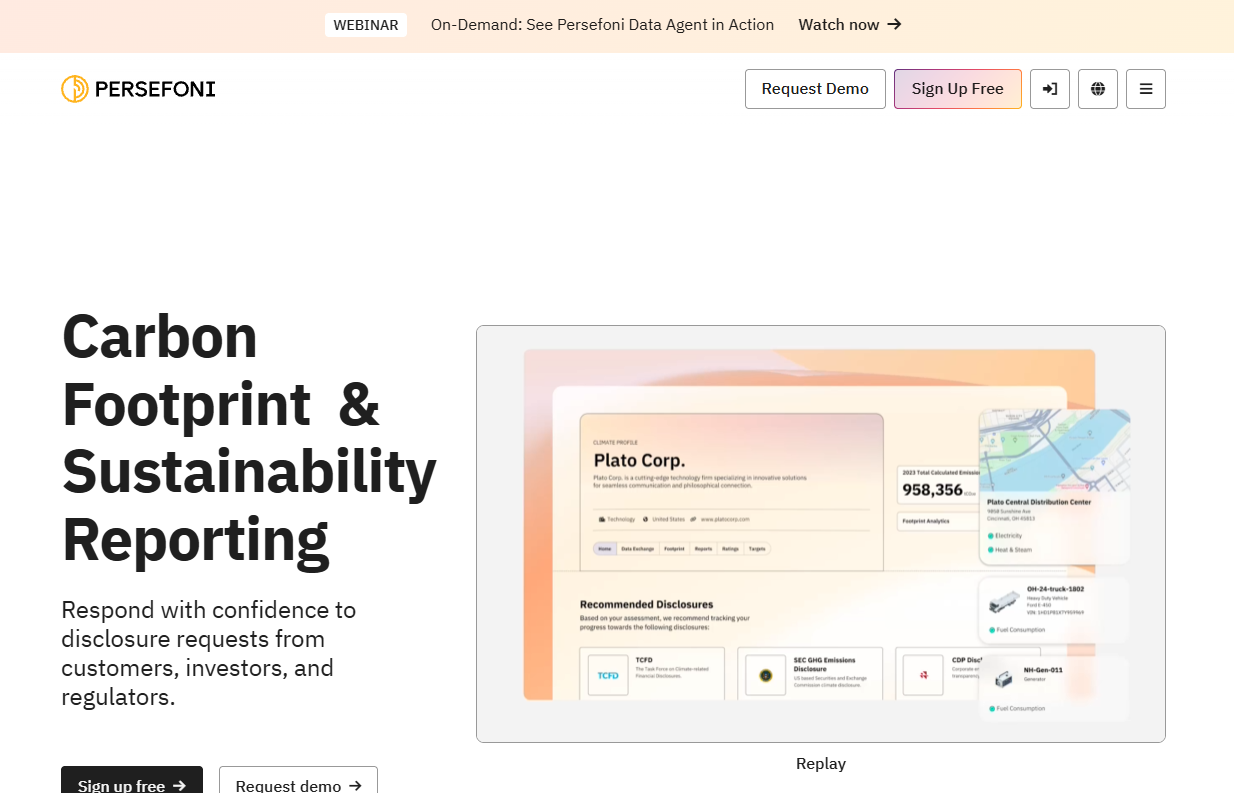
What it offers: Persefoni Pro is a free, self-service tier for measuring a company’s core Scope 1, 2 and 3 footprint.
What to check: Pro is limited to one user. Confirm that the exact output your customer or board needs is available before entering a year of data.
Pricing: Pro is free. Additional users and some features are add-ons on Pro, and the Advanced tier is priced by quote.
2. Sweep
Best fit: Companies managing emissions across several entities, suppliers and reporting frameworks.
What it offers: Sweep, the sustainability intelligence platform, also publishes this software shortlist for buyers comparing options. Its “Sweep trees” model organizational supply chains, backed by an extensive emission-factor library. Data uploaded once can be reported against CSRD, GRI, ISSB, TCFD and CDP, and the platform supports supplier engagement and science-based target setting.
What to check: Confirm which frameworks and supplier workflows your package includes. A Starter package serves growing businesses alongside enterprise plans.
Pricing: Request a quote based on your entities and scope.
3. Watershed
Best fit: Companies that need category-level Scope 3 results and receive data in inconsistent formats.
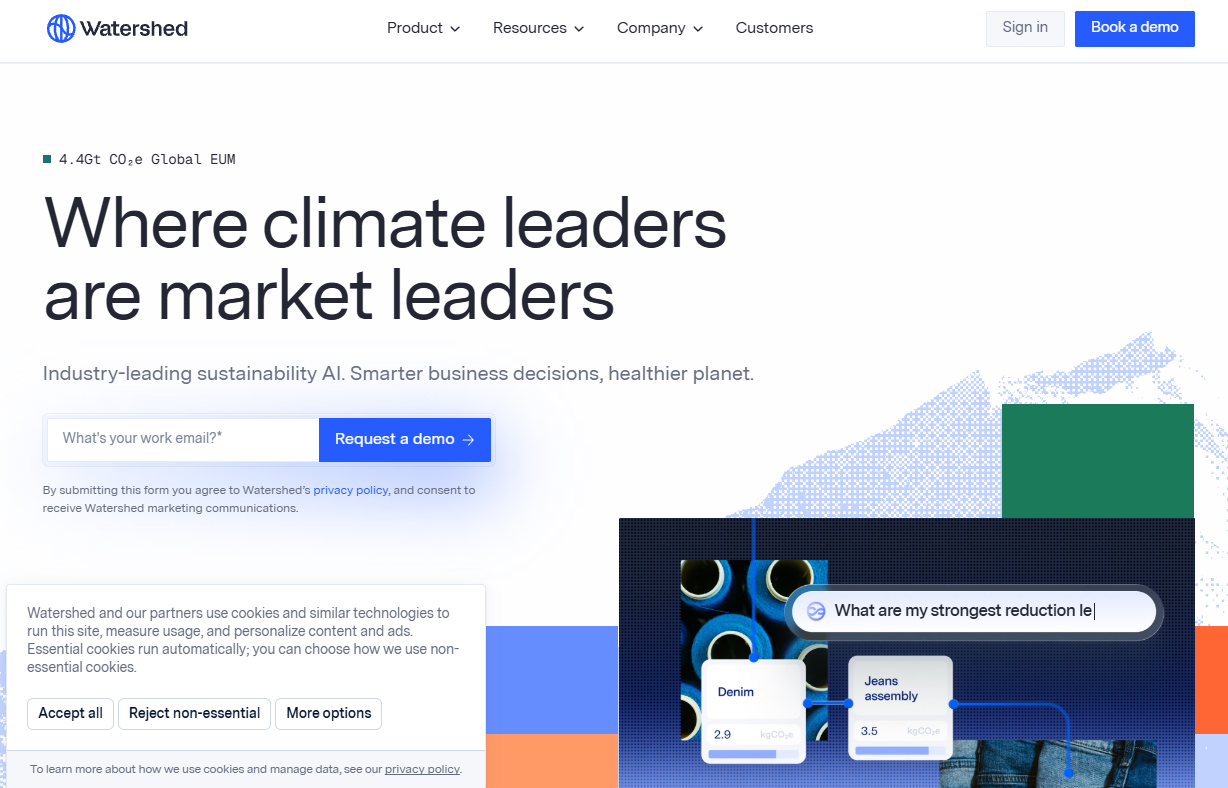
What it offers: Watershed advertises transparent calculations and built-in human review, with purpose-built methodologies for all 15 Scope 3 categories. It also offers activity-based measurement for purchased products and materials.
What to check: Ask who performs the human review, what it covers and how much data preparation your team must do. Follow one figure from its source document to the reported result.
Pricing: No public price on the reviewed pages. Request a proposal tied to your entities and categories.
4. Microsoft Sustainability Manager
Best fit: Companies already using Microsoft business applications, with IT capacity to configure the system.
What it offers: Microsoft Sustainability Manager offers two tiers:
- Essentials: calculation models for Scopes 1 and 2 and multiple Scope 3 categories.
- Premium: adds all of Scope 3 and product carbon footprint management.
A 30-day free trial is available.
What to check: Map your required Scope 3 categories against each tier. Ask which features are in preview and which are generally available.
Pricing: Essentials is US12,000 per tenant per month. These are tenant subscriptions, so budget implementation and partner services separately.
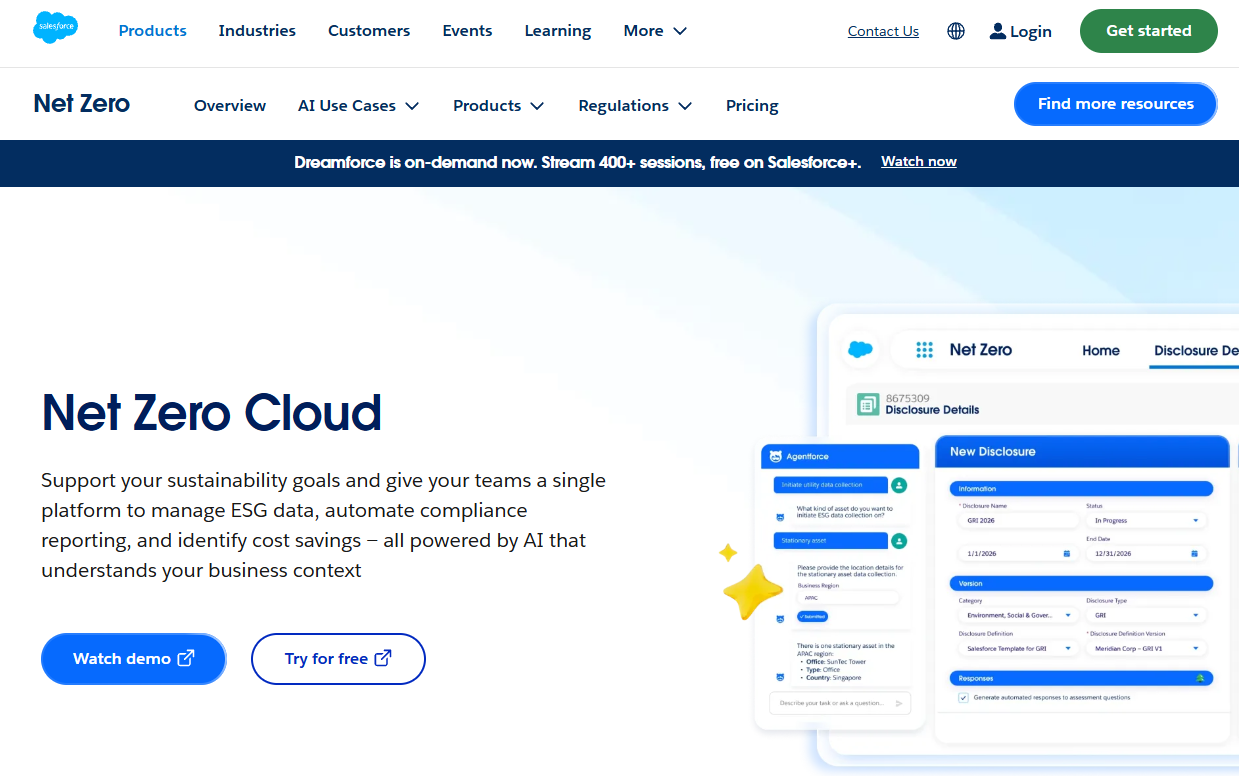
5. Salesforce Net Zero Cloud
Best fit: Companies that already run sales and service on Salesforce.
What it offers: Net Zero Cloud tracks Scope 1, 2 and 3 emissions within the Salesforce platform. Its Growth edition adds Scope 3 Hub for spend-based purchased goods, supplier sustainability data and carbon credit management.
What to check: Scope 3 coverage varies by edition. Scope 3 Light covers business travel and freight, while Growth adds waste and purchased goods.
Pricing: The Growth edition is listed at US$210,000 per org per year, billed annually, including one CRM license.
Validate the Shortlist Before Signing
A demo built on a vendor’s sample company may not expose gaps in your own records. Run the same pilot with every finalist.
Run an identical pilot. Give each vendor the same packet: an electricity bill, a fleet fuel record, a monthly purchasing extract and one supplier response. Ask them to:
- Attach each document to its activity figure.
- Explain the emission factor they chose.
- Correct an approved number and show the approval history.
- Export the report your customer or board needs.
Compare the full cost. Build a worksheet covering:
- The subscription, priced in each vendor’s own unit
- Setup and configuration
- Integration work for each connector
- Advisory support
- Additional users and entities
- Renewal terms
- Data exit, including the format and cost of retrieving records and audit trails
Assign ownership. Name the owner of each data source, the person who approves reported figures, and the administrator who maintains factors and hierarchies.
FAQ
1. What is carbon accounting software?
It collects activity data such as energy bills, fuel use and purchases, applies emission factors, and reports Scope 1, 2 and 3 emissions.
2. Is there free carbon accounting software?
Persefoni offers a free single-user Pro tier. Paid add-ons or upgrades are needed for additional users and some reports.
3. Why is Scope 3 the hardest to measure?
Most Scope 3 data sits with suppliers and customers, so collecting it requires outreach, estimates and consistent methods.
4. Does software make a report audit-ready on its own?
No. Software can organize evidence and audit trails, but external assurance requires an independent reviewer.
Final Thoughts
Start with what you must report and who owns each input, then shortlist platforms whose pricing model matches how your company buys software. Run the same pilot with every finalist, and choose the platform that can trace each figure back to its source.








 Business Programs


Leave a Reply
Want to join the discussion?Feel free to contribute!