 A VETERAN OWNED SMALL BUSINESS |
The Hidden Costs Affecting Distribution Profitability

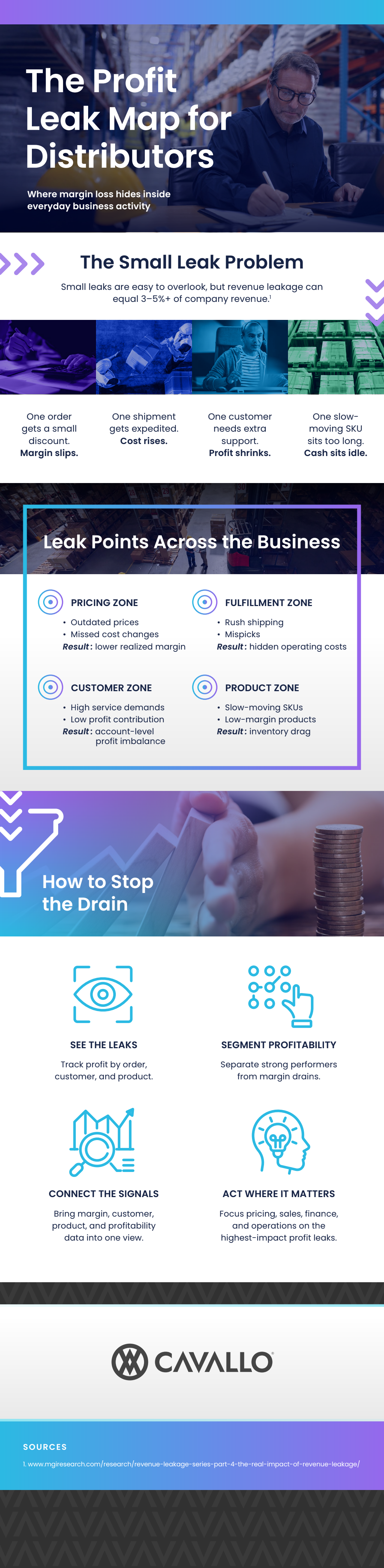
For many distributors, profitability is influenced by factors that rarely appear on a dashboard or financial report right away. Small operational decisions made throughout the day can gradually chip away at margins without drawing much attention. A special pricing request, an unexpected shipment adjustment, excess handling requirements, slow-moving inventory, or repeated customer service interventions may seem routine, but each carries a cost.
The difficulty is that these costs often blend into everyday operations. Teams stay focused on fulfilling orders, serving customers, and maintaining inventory levels, while the financial impact of certain activities accumulates quietly in the background. By the time a decline in profitability becomes visible, the actions that contributed to it may be difficult to isolate and address.
Profitability Is Influenced by More Than Sales Performance
Many distribution organizations measure success through revenue growth, order volume, and customer acquisition. While these metrics are important, they only tell part of the story. Revenue alone cannot explain whether a customer, product line, or business segment is contributing positively to the bottom line.
Consider a customer that consistently places large orders. At first glance, the account may appear highly valuable. However, if those orders frequently require expedited shipping, custom pricing, manual intervention, or repeated corrections, the actual profitability of the relationship may be far lower than expected.
The same principle applies to inventory. Products that continue to generate sales can still create hidden costs through storage requirements, low turnover rates, carrying expenses, and purchasing commitments. Without examining the full operational picture, these profitability drains often go unnoticed.
Disconnected Data Creates Blind Spots
One reason profit leaks are difficult to identify is that critical information is often spread across multiple systems and departments. Sales teams focus on customer activity. Warehouse teams monitor fulfillment performance. Finance reviews margin trends and operating costs. Customer service manages exceptions and account concerns.
Each group has access to valuable information, but no single team may have visibility into how those factors combine to affect profitability. As a result, organizations can unknowingly reward activities that increase revenue while simultaneously reducing margin.
When pricing decisions, inventory performance, operational costs, and customer behavior are viewed independently, it becomes harder to recognize patterns that point to larger profitability issues. Small inefficiencies remain hidden because no one sees their cumulative impact across the business.
A More Detailed View Leads to Better Decisions
Organizations that successfully improve profitability often start by examining performance at a deeper level. Instead of relying solely on company-wide metrics, they evaluate results by customer, product category, sales representative, order type, and market segment.
This level of analysis provides a clearer understanding of where resources are producing the greatest return. It also helps leaders identify opportunities that may otherwise be overlooked.
For example, some customers may consistently generate strong margins while requiring relatively little support. Others may contribute significant revenue but consume a disproportionate amount of time, labor, and operational resources. Certain products may outperform expectations, while others quietly absorb warehouse space and working capital without generating sufficient returns.
The goal is not to reduce service levels or limit customer relationships. Rather, it is to ensure that decisions are based on a complete understanding of their financial impact.
Managing Profitability in Real Time
Profitability is strongest when it becomes part of everyday decision-making rather than something reviewed after the accounting period ends. With better visibility into the relationship between customers, products, pricing, and operations, distributors can address issues before they become embedded in routine processes.
When organizations connect these data points with sales order management software, they gain the ability to identify profit leaks earlier, respond more effectively, and make decisions with greater confidence. Over time, this approach creates stronger margins, more efficient operations, and a healthier foundation for long-term growth.







 Business Programs

Leave a Reply
Want to join the discussion?Feel free to contribute!