 A VETERAN OWNED SMALL BUSINESS |
How to Expunge Your Record in Delaware: 6 Steps From Automatic Clearing to Court Petition
June 1, 2026: Delaware’s first automated Clean Slate sweep erased 64,000 cases – but more than 1 million remain. This guide walks you through confirming automatic clearance, pulling your certified SBI record, mapping every charge to the right pathway, fixing blockers like unpaid fees or Title 21 issues, filing in the correct court or through SBI, and verifying that background-check services wipe the data. Ready to see whether the state already cleaned your slate?
First, Understand the Three Ways Delaware Uses “Clean Slate”
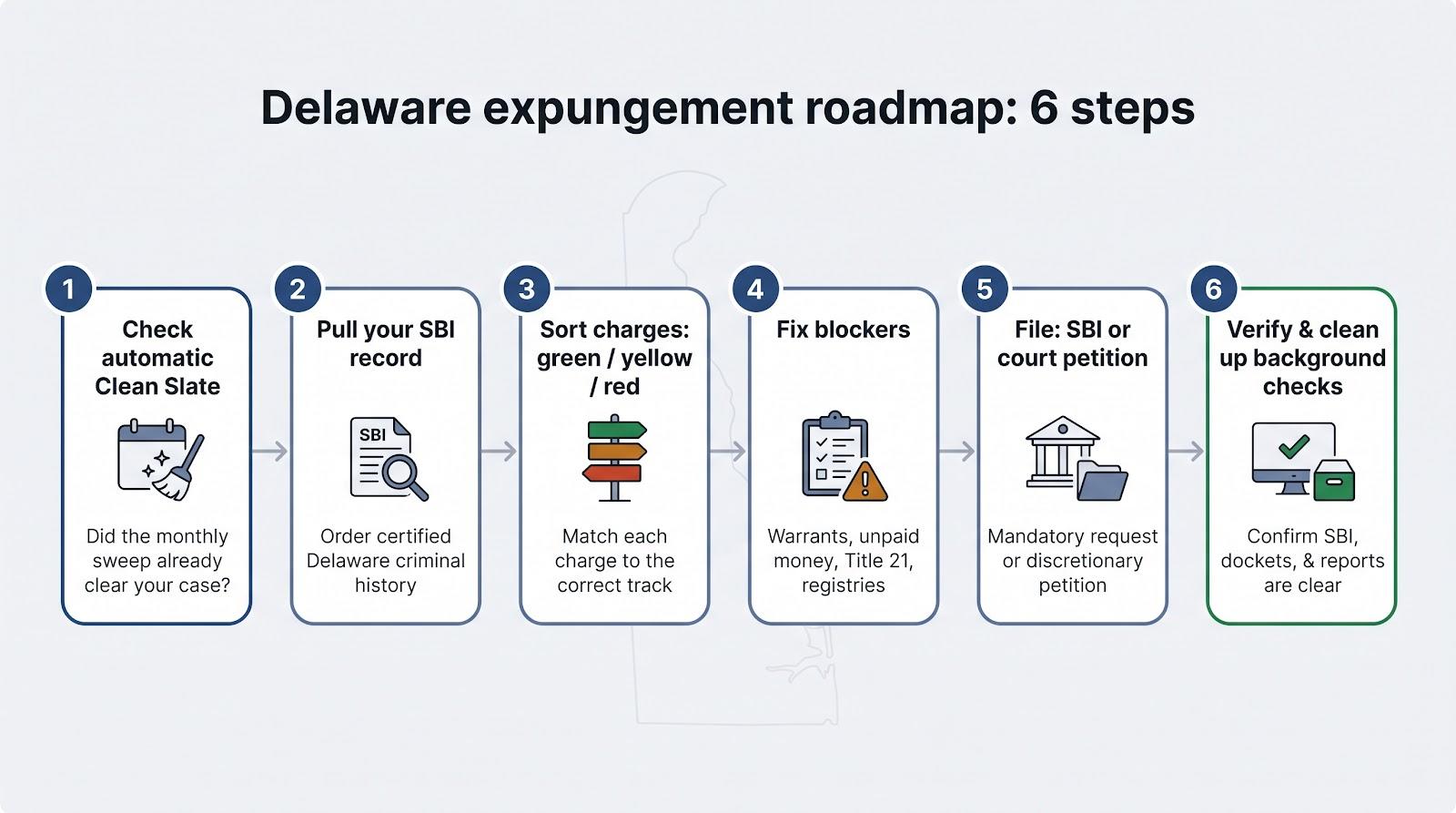
In 2021 the General Assembly amended Delaware’s expungement law to make every mandatory-eligible case disappear for free. The statute directs the State Bureau of Identification (SBI) to run a monthly sweep – starting August 1, 2024 – and remove those records from public view.
That sweep erased 64,000 cases on June 1, 2026, yet the state says more than one million cases still wait their turn. If a charge falls outside the mandatory rules – most felonies, certain misdemeanors, or any mixed DUI case – you’ll need a court petition or, sometimes, a pardon.
Remember: check the automatic path first, then move to petitions only if the statute doesn’t cover your charge.
Clean Slate Delaware: The Navigation Hub
Clean Slate Delaware, an advocacy coalition, launched an online hub in 2023 to untangle the expungement maze. The page bundles FAQs, clinic calendars, and fee-waiver tips so you can find:
- Court packets and SBI fingerprint forms
- Dates for free legal-aid clinics
- Contact links for defense services and job-training programs
Use the hub for orientation only. It’s not a government portal, law firm, or filing service; it can’t decide eligibility or erase a record. After skimming its checklists, always verify details with the Delaware Code, SBI, or the courts.
Next, you’ll meet the national nonprofit behind the state campaigns that produced Delaware’s law.
The National Clean Slate Initiative
A separate national nonprofit, the Clean Slate Initiative, runs the state campaigns behind laws like Delaware’s and publishes the hub page you reach in Step 1. It does not decide any case. The Delaware hub itself is operated by the ACLU of Delaware with the Office of Defense Services, the Delaware Center for Justice and Friendship House, and ACLU-DE is the place to ask about financial assistance with fines and fees. Remember the hierarchy:
- Statute decides eligibility.
- SBI or the courts execute the decision.
- Advocacy partners speed up the journey.
With the terms sorted, you’re ready for Step 1: check whether the monthly sweep already cleared your record.
Step 1: Check Whether Clean Slate Already Cleared Your Case
To get oriented, start at Clean Slate Delaware’s expungement hub, first unveiled at the Delaware Center for Justice’s “Visions of Justice” conference in October 2023.
The one-page site bundles every current form, clinic date, and fee-waiver tip so you can chart your next move with confidence.
The Clean Slate Act directs the State Bureau of Identification (SBI) to run a monthly sweep, starting August 1, 2024, for every case that meets Delaware’s mandatory rules. One automated batch erased 64,000 cases on June 1, 2026, yet the state says more than 1 million cases are still in the pipeline. Verifying automation now could save you the $72 fingerprint fee and weeks of paperwork.
Prove It: Three Fast Ways to Confirm Clearance
Delaware doesn’t mail a “you’re cleared” notice, so gather your own proof:
- Order a certified SBI criminal history (about $72). If the charge is missing on the new printout, the monthly sweep worked.
- Check the court docket and call the clerk. An online search may still cache old data, but a clerk can confirm the file is truly removed.
- Ask a free clinic or the Office of Defense Services. Their internal dashboards often flag freshly cleared cases, saving the fingerprint fee if money is tight.
If any source still lists the case, remember that the state says more than 1 million cases remain in the automation queue. You can file a manual request while the backlog clears.
Step 2: Pull Your Official SBI Record and Check Every Line
Courts rely on a single document: a certified Delaware criminal history from the State Bureau of Identification (SBI). The report costs $72 and cannot be older than 45 days if you later file in Superior Court. Order the full history, not the cheaper “name search,” so you see exactly what a judge sees.
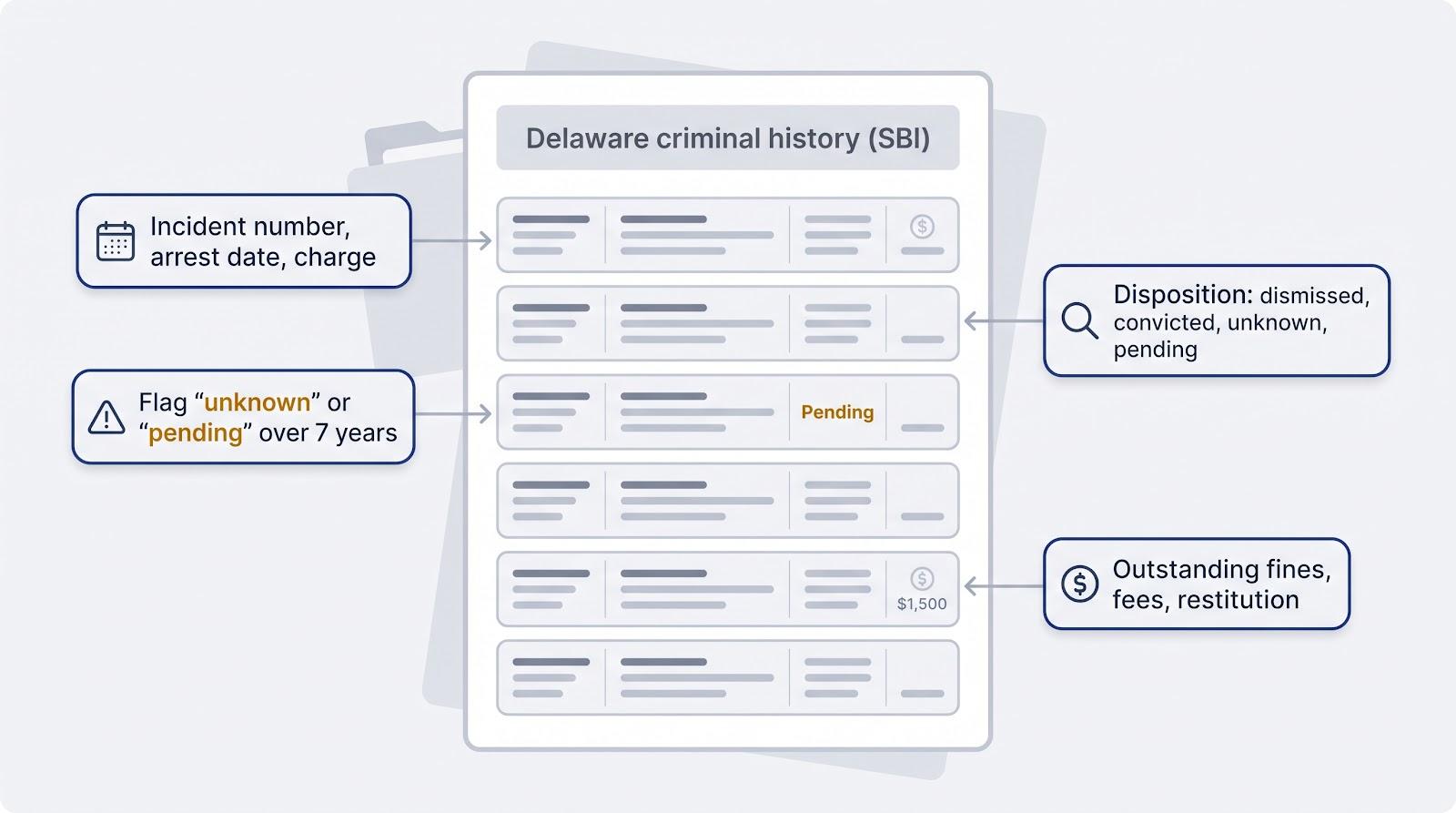
- Incident number, arrest date, and charge for each entry
- Disposition (dismissed, convicted, unknown, pending)
- Any line marked “unknown” or “pending” more than 7 years old
- Outstanding fines, fees, or restitution balances
Make margin notes, then sort each charge into mandatory, discretionary, or pardon-first tracks in the next step. Keep the packet safe; its date stamp starts the 45-day countdown if you plan to petition the court.
Step 3: Match Each Charge to the Correct Track
Use your marked-up SBI printout and sort every charge into one of three buckets.
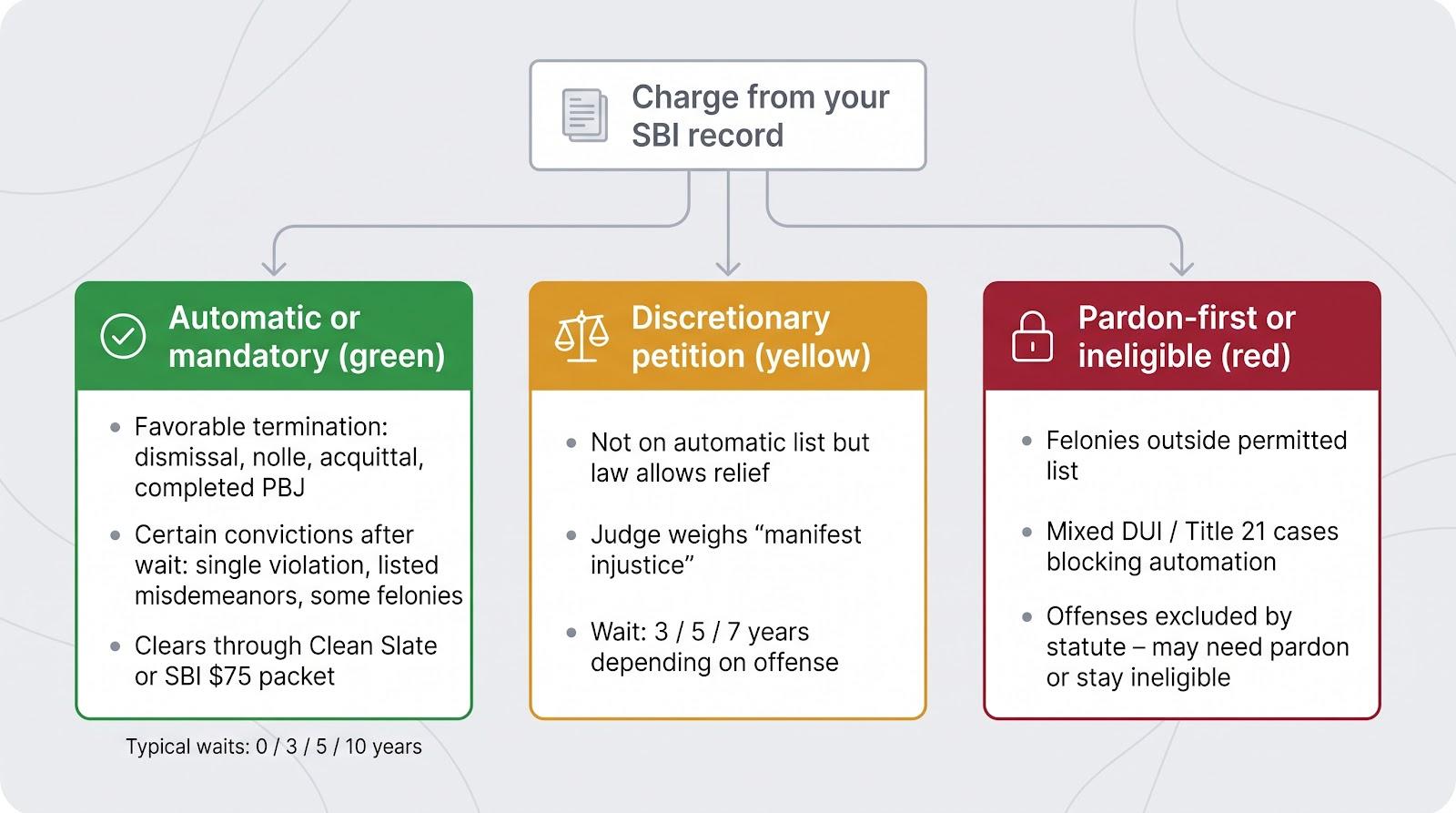
1. Automatic or Mandatory (Green)
These disappear for free once the waiting period ends, or through a $75 SBI packet if automation lags.
| Category | Waiting period* | Notes |
|---|---|---|
| Favorable termination (dismissal, nolle prosequi, acquittal, completed PBJ) | None (immediate) | Arrests with no charges carry a 1-year wait |
| Single violation conviction | 3 years | Example: disorderly conduct ticket |
| Misdemeanors not excluded under § 4373(b) | 5 years | Eligibility hook is § 4373(a)(2)b |
| Specified felonies (§ 4373(a)) | 10 years from conviction or release | Forgery 2°, maintaining a drug property, and similar |
Clock starts at the later of conviction or release when incarceration applies.
2. Discretionary Petition (Yellow)
If a charge is not on the mandatory list but the law allows relief, a judge may grant an expungement for manifest injustice after:
- 3 years: certain low-level misdemeanors with an otherwise clean record
- 5 years: multiple eligible misdemeanors across different cases
- 7 years: remaining eligible misdemeanors or select felonies that are non-violent, non-sexual, and have no vulnerable victim
File in Family Court if every count originated there; otherwise file in Superior Court. Superior Court carries a $75 filing fee, while Family Court is free.
3. Pardon-first or Ineligible (Red)
- Felonies excluded from discretionary relief by § 4374(b): Title 11 felonies listed in § 4201(c), offenses under 16 Del. C. § 1136 or 31 Del. C. § 3913, and physical or sexual assault felonies under the Beau Biden Child Protection Act
- Mixed DUI or traffic cases that block an automatic sweep
- Offenses excluded under § 4373(b) together with § 4372(f)
These are the cases that need a gubernatorial pardon under § 4375 before a court petition, and six crimes stay barred even after a pardon. Note what is not in this bucket: a felony that simply missed the mandatory six-offense list is not pardon-first. Under § 4374(a)(3) it qualifies for a discretionary petition seven years after conviction or release, whichever is later, provided you have no prior or subsequent convictions.
With every charge flagged green, yellow, or red, move to Step 4 to clear blockers and pick the right filing strategy.
Step 4: Clear Roadblocks Before You File
- Open matters: any pending charge or active warrant freezes an expungement request until the case is resolved.
- Unpaid money: fines, fees, or restitution must be paid, formally waived, or converted to a civil judgment.
- Title 21 complications: most traffic offenses, especially DUI, sit outside Clean Slate, and a DUI joined to other charges blocks an automatic sweep. In Cornette v. State (Del. Feb. 5, 2026) the Delaware Supreme Court held that eligibility for a pardoned conviction under § 4375 is judged charge by charge, so a Title 21 charge sitting in the same case does not automatically bar expungement of an eligible pardoned conviction.
- Registry or protection orders: entries on the Child Protection or Adult Abuse registries, or an active protection-from-abuse order, survive an expungement.
Spot and Fix the Usual Trip-wires
Resolve these four issues before you file; any one of them can freeze an otherwise eligible case.
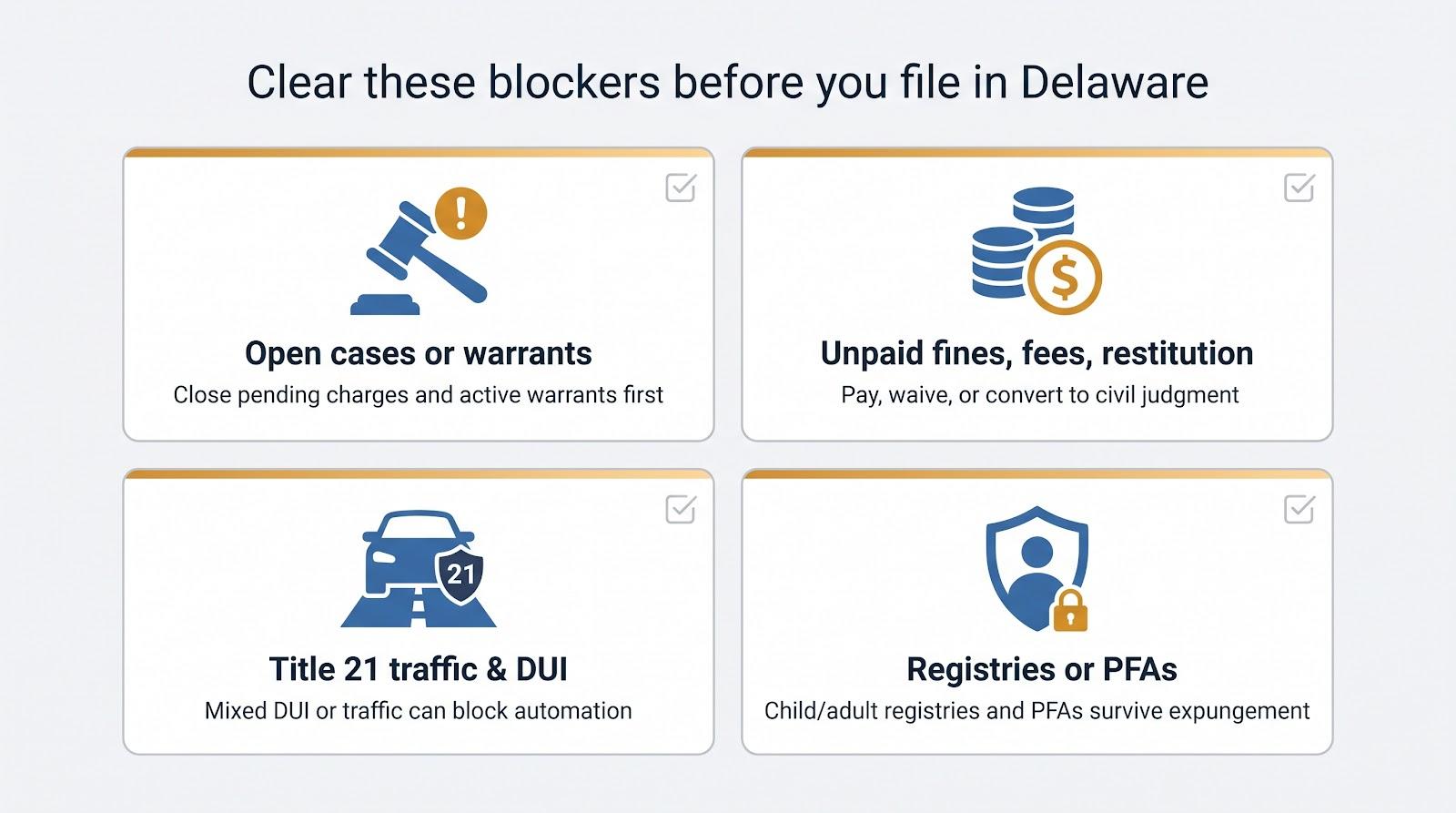
- Pending charges or active warrants
- Pay the fine, appear in court, or work with counsel to close the matter. The petition moves forward only after the docket shows “closed.”
- Unpaid fines, fees, or restitution
- Delaware courts require every dollar to be paid, formally waived, or converted to a civil judgment. Ask the clerk about installment plans or a fee-waiver motion if money is tight.
- Title 21 traffic complications
- Most traffic offenses fall outside Clean Slate, and a DUI joined to other charges blocks an automatic sweep. In Cornette v. State (Del. Feb. 5, 2026) the Delaware Supreme Court held that eligibility for a pardoned conviction under § 4375 is judged charge by charge, so a Title 21 charge sitting in the same case does not automatically bar expungement of an eligible pardoned conviction. That helps if you have a pardon in hand; it does not make the DUI itself expungeable, and success still hinges on precise drafting.
- Registry or protection-order flags
- Expungement does not remove entries from the Child Protection or Adult Abuse registries and does not cancel an active protection-from-abuse order. Consult counsel before filing if either appears on your record.
Pick Your Team: DIY, Free Clinic, or Private Counsel
| Option | Out-of-pocket cost* | Best when | Key advantage | Main risk |
|---|---|---|---|---|
| DIY filing | $147 in Superior Court<br>$72 in Family Court | Single, clearly eligible case | Lowest cost, full control | Drafting or venue mistakes can cause rejection |
| Free clinic (Office of Defense Services, partner clinics) | Same official fees | Up to three cases or unclear eligibility; limited budget | Lawyer guidance at no legal fee; check the hub’s clinic calendar for upcoming dates | Appointment slots fill quickly; bring every document |
| Private Delaware lawyer | Official fees plus market rate (ask for a flat quote) | Felony, mixed DUI, contested, or high-stakes licensing cases | Custom strategy, negotiation with AG, error spotting | Higher cost; secure a written scope and timeline |
Official fees current as of August 5, 2026.
Pick the lane that matches both your budget and your risk tolerance, then move to filing in Step 5.
Step 5: File Through SBI When Mandatory Rules Apply
Follow these two steps if an otherwise mandatory case has not cleared automatically:
- Request eligibility review
- Submit the certified criminal history you already ordered.
- SBI compares the record with § 4373 and, if eligible, mails you an approval letter and a form packet.
- Return the signed packet and payment
- Sign every page.
- Enclose a $75 money order payable to “Delaware State Police.”
- Mail or deliver the packet within 30 days of the letter date.
- Keep copies and postal tracking.
After SBI receives the packet it promptly notifies every court and law-enforcement agency holding records on the case, and each must confirm completion back to the Bureau. The statute sets no deadline on this path, so set a 90-day reminder; if the case still appears online, contact SBI with your tracking receipt for a status check.
Step 5, Alternate: File a Discretionary Petition in the Right Court
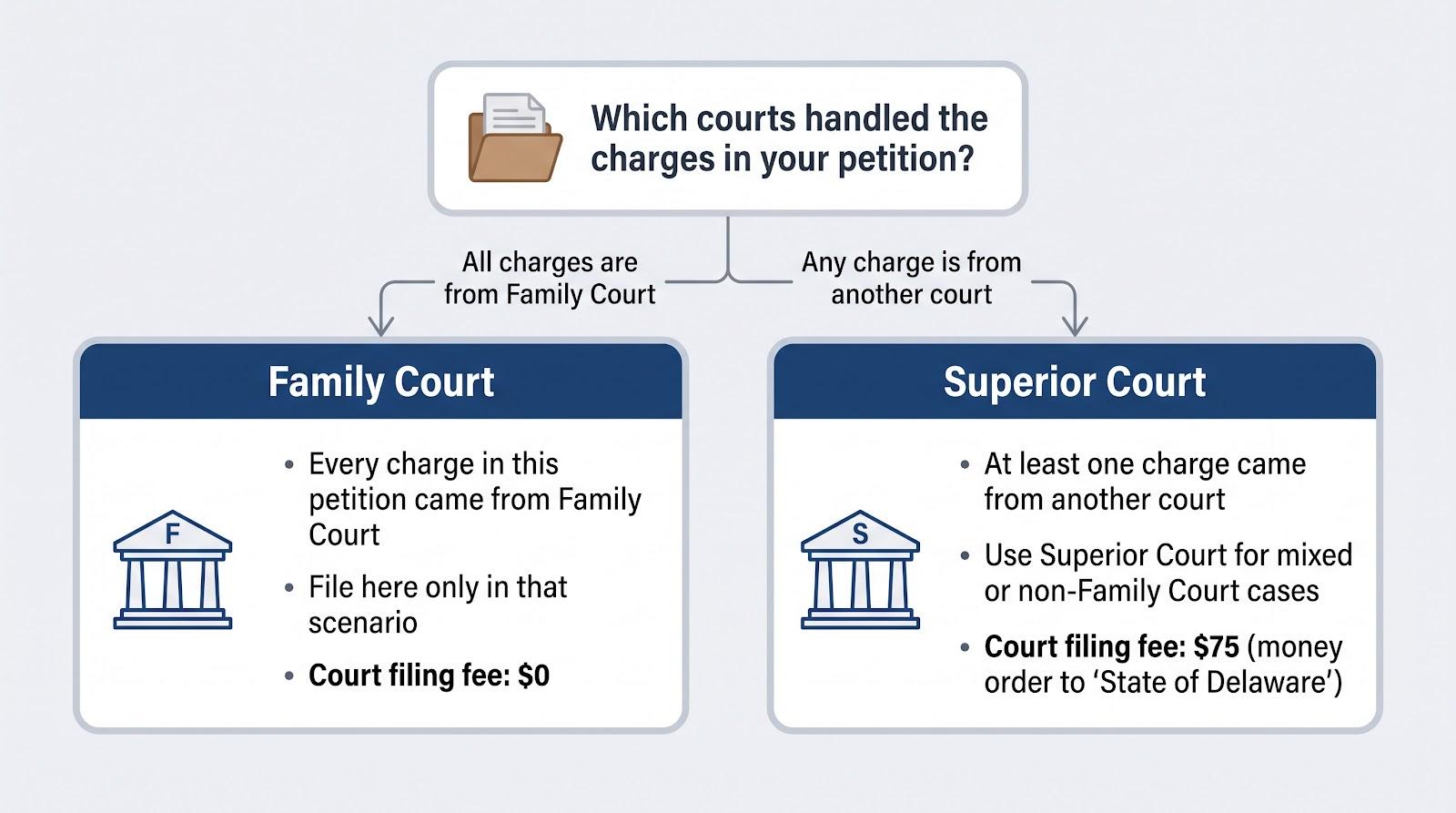
- Family Court: file here only if every charge in the petition was handled in Family Court. No court filing fee.
- Superior Court: file here if any charge came from another court. Filing fee: $75 (money order to “State of Delaware”).
- Completed petition form
- Proposed order
- Certified SBI history dated 45 days or less ago
- (Optional) SBI eligibility letter
- One full copy for the clerk
Mail-in filers must notarize the signature and include a self-addressed stamped envelope.
- Attorney General response: up to 120 days to object.
- Court order issued: most cases are decided on the papers; a hearing is rare.
- Implementation: courts and agencies have 60 days to seal or remove the record once the order is signed.
Mark all three clocks on your calendar so nothing slips by unnoticed.
Step 6: Verify the Order and Clean Up Stray Records
- Wait, then pull proof
- Courts and agencies have 60 days to enforce the order. Add a 10-day buffer, then request a new SBI criminal history and recheck the online docket.
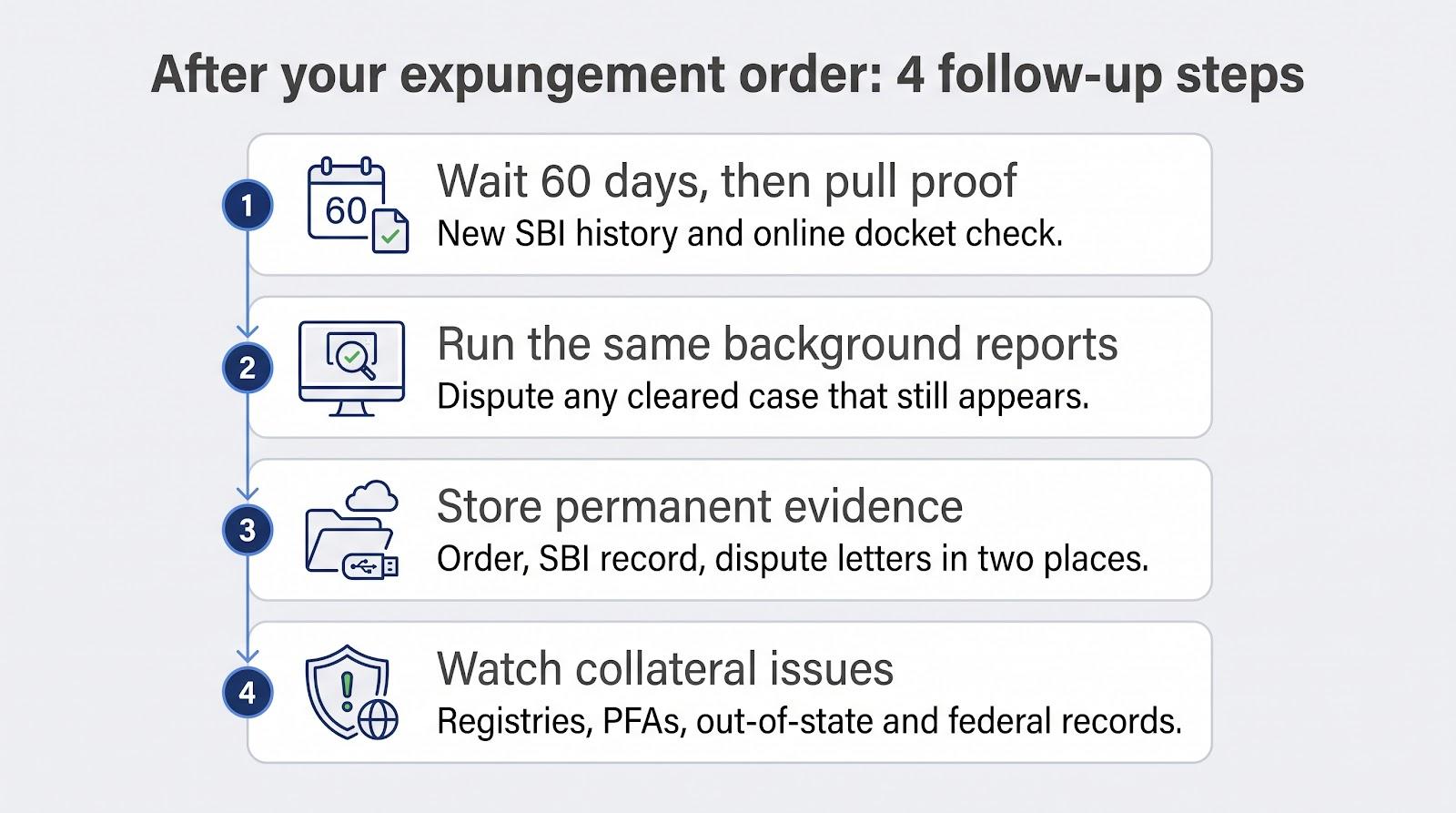
- Run the same background report employers use
- Order your consumer report from major screening vendors. If the cleared case still appears, file a dispute and attach the court order plus the fresh SBI printout.
- Store permanent evidence
- Keep PDF and paper copies of the petition, signed order, updated SBI record, and any dispute letters in at least two locations (for example, a cloud folder and a USB drive).
- Watch for collateral issues
- Expungement does not erase entries from the Child Protection or Adult Abuse registries, cancel an active protection-from-abuse order, or touch out-of-state and federal records. Consult counsel if any apply.
Quick Recap Before the Reference Tables
Follow these six steps and a cleared record stays invisible where it matters most: job screens, rental applications, and licensing checks. The tables and FAQ below cover what changes, what it costs, and what stays visible.
What an Expungement Changes and What It Does Not
| What changes for the public | What stays visible or enforceable |
|---|---|
| Routine background checks must return “No record exists.” | Law-enforcement agencies keep restricted access, and criminal justice agencies may see expunged cases when screening concealed-carry license applications and diversion-program eligibility (§ 4376). |
| You may answer “No” to conviction questions on job, housing, and college applications (unless the form asks specifically about sealed records). | Child or adult-abuse registries remain until separately removed. |
| Cleared cases disappear from Delaware’s online court docket and SBI printouts within 60 days of the order. | Out-of-state or federal records remain until you win relief in that jurisdiction. |
| Active protection-from-abuse orders continue to be enforced. |
What Delaware Employers and HR Teams Can Do Next
| Action | Why it matters | Quick win |
|---|---|---|
| Update application language | Delaware law bars questions about expunged records; narrow the prompt to “Have you been convicted of a crime that has not been expunged or sealed?” | Replace blanket “list all arrests” fields in your applicant-tracking system. |
| Audit your background-check vendor | Out-of-date data creates legal exposure. Confirm refresh frequency for Delaware court feeds, plus the vendor’s expungement-suppression workflow. | Add a vendor-response service-level agreement to your contract. |
| Build an exception workflow | Applicants may dispute stale records. A formal pause-and-review process limits Fair Credit Reporting Act risk. | Create a one-page SOP: pause, request order, rerun report, document outcome. |
| Track second-chance metrics | A Michigan study found wages rose 22 percent within a year of expungement; monitoring retention, performance, and promotions can reveal similar upside. | Tag “record cleared” hires in the HRIS, then review 12-month outcomes. |
Delaware Expungement Costs and Timelines at a Glance
| Pathway | Up-front cost* | Single deadline | Who controls the clock |
|---|---|---|---|
| Automatic Clean Slate sweep | $0 | Monthly SBI review; agencies notified promptly, no statutory deadline | Statute and SBI |
| Mandatory request via SBI | $147 ($72 record + $75 packet) | Return signed packet within 30 days of the SBI letter | SBI |
| Discretionary petition (Superior Court) | $147 ($72 record + $75 filing) | Attorney General may object within 120 days | Attorney General |
| Discretionary petition (Family Court) | $72 (record fee; no court fee) | Same 120-day Attorney General window | Attorney General |
| Free clinic assistance | Official fees only | Clinic calendar sets prep time | Office of Defense Services and partner clinics |
| Private attorney | Official fees plus quoted legal fee | Depends on attorney workload; court clocks stay the same | Attorney and courts |
All petitions require a certified SBI record dated 45 days or less before filing.
1. Is clean slate expungement really automatic?
Only if your case meets the mandatory rules and SBI’s monthly sweep has already processed it. Always pull a fresh SBI record to confirm.
2. How much does an expungement cost in Delaware?
$0 for automatic relief. Manual mandatory or Superior Court discretionary petitions cost $147 in official fees; Family Court petitions cost $72 (record fee only).
3. How long does the process take?
Automatic sweeps run monthly. Manual mandatory requests usually wrap up about 60 days after SBI receives the packet. Discretionary petitions add the Attorney General’s 120-day response window.
4. Do I require a lawyer?
Not for a single, clearly eligible mandatory case. Consider free clinics or private counsel for felonies, mixed DUI cases, or any petition likely to draw an objection.
5. Does a juvenile record disappear at age 18?
Age alone does not clear it, but you probably do not need to file. Delaware’s juvenile expungement is automatic under 10 Del. C. § 1017A, and the State Bureau of Identification has run monthly juvenile sweeps since August 1, 2024, on the same schedule as the adult mandatory process. A Family Court petition under § 1017A(d) is the fallback for cases the automatic process does not reach. Pull a fresh record before assuming you need to file anything.
6. Can one ineligible traffic charge block everything else?
Sometimes. Most Title 21 offenses, including DUI, sit outside Clean Slate. In Cornette v. State (Del. Feb. 5, 2026) the Delaware Supreme Court held that eligibility for a pardoned conviction under § 4375 is judged charge by charge, so a DUI in the same case does not automatically bar expungement of an eligible pardoned conviction. Without a pardon in hand, the DUI still blocks the sweep.
7. How do I prove my record is gone to an employer?
Order a new SBI history, keep a PDF of the court order, and dispute any background report that still shows the case.









 Business Programs
Leave a Reply
Want to join the discussion?Feel free to contribute!